Alcohol-free alternatives to whisky: better in a cocktail
Why whisky-inspired alcohol-free spirits have a better chance in a mixed drink than a Glencairn, and how to put them to work.
Pour an alcohol-free alternative to whisky into a Glencairn and you can admire the colour, appreciate the glass and prepare yourself for a dram. Then you taste it. Whatever the label may suggest, it is not whisky, and no amount of encouragement in the world is going to persuade your outraged tongue otherwise.
Put the same drink in a tall glass with ginger beer, lime and ice, however, and the conversation changes. It no longer has to account for every missing note by itself. It has colleagues. Some of them are ginger.
That, to us, is where these drinks make the most sense: as ingredients for mocktails, rather than stand-ins for neat whisky. This is a matter of taste, not a universal law. Some people enjoy them neat, and they are perfectly entitled to keep their Glencairns. Nobody is coming round to confiscate them. Well, at least not from Uisge Beatha.
What is in the bottle?
Whisky is a spirit with rules attached, and the rules are not shy. Scotch, for example, must be matured in oak casks in Scotland for at least three years and bottled at a minimum of 40% ABV. The Scotch Whisky Regulations have rather more to say about it, as regulations generally do, in numbered paragraphs.
An alcohol-free alternative is a different sort of drink, made to suggest some of the flavours associated with whisky. Glen Dochus West Coast, for instance, lists spring water, botanical extracts, glycerine, vinegar, caramel and other ingredients on its product page. It is not whisky with the alcohol politely asked to leave. It is a separate drink that has studied whisky closely from the other side of the room.
That distinction matters when choosing one. A maker may aim for smoke, spice, malt or oak, but the result does not have to reproduce an entire cask’s worth of work to be useful in a glass. It only has to be useful, which is a much shorter brief.
The problem with drinking it neat
Alcohol does more than supply the number on the label (along with a warm fuzzy feeling, questionable dance moves and occasionally poor life choices). Research on a model whisky found that changing the ethanol concentration changed how aroma compounds moved into the air above the liquid (Boothroyd and colleagues). Ethanol also activates a receptor involved in the sensation of heat (Trevisani and colleagues). Take it away and the producer is left building a drink around a hole the exact shape of the thing it is meant to resemble.
That is not a simple matter of adding a little more flavour. A neat pour asks the contents of the glass to provide the aroma, texture, warmth and finish. If one part is missing, there is nowhere for it to hide. It stands alone in a well-lit glass, inspected by somebody who was promised whisky. In a cocktail, lime, ginger and the rest of the ingredients have agreed to share the work, even if nobody has formally written down their job descriptions.
Our cocktail guru Tom Gregan is less diplomatic about the neat comparison. He has seen Glen Dochus West Coast described as close to the real thing neat, and he has a theory about who wrote that:
“I can only assume that this was written by someone who had never smelled a whisky, let alone tasted one.”
Other people disagree, and tasting is personal. Sporked’s tasting, for example, found alternatives its reviewers enjoyed on their own. Tom has no objection to what is in your glass. He reserves that for when you refuse to share it. Enjoying a drink and mistaking it for whisky, though, are separate achievements.
Give it something to mix with
The point of a mixed drink is that no ingredient has to do everything. Ginger beer brings spice and fizz; lime adds acidity. Cola supplies sweetness and a flavour of its own, at some volume. An alternative with a smoky or malty character can contribute to the whole without having to impersonate a whisky under cross-examination. In a highball, nobody asks it for an alibi.
Tom, for the record, is not against these alcohol-free impostors. He has in fact had at least one domestic reason for keeping one in his drinks cabinet:
“I’m not knocking it. My wife loves a whisky and Coke, and being able to mix her one during pregnancy kept me on her good side.”
The version he mixed for her used the alcohol-free alternative, which is rather the point of the story.
His other pick is Glen Dochus Island Blend, which its maker describes as peaty. Tom’s enthusiasm has limits. He rates it as a passable peaty alternative, says it works “better than I’d have thought possible” in his whisky take on the Dark and Stormy, and adds that it “isn’t going to pass muster in a Glencairn”. From someone who dismisses the neat comparison so briskly, that counts as praise.
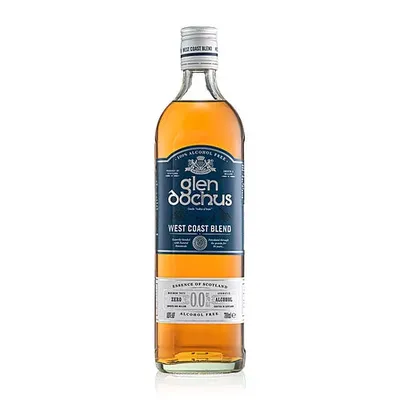
Glen Dochus West Coast Blend
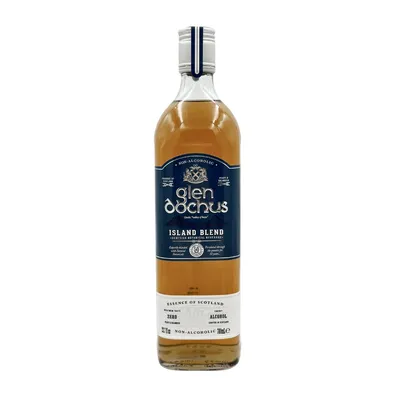
Glen Dochus Island Blend
His Dark and Stormy revisited pairs a smoky base with lime and ginger beer. The recipe also gives the peated whisky version, so check which bottle goes into the glass. If making the alcohol-free version, check the ginger beer too: some ginger beers contain alcohol, and the name makes no promises.
What to look for
Start with the drink you intend to make. A smoky alternative has a role in a ginger and lime serve; a sweeter, vanilla-led one may sit more comfortably with cola. Treat manufacturers’ descriptions as a starting point rather than a promise that the finished drink will taste like a particular whisky. A tasting note is a maker’s hopes written out in its best handwriting. Products vary, and an ingredient that works in one mixture will not necessarily rescue another.
Check the ABV on the bottle if avoiding alcohol matters to you. Some products are labelled 0.0%, while others contain a small amount, so read the number as well as the adjective. Check mixers and other additions too; a drink made with alcoholic bitters, for example, is not alcohol-free simply because the main ingredient is. Bitters come in small quantities, and they still count.
Finally, look at the storage instructions. These bottles do not all keep like an unopened cask sample from a distillery warehouse, and some makers specify a shorter period after opening. Buy one for a drink you actually want to make, rather than for a ceremonial place at the back of the cupboard, where it will outstay the maker’s advice in the company of a fondue set.
In a Glencairn, the comparison asks a great deal of a drink that was never going to be whisky. In a cocktail, there is room for a very good drink to be its own thing. The ginger, at least, is entirely comfortable with the arrangement.
Sources and review
About the author
