The Artificial Whisky Tongue
How Heidelberg (2017) and Glasgow (2019) scientists built 'artificial tongues' that tell whiskies apart, and their limits for spotting fakes.
As auction prices for old and rare Scotch rose, so did the problem of counterfeit whisky.
In 2018, the broker Rare Whisky 101 commissioned the Scottish Universities Environmental Research Centre (SUERC) to test 55 bottles of Scotch acquired through the secondary market. According to a University of Glasgow research impact case study, 21 of the 55 (38%) were fakes or not distilled in the year stated; all the malt whisky samples claiming to be from around 1900 or earlier were found to be fake. The university announced the results in December 2018 (University of Glasgow news release). This was a selected sample, not an estimate for every bottle on the market.
Checking a bottle usually means taking a sample out of it and sending it to a laboratory. This is awkward for a valuable unopened bottle, which may have spent decades being carefully preserved precisely so nobody would do that.
Two university teams have tested a cheaper idea, the “artificial tongue”: Heidelberg University in 2017 and the University of Glasgow in 2019. Neither resembles the thing in your mouth. The name is doing some optimistic work.
Here is how the two sensors work, what they managed in the lab, and what they cannot yet do.
1. How the Human Tongue “Tastes” Whisky
To build an artificial tongue, engineers first had to understand why the human palate is so effective at deciphering spirits.
Our tongues do not possess individual receptors for every single chemical in a glass of Glenfiddich or Ardbeg. Instead, human gustatory perception relies on differential sensing:
- Thousands of taste buds sensitive to sweet, sour, salty, bitter, and umami fire in varying combinations.
- The brain combines these overlapping signals into one impression of flavour.
- Combined with retronasal smell (aromas travelling from the back of the mouth into the nose), an experienced taster can quickly tell a peated Islay malt from an unpeated Speyside.
Both artificial tongues copy this idea: many sensors that each respond a little differently, read together as a pattern. No individual sensor needs to announce that it has detected a Laphroaig. The useful answer emerges when their responses are read together.
2. The Glasgow Bimetallic Nanoplasmonic Sensor
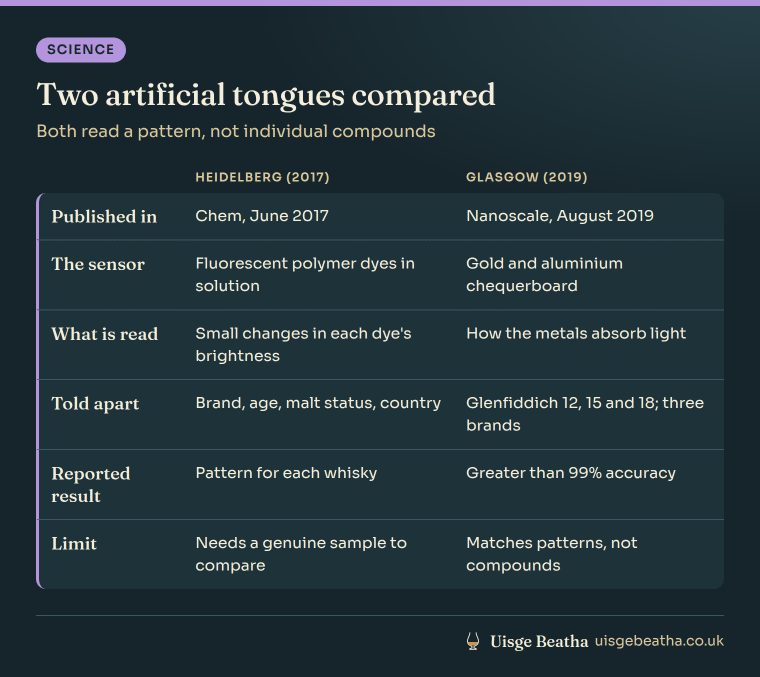
Engineers at the University of Glasgow’s School of Engineering, led by Dr Alasdair Clark, built a microscopic “tongue” that reads how whisky changes the way metal surfaces absorb light (University of Glasgow news release). Their paper, Macias et al. (2019, Nanoscale, 11(32), 15216 to 15223, DOI 10.1039/C9NR04583J), was first published online in July 2019; an open access copy is in the University of Glasgow’s Enlighten repository.
How it works:
- The “taste buds”: Sub-microscopic slices of gold and aluminium, arranged in a chequerboard pattern, each about 500 times smaller than a human taste bud.
- Plasmonic response: The tiny metal structures absorb light at particular wavelengths, and what is on their surface shifts that absorption.
- The fingerprint: Because gold and aluminium respond differently, measuring how both absorb light when whisky is poured over them gives a pattern for each whisky.
In the published tests, the Glasgow sensor classified the samples with 99.7% accuracy using leave-one-out cross-validation (Macias et al., open access PDF). This result applies to the whiskies and measurements tested, not to an independent trial of every possible whisky:
- It distinguished Glenfiddich 12, 15 and 18 year olds.
- It told apart whiskies from Glenfiddich, Glen Marnoch and Laphroaig.
- It picked up differences between the same whisky aged in different barrels.
3. The Heidelberg Fluorescent Polymer Array
Two years earlier, chemists at Heidelberg University led by Professor Uwe Bunz had built an artificial tongue from an array of glowing (fluorescent) polymer dyes. The paper is Han et al. (2017, Chem, 2(6), 817 to 824, DOI 10.1016/j.chempr.2017.04.008), summarised in a Cell Press news release.
- Each dye is in its own solution and glows under the plate reader’s light.
- Adding whisky changes the brightness of each dye slightly, by a different amount.
- Read together, the changes form a pattern that the team used to tell whiskies apart by brand, age, malt status and country of origin.
The array produces patterns that can be compared with known samples. It does not identify every individual chemical or establish that a drink is safe.
4. Practical Applications: What Could They Be Used For?
Both were laboratory studies, not products you can buy. The uses their authors suggested are:
1. Checking Bottles Against Genuine Samples
Because both tongues compare a sample with a known reference, they suit checking whether a bottle matches what it claims to be, given a genuine sample to compare with. They need only a small sample, but it still has to come out of the bottle.
2. Quality Control
The Glasgow team suggested the approach could be used for food safety testing, quality control and other jobs that need portable liquid analysis.
3. What They Do Not Do
Neither tongue measures individual compounds. A pattern match cannot tell you which chemical is present, and a small amount of something harmful could go unnoticed. Testing for methanol or other contaminants still needs conventional laboratory analysis.
Can an Artificial Tongue Replace the Master Blender?
No. Both sensors are good at saying whether two samples are the same or different. Neither says whether a whisky tastes good, and neither was designed to. A blender’s job is to judge flavour and build a consistent whisky from many casks, which is a different task from matching a fingerprint.
The more realistic role is a cheaper first check on whether a bottle is what its label says. For how the industry’s own flavour vocabulary works, see our whisky flavour map.
Sources and review
About the author
