Are All Whiskies Kosher? Casks, Wine Finishes & Kashrut Law
Whisky under Kashrut: ex-bourbon casks, sherry finishes, stam yeinam rules, certified kosher bottlings and Passover chametz restrictions, in plain terms.

A common assumption among casual spirits drinkers is that because whisky is distilled purely from grain and water, all whisky must inherently be kosher.
In practice, whether a whisky complies with Jewish dietary law (Kashrut) depends mainly on the casks. Many whiskies need no formal certification, but maturation or finishing in wine, sherry and port casks raises halakhic questions on which authorities differ.
Here is what the main kashrut agencies say, why sherry casks are debated, and which bottlings carry certification. We are not a religious authority: for a ruling, ask your own rabbi or kashrut agency.
1. The Baseline: Ingredients & Ex-Bourbon Casks
Under basic Kashrut principles, pure grain distillates start with kosher fundamentals:
- Raw Ingredients: Malted barley, wheat, rye, and corn are grains permitted under Jewish law.
- Water & Yeast: Natural spring water and cultivated distilling yeast (Saccharomyces cerevisiae) are inherently acceptable.
- Additives: Apart from water, the Scotch Whisky Regulations permit only one addition: plain caramel colouring (E150a), which is not generally treated as a kashrut concern.
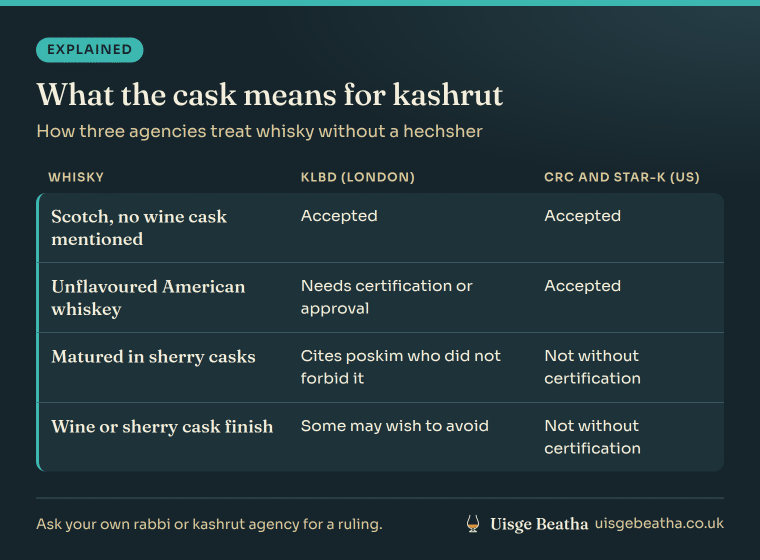
Because bourbon must by US law (27 CFR § 5.143) mature in new charred oak containers, with no added colouring or flavouring, the US agencies Star-K and the Chicago Rabbinical Council (cRc) list unflavoured bourbon, rye, Tennessee and other American whiskeys as acceptable without certification, unless the label mentions sherry, port or other wine casks or a finish. The London Beth Din’s KLBD takes a different line for imports: it says American, Japanese and other overseas whiskeys lack the UK’s controls and need certification or individual approval.
For Scotch, the KLBD says that ordinary Scotch, English and Welsh whisky, single malt or blended, with no mention of sherry, port or other wine casks on the label or in its marketing, can be drunk without halakhic concerns about wine casks. It extends this to Irish whiskey bottled since mid-2009. The cRc and Star-K likewise accept Scotch unless the label or the producer mentions wine casks, a special finish or extra maturation. None of these needs an individual hechsher (kosher certification mark) on the bottle.
2. The Sherry and Wine Cask Dilemma: Stam Yeinam
The primary halakhic obstacle in modern whisky production arises from ex-wine casks.
Under Jewish law, grape wine made or handled by non-Jews is categorised as stam yeinam, and kashrut authorities treat it as forbidden to drink. Ex-bourbon casks held American whiskey and raise no wine question; ex-sherry casks held non-kosher fortified wine; finishing casks may have held port, Sauternes, Madeira or other wines.
When single malt whisky is aged or finished in casks that previously held non-kosher sherry (oloroso, Pedro Ximénez) or port, does the wine absorbed into the wood staves render the whisky non-kosher?
The Two Rabbinic Views
Rabbinic authorities broadly take two positions:
View A: The Leniency (Heter)
Major poskim, including Rabbi Moshe Feinstein (Igros Moshe, Yoreh De’ah 1:62–63) and the Minchas Yitzchok (Vol. 2, 28), did not forbid whisky matured in sherry casks. The KLBD cites both. The reasoning usually given is:
- Nullification (Batel b’Shishim): The volume of residual wine drawn from the wood staves into the whisky is estimated to be well below the 1:60 ratio required for halakhic nullification.
- Intent (Kavanah): The distiller buys the barrel for oak wood extraction and maturation, not explicitly to blend grape wine into the spirit.
- Change of Substance: The absorbed wine residue undergoes chemical degradation (pagum) inside dried wood pores over months of storage.
View B: The Strict Ruling (Chumra)
Other agencies are stricter, particularly about modern “cask finishes”. The cRc and Star-K lists do not accept, without certification, whiskies labelled as aged in sherry casks or with a sherry, port, Madeira, dual-cask or double-matured finish. Even the KLBD notes that finishing, where mature whisky is put into specially prepared wine casks for a further period, “may not be covered” by the older lenient rulings, and that some may wish to avoid products so labelled.
- Flavour Enhancement (Milsa d’Avida l’Ta’ama): A substance added deliberately to give flavour is not nullified, however small the amount. Producers promote sherry and wine finishes for exactly the flavour they add.
- So stricter authorities advise avoiding whiskies with a stated wine, port or sherry cask unless the bottling carries kosher certification.
3. Certified Kosher Whiskies
For kosher consumers who follow the stricter standard, some producers make certified kosher whisky:
Dedicated Kosher Distilleries
- The M&H (Milk & Honey) Distillery (Tel Aviv, Israel): Founded in 2013 as Israel’s first whisky distillery; its products are kosher. Its Elements Sherry Cask, matured under Star-K supervision in kosher sherry casks, was named World’s Best Single Malt at the World Whiskies Awards 2023.
- Golan Heights Distillery (Katzrin, Golan Heights): A small distillery founded by David Zibell, making whisky under rabbinic supervision.
Certified Single Cask & Batch Releases
- Buffalo Trace Kosher Whiskey: Made under the supervision of the Chicago Rabbinical Council (cRc) in barrels set aside in 2012, first released in April 2020 and planned as an annual release after Passover, in three styles: Kosher Rye Recipe Bourbon, Kosher Wheat Recipe Bourbon and Kosher Straight Rye.
- Scotch Whisky: Some Scotch bottlings carry KLBD certification, for example The Glenrothes Alba Reserve. The KLBD says every whisky it certifies is matured only in non-wine casks or kosher wine casks.
4. The Critical Rule: Whisky During Passover (Pesach)
Whatever the cask or supervision during the rest of the year, whisky made from the five grains is treated by mainstream kashrut authorities as not kosher for Passover.
Spirits distilled from the five grains (wheat, barley, rye, oats and spelt) are treated as chametz (leavened grain products):
- Chametz may not be eaten, owned or benefited from during the seven (or, outside Israel, eight) days of Pesach.
- Observant Jews who own whisky usually sell it to a non-Jew before Passover through a formal contract known as Mechirat Chametz.
- Chametz owned by a Jew over Passover without being sold is forbidden afterwards (Chametz she’avar alav haPesach).
Summary Consumer Checklist
On smaller screens, scroll sideways to see every column.
| Whisky Type | General Rabbinic Consensus | Notes |
|---|---|---|
| Bourbon and American whiskey (unflavoured) | Accepted without certification by Star-K and the cRc | New charred oak; no wine or flavour additives. The KLBD wants certification for overseas whiskeys. |
| Scotch / Irish with no wine cask mentioned | Accepted without certification by the KLBD, cRc and Star-K | Check the label and the producer’s website for any sherry or wine cask. |
| Matured in sherry casks | Disputed (permitted by the poskim the KLBD cites; not accepted without certification by the cRc or Star-K) | Follow your own authority. |
| Wine or sherry cask finishes | Avoided by stricter agencies; the KLBD says some may wish to avoid | Look for a recognised hechsher. |
| All whisky during Passover | Not kosher for Passover (chametz) | Usually sold before Pesach. |
Before buying, observant consumers should consult their own kashrut authority or the published lists of the London Beth Din (KLBD), Star-K or the Chicago Rabbinical Council (cRc). To see which bottles name their casks, browse our sherry cask whiskies guide, or read what sherry casks are.
About the author
