Barley Science: The James Hutton Institute
How the James Hutton Institute and International Barley Hub study barley genetics, which varieties distillers use, and what becomes of draff and pot ale.

When people discuss what shapes the character of single malt Scotch, the talk usually turns to still shape, worm tubs and casks. Yet every malt whisky begins in a field, mostly with two-row spring barley (Hordeum vulgare).
Barley is Scotland’s biggest crop: in 2025 it took 62% of the land used for cereals and oilseeds, according to the Scottish Agricultural Census.
Much of the country’s barley research happens at The James Hutton Institute in Invergowrie, near Dundee. Its International Barley Hub (IBH), a £62 million Tay Cities Deal project, opened a field centre in 2022 and moved into the new Crop Innovation Centre in October 2024. Scientists there study barley genetics, disease resistance and new ways of managing the crop.
Here is what that work means for the grain that goes into whisky.
1. Decoding the Barley Genome: 5.1 Billion Base Pairs
In 2012, the International Barley Genome Sequencing Consortium published the first physical, genetic and functional assembly of the barley genome in Nature. The UK team was led by Professor Robbie Waugh of the James Hutton Institute.
The barley genome is large: about 5.1 billion base pairs, roughly 1.7 times the size of the human genome. Much of it is repetitive DNA. The 2012 work identified 26,159 “high-confidence” genes.
Why the genome matters to whisky:
- It helps breeders find genes linked to grain quality and the starch that becomes fermentable sugar.
- It helps them track traits such as drought and heat tolerance.
- It helps them select for the non-glycosidic nitrile (non-GN) trait distillers ask for (see below).
- It helps them bring back disease resistance from older varieties and landraces.
2. The Battle Against Crop Disease: Rhynchosporium
One of the main fungal diseases of barley in Scotland is Rhynchosporium commune (barley scald, or leaf blotch).
It thrives in cool, wet weather and attacks the leaves, cutting the plant’s ability to photosynthesise. A 2012 review by Anna Avrova of the James Hutton Institute and Wolfgang Knogge reported yield losses of 10% to 45% where it takes hold, and put UK losses in the millions of pounds a year even after fungicide treatment.
Hutton researchers study the effector proteins the fungus releases during infection, and screen older barley for resistance. One Hutton-funded study tested 131 heritage cultivars and landraces, including Scottish Bere barley, and found that Bere lines showed promise as sources of resistance. The aim is varieties that need fewer fungicide sprays.
3. From Golden Promise to Laureate: The Malting Evolution
The barley varieties grown in Scotland today are not the ones grown a generation ago. Each new variety has generally given more spirit per tonne than the one it replaced:
On smaller screens, scroll sideways to see every column.
| Era | Leading variety | Key characteristics |
|---|---|---|
| Late 1960s to early 1980s | Golden Promise | Semi-dwarf mutant variety, first recommended in Scotland in 1968; famously used by Macallan. |
| Mid-1990s to 2000s | Optic | First recommended in 1995; at its peak almost two thirds of the spring malting barley bought in Scotland. |
| 2010s | Concerto | High extract and consistent grain. |
| Today | Laureate, LG Diablo, KWS Sassy, Firefoxx | All have full Malting Barley Committee approval for malt distilling; Laureate and LG Diablo lead in Scotland. |
The Non-GN Requirement
Scotch distillers generally want barley that is non-GN: free of glycosidic nitrile. In varieties that carry it, this natural compound can break down during distilling to cyanide, a precursor of ethyl carbamate, a compound whose levels in spirits are controlled. Non-GN varieties remove the starting material at source.
4. Closing the Loop: Draff, Pot Ale & Celtic Renewables
Every year, Scotch whisky production generates massive quantities of organic by-products:
- Draff: About 500,000 tonnes a year of spent barley grains left in the mash tun.
- Pot Ale: About 1.6 billion litres a year of protein-rich liquid left in the wash stills after the first distillation.
Those are Zero Waste Scotland’s estimates. Draff has long gone to livestock feed, and pot ale to feed syrup or onto fields, and some distilleries now use both to make biogas. Celtic Renewables, a spin-out from Edinburgh Napier University founded by Professor Martin Tangney, takes another route.
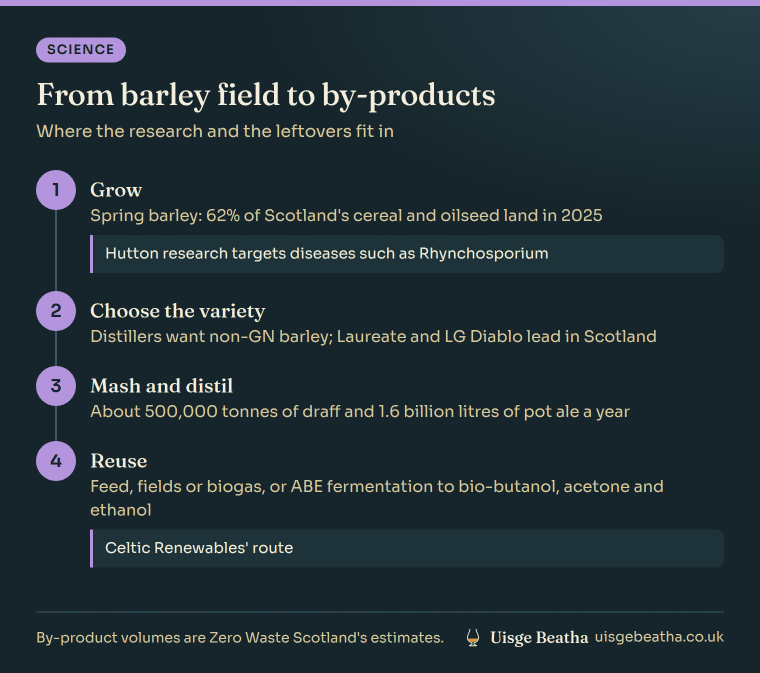
Using the century-old acetone-butanol-ethanol (ABE) bacterial fermentation, Celtic Renewables turns draff and pot ale into bio-butanol, acetone and ethanol, which can be used as fuels or as chemicals; the company says the leftover solids can go to animal feed. It completed its first biorefinery, at Grangemouth, in late 2021 and, with Scottish Government funding announced in December 2025, is planning a much larger one there.
A Sustainable Horizon for Scotch
From genome mapping at the James Hutton Institute to biorefineries running on distillery by-products, barley science affects how much spirit Scotland gets from each field, how many sprays the crop needs, and what happens to what is left over.
Whether barley variety changes the taste of the finished whisky is a separate and much-argued question; our piece on whisky terroir looks at the evidence. For how barley becomes spirit, see our whisky production course.
About the author
