Continuous Still vs Pot Still: How Whisky Distillation Works
The difference between batch pot stills and continuous column stills: distillation mechanics, copper reflux, congeners, and flavour profiles.
A pot still and a column still have the same broad assignment: take fermented wash and make a stronger spirit. They go about it in rather different ways. One works through a batch, empties itself and starts again. The other, given a steady supply of wash, can carry on without calling the meeting to a close.
The still is one influence on a whisky’s character, alongside the grain, the yeast and the cask. It is an important member of the committee, but it does not get to make every decision.
In Scotch whisky the law draws the line. Single malt Scotch must be distilled in batches in pot stills, under the Scotch Whisky Regulations 2009. Grain Scotch has no such rule, and almost all of it is made in continuous column stills (also called patent or Coffey stills).
The differences between the two methods explain why single malts tend to be heavier and more varied, while grain whiskies are lighter and more consistent.
The principle of distillation
Distillation uses the difference in boiling points between ethanol and water:
- Ethanol boils at about 78.3°C (173°F) at sea level.
- Water boils at 100°C (212°F).
When fermented wash (a beer-like liquid of roughly 7% to 9% ABV) is heated, the alcohol and many flavour-bearing compounds, called congeners, evaporate ahead of most of the water. The vapour passes over the lyne arm into a condenser, where cold water turns it back into a stronger liquid spirit.
1. The copper pot still (batch distillation)
A pot still works in batches: it is filled with wash, heated, the spirit collected, and the residue drained before the next charge goes in.
Double distillation in Scotland
Most Scottish single malt is distilled twice, in two pot stills (a few distilleries, such as Auchentoshan, distil three times):
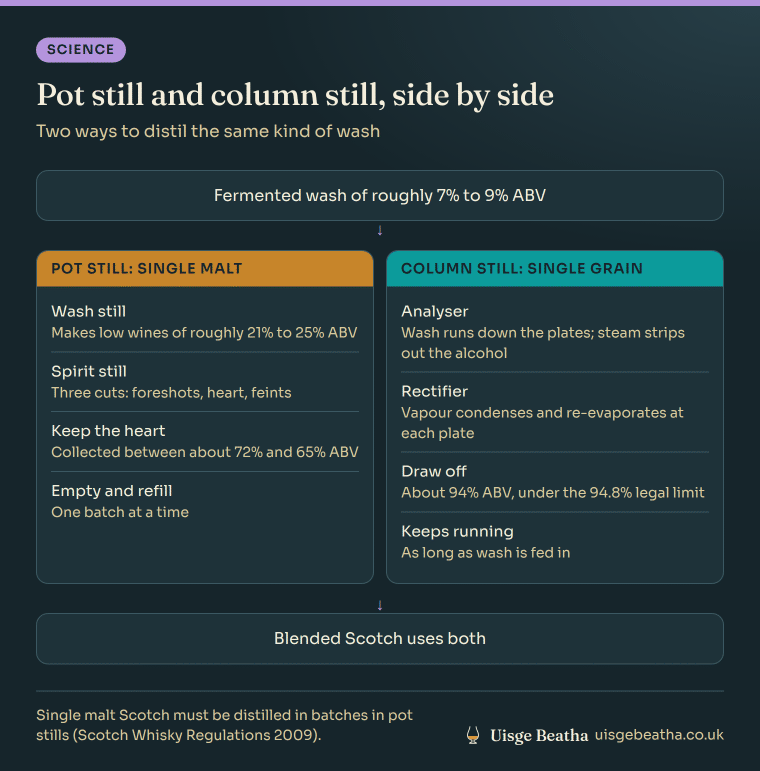
- The wash still: The first distillation turns wash of about 8% ABV into “low wines” of roughly 21% to 25% ABV.
- The spirit still: The low wines go into a second, usually smaller still for the final run.
The three cuts (foreshots, middle cut, feints)
During the spirit run, the stillman divides the distillate into three parts:
- Foreshots (heads): The first spirit off the still carries volatile compounds such as acetaldehyde, ethyl acetate and methanol. It is set aside.
- The heart (middle cut): The spirit kept for maturation, typically collected between about 72% and 65% ABV. It holds the balance of esters, cereal notes and higher alcohols the distillery wants.
- Feints (tails): As the alcohol in the still runs down, heavier oils, fatty acids and sulphur compounds come over. The stillman cuts to feints, and the foreshots and feints are mixed into the next batch of low wines to be distilled again.
Where the cut is made changes the spirit. Phenols from peated malt, for example, come over late in the run, so a later cut keeps more smoke; our guide to peat and ppm explains how.
The role of copper
Pot stills are made of copper, and not only because it conducts heat well. Copper reacts with sulphur compounds in the vapour (such as dimethyl trisulphide) and removes them from the spirit. Tall necks and upward-sloping lyne arms send more vapour back down to be redistilled (“reflux”) and give it more contact with copper, which tends to produce a light, floral spirit (Glenmorangie is the usual example). Short stills, downward lyne arms and worm tub condensers give less copper contact and a heavier, more sulphury, sometimes meaty spirit (Mortlach is the usual example).
2. The continuous column still (patent or Coffey still)
Pot stills stop and start; a column still can run for as long as it is fed with wash. It is less a copper kettle than an arrangement of plates, pipes and steam that has developed an interest in efficiency.
How it developed
- 1822: Sir Anthony Perrier of Cork patented one of the earliest continuous stills.
- 1828: Robert Stein, of the Kilbagie distilling family and a relative of the Haigs, had his continuous still working at Kirkliston, the first used commercially in Scotland.
- 1830: Aeneas Coffey, an Irishman and former excise officer, patented the two-column design that became the industry standard.
How the two columns work
A Coffey still has two tall columns, the analyser and the rectifier, each divided by perforated plates:
- The analyser: Wash, warmed on its way through a pipe inside the rectifier, enters the top of the analyser and runs down over the plates. Steam injected at the bottom bubbles up through it and strips out the alcohol.
- The rectifier: The alcoholic vapour enters the bottom of the second column and rises through its plates, condensing and re-evaporating at each one, which concentrates the alcohol.
- Continuous draw-off: Spirit is drawn off near the top of the rectifier at a steady strength. For Scotch grain whisky that is usually about 94% ABV, just under the legal limit of 94.8%.
Column stills do not have to run that high. American bourbon, often made in column stills, must be distilled to no more than 80% ABV, which keeps more grain character.
Comparing pot stills and column stills
On smaller screens, scroll sideways to see every column.
| Feature | Copper pot still | Continuous column still |
|---|---|---|
| Operation | Batch: filled, run, emptied | Continuous, as long as wash is fed in |
| Spirit strength | Heart usually about 65% to 72% ABV | Usually about 94% ABV for Scotch grain (legal limit: under 94.8%) |
| Congeners | Higher: cereal, fruity esters, oils, phenols if peated | Lower: a lighter, cleaner spirit |
| Raw material in Scotch | 100% malted barley | Wheat or maize, with some malted barley |
| Energy | More energy per litre of alcohol | More efficient |
| Scotch category | Single malt Scotch | Single grain Scotch |
Why blended Scotch needs both
Without the column still, Scotch whisky would not exist in its modern form.
Blended Scotch makes up most of the Scotch sold around the world. It combines both kinds of spirit: lighter grain whisky from column stills makes up the base of the blend and keeps its cost down, while single malts from pot stills bring depth and regional character. Our guide to the five types of Scotch sets out how each is defined.
Explore Scotch single malts and single grains
Compare pot still single malts with column-distilled single grains:

Glen Moray Elgin Classic Single Malt Whisky
40.0% ABV · 70cl
from £23.99 1 retailer
£28.94 delivered
Compare prices
Glenmorangie X
40.0% ABV · 70cl
from £24.95 1 retailer
£29.90 delivered
Compare prices
Loch Lomond Original Single Malt Whisky
40.0% ABV · 70cl
from £24.99 1 retailer
£29.94 delivered
Compare prices
Speyburn 10 Year Old
10 years · 40.0% ABV · 70cl
from £25.00 3 retailers
£29.99 delivered
Save up to £2.88
Compare prices
Glen Moray Sherry Cask Finish - Elgin Classic Single Malt Whisky
40.0% ABV · 70cl
from £25.95 1 retailer
£30.90 delivered
Compare prices
Glen Moray Peated - Elgin Classic Single Malt Whisky
40.0% ABV · 70cl
from £26.04 1 retailer
£30.99 delivered
Compare pricesAbout the author
