Does James Bond drink too much? What the doctors found
Two medical papers counted James Bond's drinks in the Fleming novels and the films. What they found, and why a spy should not drink on duty.
Yes. Two teams of doctors have done the counting, one with Ian Fleming’s novels and one with the films, and both came back with numbers that would get an ordinary civil servant a quiet word from occupational health. The answer for a whisky site is not that Bond should give up altogether. It is that he should drink a good deal less, and never at work, which happens to be where he does most of it.
With Robert Pattinson announced as the next Bond, the character starts again with a blank page and an unwritten drinks order. Before anyone writes it, Dry January seems a fair moment to read what the doctors actually said.
What the papers found:
- In Fleming’s novels, Bond drank an average of 92 units of alcohol a week on the days he was free to drink, according to a 2013 paper in The BMJ. The authors put that at over four times the recommended amount at the time. Today’s UK guideline is 14 units a week, so by our arithmetic it is more than six times that.
- In the 24 Eon films up to Spectre (2015), Bond is seen drinking 109 times, an average of 4.5 times a film, according to a 2018 paper in the Medical Journal of Australia. Its authors estimated his heaviest binge, six Vespers on a plane in Quantum of Solace, at 24 units.
- The film paper’s psychiatrist judged that Bond met six of the 11 criteria for alcohol use disorder in the US diagnostic manual DSM-5, which puts him in its “severe” category.
- Both papers find his performance at work hard to square with his drinking, and the films’ villains repeatedly use drink against him.
- None of this is a case for abstinence. The UK Chief Medical Officers’ guideline is to stay within 14 units a week, spread over three or more days, with several drink-free days for anyone cutting down.
What the doctors found in the novels
The first paper is “Were James Bond’s drinks shaken because of alcohol induced tremor?” by Graham Johnson, Indra Neil Guha and Patrick Davies, doctors in emergency medicine, hepatology and paediatric intensive care in Derby and Nottingham. It appeared in The BMJ’s Christmas issue on 12 December 2013 (BMJ 2013;347:f7255). The Christmas issue is where the journal puts its lighter research, and the paper is cheerful throughout. It gives its study setting as the authors’ homes, “in a comfy chair”. The arithmetic is less relaxed.
Two of the authors read the 14 Bond books between them, seven each, between January and July 2013, and noted every drink. They converted each one to UK units (one unit is 10 ml of pure alcohol) using NHS definitions, assuming an equal split whenever Bond shared a bottle. Where Fleming was vague, they used fixed estimates: a visit to a bar counted as 10 units, and “serious drinking” as 20. They left out The Spy Who Loved Me, in which Bond appears for only about eight hours, and the short-story collection Octopussy and The Living Daylights.
That left 123.5 days of described action across 12 books. On 36 of them Bond could not drink at all, being in hospital, in prison or in rehabilitation. Over the rest he drank 1,150 units, which the authors give as 92 units a week. Counting the days he could not drink brings it down to 65.2. His heaviest day was 49.8 units, on the third day of From Russia with Love, and he had just 12.5 alcohol-free days out of 87.5. The heaviest book was You Only Live Twice (1964), at 132 units a week. The authors also judged their estimates conservative, and “at the lower end of the truth”.
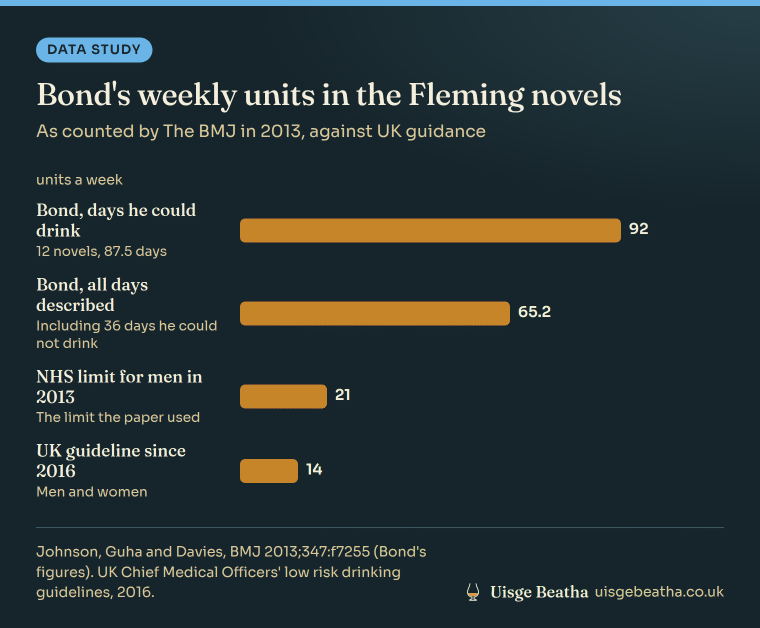
The NHS advice the authors used was the one in force in 2013: no more than 21 units a week for a man, no more than four in a day, and at least two alcohol-free days a week. Bond exceeded all three. The paper goes on to list the illnesses that drinking at this level puts at risk, and notes that he drives after drinking more than once. In Goldfinger he drinks 18 units over drinks and dinner before driving home, and in Casino Royale more than 39 units before a high-speed car chase that ends in a crash and 14 days in hospital.
Then there is the title. Vodka martinis, the authors say, should ideally be stirred, and a man of Bond’s otherwise immaculate culinary manners ought to know it. So they asked whether he orders them shaken because a tremor has made stirring impractical, and concluded that he was “unlikely to be able to stir his drinks”. This is a hypothesis about a fictional man’s hands, offered at Christmas, and they present it as one. Fleming himself left a hint in the same direction. In the novel Thunderball, the paper notes, Bond “recognises his high alcohol intake and that he feels better drinking less”.
What the doctors found in the films
The second paper is “Licence to swill: James Bond’s drinking over six decades” by Nick Wilson, Anne Tucker, Deborah Heath and Peter Scarborough, of the University of Otago in Wellington, Te Aka Kura in Hamilton and the University of Oxford. It was published online on 10 December 2018 (Med J Aust 2018;209(11):495–500) and was a joint winner of the journal’s Christmas competition.
Two of the authors watched all 24 Eon films from Dr. No to Spectre. A drinking event was counted when Bond was seen drinking, with “the glass or bottle reaching his lips”, and a third author watched the segments where the coding was uncertain. For the two heaviest binges, they estimated his blood alcohol with the Widmark formula, assuming Bond weighs the same as an average British man, 84 kg. A psychiatrist on the team then assessed his behaviour against the DSM-5 criteria for alcohol use disorder. Because Bond was not available for interview, they looked at his whole screen life rather than the usual past 12 months.
Bond drinks in every film, with a median of four events and a range of two to nine, and with no significant trend across the six decades. More than half his drinks (55%) were cocktails or spirits; he drank beer only four times. The heaviest decade was the 2000s, at 7.7 drinking events a film across Die Another Day, Casino Royale and Quantum of Solace. Meanwhile the number of alcohol brands placed in shot rose from 0.2 a film in the 1960s to 4.5 in the 2010s.
The paper’s heaviest binge is the plane in Quantum of Solace, where the barman notes that Bond has had six Vespers. The authors put that at 24 units and an estimated blood alcohol level of 0.36 g/dL, in the range they describe as potentially fatal, and observe that his movements seem slower but his speech is not slurred. The next heaviest, about 12 units of neat vodka alone in a hotel room in Tomorrow Never Dies, comes to an estimated 0.18 g/dL. Bond, for his part, has some insight. Asked in Spectre how much he drinks, he answers “Too much”.
Of the 11 DSM-5 criteria, the team judged six met, four possibly met and one not met, which is enough for “severe”. The one he fails is withdrawal. In its place, the authors note, he shows “amazingly rapid reflexes” and wins most of his fights. This is the part of the record a screenwriter supplies, and a doctor cannot.
Why a spy should not drink on duty
Leave health aside for a moment, and Bond’s drinking is still a professional problem. When the Chief Medical Officers list what can go wrong after too much to drink on one occasion, the list includes “misjudging risky situations” and “losing self-control” (UK Chief Medical Officers’ low risk drinking guidelines). For most people this is advice about getting home. For a man whose working day may include a gunfight, a car chase and the instrument panel of a helicopter, it is closer to a job description.
The film paper’s authors logged what Bond does after drinking and before bed: 38 fights, 15 spells at the controls of complex machinery, 12 drives and 10 rounds of high-stakes gambling across the 24 films. Their recommendation is that he avoid drinking on the job, “in particular when anticipating a gunfight or if he is likely to be drugged”, and that tasks such as deactivating nuclear weapons are best done with a blood alcohol level of zero. It is difficult to find a flaw in this. It is also difficult to imagine it in a briefing.
The second half of that advice matters because the opposition know about the drinking too. The paper counts 15 occasions in the films when a drink or its container was used as a weapon, including spiked drinks in From Russia with Love and The Living Daylights. A spy whose habits are known is a spy whose habits can be planned for, and Bond’s are about as secret as his name, which he gives out to almost everyone he meets.
Our own scene count, from our article on whisky in the James Bond films, says something about where the whisky turns up. A whisky scene there is any scene where whisky is ordered, poured, drunk or simply shown, so a bottle on a desk counts as much as a glass in a hand, and not every scene is a drink. Even so, five of the 16 confirmed scenes are in M’s company: her office in GoldenEye and The World Is Not Enough, the bottle on her desk in Die Another Day, the Siena safe-house briefing in Quantum of Solace and her flat in Skyfall. The film paper uses that last scene as evidence for one of its criteria (drinking causing job troubles), quoting M’s “Ran out of drink where you were, did they?”. It also suggests, with the gravity of a staff handbook, that M “should no longer offer Bond drinks in workplace settings”.
So Bond is good at his job in spite of the drinking. The BMJ paper notes that he is still described as “the best shot in the Secret Service” and calls the idea, at 92 units a week, “likely to be pure fantasy”. The films have the same arrangement. The reflexes are in the script, which is never on the second Vesper.
So should Bond go teetotal?
That is not our verdict to give, and a whisky website would be an odd place to argue for it. Neither paper does either. The BMJ authors recommend “a reduction in alcohol consumption to safe levels”, and the film paper recommends professional help and other ways of managing on-the-job stress.
The UK guidance is just as moderate in its aims. Since 2016 the Chief Medical Officers’ guideline for men and women has been that “it is safest not to drink more than 14 units a week on a regular basis”, spread evenly over three or more days for anyone who drinks that much, and that a good way to cut down is “to have several drink-free days each week”. The same report is clear that 14 units is a low-risk line rather than a safe one: it says there is “no level of regular drinking that can be considered as completely safe” for some cancers. For a single occasion, it advises drinking more slowly, with food, and “alternating with water”.
For scale, one unit is 10 ml of pure alcohol, so a 25 ml measure of whisky at 40% ABV is one unit. Fourteen units is a ceiling, and it does not have to be reached. The working title of this article had Bond sticking to tonic. The guidance is less specific about the mixer, and it would accept water.
Dry January is one way to take stock, and a month off is a perfectly good one. It is not the only way. A whisky worth drinking is generally worth drinking slowly, which puts whisky drinkers and the Chief Medical Officers, unusually, on the same side of the table.
And the next Bond?
On 16 November 2026 Amazon MGM Studios announced Robert Pattinson as the next James Bond (Amazon). The new films start without a drinking record, and the actor’s own habits are no business of ours. What the next Bond orders, and how often, is up to the writers. Both papers have left them some notes, and the second has left M a staff handbook. When the film arrives, we will count the whisky on screen in the same way, and note what else is in the glass.
How we checked
We read both papers in full: The BMJ paper in its open-access version on PubMed Central, and the Medical Journal of Australia paper on the journal’s website. The figures here are the authors’ own, including their unit estimates and blood alcohol calculations, and they are about a fictional character. The comparison with today’s 14-unit guideline is our arithmetic. The guideline wording comes from the Chief Medical Officers’ 2016 report on gov.uk. The scene counts come from our Bond whisky article, and the film paper covers the 24 films up to Spectre, so it does not include No Time to Die (2021). This article reports published research and is not medical advice. Corrections are welcome through our contact page.
Which whiskies appear in the films, and where, is in our article on whisky in the James Bond films; the bottles themselves, as they are sold today, are in our guide to the Bond film whiskies.
About the author
