Does Whisky Terroir Really Matter?
Can soil, weather and barley provenance survive the still and the cask? What Bruichladdich's Islay barley and the Waterford terroir study actually show.

In wine, terroir (the combined effect of soil, slope, rainfall and climate on the grapes) is taken for granted. Two vineyards on either side of a road in Burgundy can make noticeably different wines.
In whisky the idea was long dismissed by large distillers as romance or marketing. A barley field, the argument went, has a demanding itinerary ahead of it: malting, mashing, fermentation, distillation and years in oak. By the end, the field might reasonably have stopped expecting its name on the label.
The question is whether anything about where the barley grew survives that process, and how far.
Over the past decade, distillery-led barley trials and a peer-reviewed study have given a clearer answer: where barley is grown can measurably change the flavour of new-make spirit. Whether that difference survives years in the cask has not yet been shown in published research.
Here is how the debate developed, what the research found, and what it leaves open.
1. The sceptics’ argument: distillation as a filter
For much of the industry, barley was mainly a source of starch, chosen for how much alcohol it yields. The case against terroir rested on three points:
- Distillation leaves a lot behind: Minerals and heavy compounds from the grain do not vaporise. They stay in the wash still as pot ale.
- New make is mostly ethanol and water: Malt spirit leaves the spirit still at roughly 65% to 72% ABV, and the other compounds that carry flavour make up only a tiny part of it.
- The cask is a big influence: Oak is commonly cited as the source of 60% to 80% of a mature whisky’s flavour, and nearly all of its natural colour. Subtle differences in the grain, the argument goes, would be lost under vanillin, lactones and wood sugars.
2. Bruichladdich and Islay barley
The best-known modern challenge came from Bruichladdich on Islay, reopened in 2001 by a group led by Mark Reynier, with Jim McEwan as production director.
Bruichladdich began buying barley grown on Islay in 2004, and has since distilled it island-wide, by groups of farms, by single farm and in some cases by single field. Its Islay Barley bottlings name the farm, and one release was traced to a single field at Rockside farm, grown in 2006 and distilled in 2007.
The distillery’s own records show how much a single field can vary. Describing the 2013 harvest at Octomore farm, Bruichladdich reported that the crop on the higher slope ripened much faster than on the lower, flatter ground. These are a producer’s observations and releases rather than a controlled study, but they put the question of barley provenance back on the table. Bruichladdich has been owned by Rémy Cointreau since 2012.
3. The science: the Waterford terroir study (2021)
After leaving Bruichladdich, Mark Reynier founded Waterford Distillery in Ireland, which built its whole range around barley from named Irish farms. In 2021 its terroir project published the first peer-reviewed study of the question, in the journal Foods: Kyraleou and colleagues, “The Impact of Terroir on the Flavour of Single Malt Whisk(e)y New Make Spirit”.
The research was carried out by Teagasc (Ireland’s agriculture and food development authority), Oregon State University, Waterford Distillery and the maltster Boortmalt, with Enterprise Ireland funding. It was designed to keep everything but the growing conditions the same:
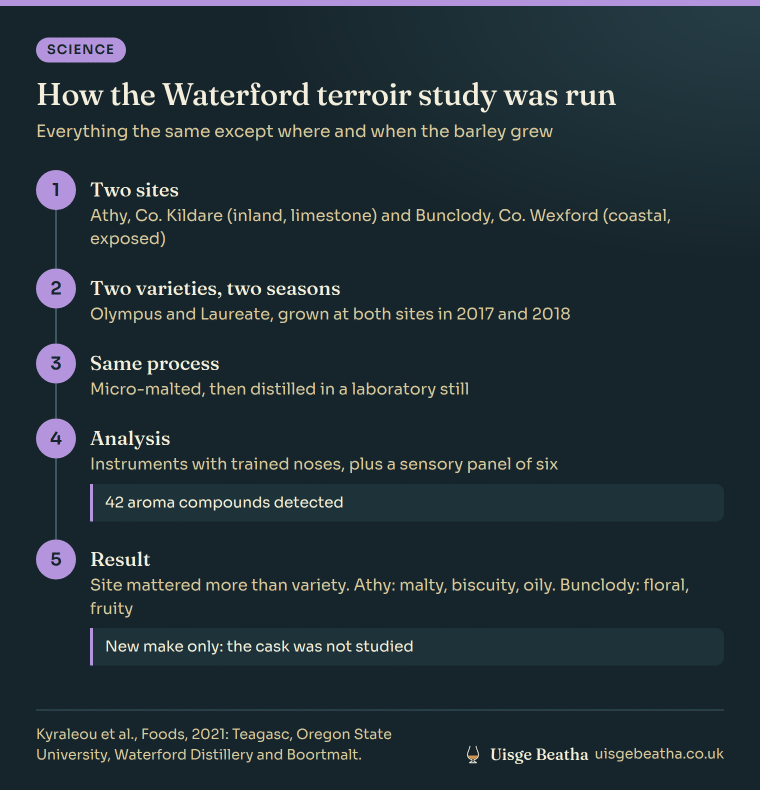
- Two sites: Athy, Co. Kildare (more inland and sheltered, a limestone soil, steadier and warmer weather) and Bunclody, Co. Wexford (more coastal and exposed, with more changeable weather).
- Two barley varieties, Olympus and Laureate, grown at both sites over two seasons, 2017 and 2018.
- The same process for every sample: micro-malted, then distilled in a laboratory still.
- Two kinds of analysis: gas chromatography with mass spectrometry and olfactometry (instruments plus trained human noses at the sniffing port), and a trained sensory panel of six.
The findings
- Measurable differences: The analysis detected 42 aroma compounds in the new make, eight judged very influential and 15 influential.
- Place mattered more than variety: The site, and the way each variety responded to each site, affected the aroma more than the variety alone. The season also had a bigger effect than the variety.
- Different sites, different spirit: New make from Athy scored higher for pungent, feinty or earthy, malty or biscuity notes and an oily finish. New make from Bunclody leaned towards floral, fresh fruit and dried fruit notes.
What it did not test
The study looked only at new-make spirit, made at laboratory scale. The authors state that the reactions in the cask during maturation were not explored. Waterford announced a second stage using its own commercial-scale spirit and matured whisky.
Waterford itself went into receivership in 2024, and in March 2026 Tennessee Distilling Group agreed to buy the distillery and brand.
4. Does the cask erase terroir?
That is the open question. The published research shows that barley grown in different places can give measurably different new make; it does not yet show how much of that difference remains after years in oak. The cask has been invited to the experiment, but its report is still awaited.
There are reasons to think some of it might. Spirit is not an inert liquid in the cask: a heavier, oilier new make and a lighter, fruitier one may take up oak compounds differently, and the weight and texture of a whisky owe a good deal to its spirit. But that is a reasonable hypothesis, not a finding.
The verdict
Scotch distillers have long chosen barley varieties mainly for how much alcohol they yield; our look at barley research covers the genetics behind that selection.
The evidence now supports a narrower claim than “terroir is proven”: where and in which season barley is grown can change the aroma of the new-make spirit, by amounts trained panels and instruments can measure. How far that carries through to a mature whisky in your glass is still to be shown.
For buyers, that makes farm and field on a label a real piece of information about the barley, though not by itself a guide to how the whisky will taste. Our guide to what single malt Scotch is covers the rules that still apply whatever the barley.
About the author
