Dr Bill Lumsden on Glenmorangie
The distilling approach of Dr Bill Lumsden at Glenmorangie: Scotland's tallest stills, extra-matured cask finishes, and designer oak casks, in his words.

Few people in Scotch whisky have done more to shape modern wood policy than Dr Bill Lumsden.
A biochemist with a PhD, Dr Lumsden joined Glenmorangie in 1995 as distillery manager. Since 2012 he has sat on the board of The Glenmorangie Company as Director of Distilling, Whisky Creation and Whisky Stocks, overseeing both the light Highland malts of Glenmorangie in Tain and the heavily peated Ardbeg on Islay. The company is owned by LVMH.
Heriot-Watt University, which gave him an honorary doctorate in 2017, calls him “the pioneer of wood management”. Under him, Glenmorangie became known above all for its cask finishes and wood experiments.
Here is how the stills, the copper and the wood fit together at Glenmorangie.
1. The “Giraffe Stills” of Tain: Extreme Copper Reflux
The foundation of Glenmorangie’s spirit character is not wood; it is copper.
Inside the distillery’s stillhouse on the shores of the Dornoch Firth stand six pairs of pot stills (six wash and six spirit stills) with necks measuring 5.14 metres (16 feet 10¼ inches) high: about the height of an adult giraffe, and the tallest stills in Scotland.
                  Extreme Copper Column (5.14m)
                          ┌────────┐
                          │  Neck  │
                          │        │
                          │   ▲    │ ◄── Only light, delicate floral & ester
                          │   │    │     vapours reach the condenser
                          │   │    │
                          │   ▼    │ ◄── Heavy, oily, sulphurous compounds
                          │ Reflux │     condense and wash back into the pot
                          │        │
                     ┌────┴────────┴────┐
                     │   Pot Still Boil  │
                     └──────────────────┘
The Physics of Copper Contact:
- Maximised Reflux: In a tall still neck, rising vapour cools as it travels upward. Denser, heavier alcohol congeners (such as long-chain fatty acids, higher fusel oils, and sulphurous compounds) condense prematurely on the copper walls and cascade back down into the boiling wash.
- Copper Cleansing: Copper actively binds with volatile sulphur compounds (mercaptans and dimethyl trisulfide), converting them into insoluble copper sulphides that drop out of the distillate.
- The Light Spirit: Mostly the lighter, more volatile compounds, including fruity esters, make it over the top of the neck to the condenser.
This matters for what follows: because Glenmorangie’s new make is so light, the casks it is matured in have a large say in how the finished whisky tastes.
2. The Architecture of Extra-Maturation (Cask Finishing)
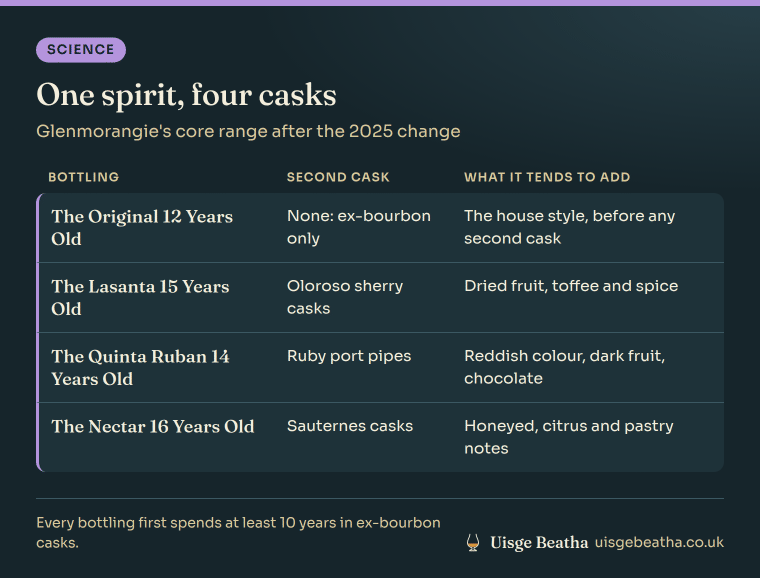
Glenmorangie was among the first distilleries to sell cask finishes. Its Port Wood Finish came out in 1993 or 1994, and Madeira and Sherry finishes followed in 1996. (Balvenie, whose malt master David Stewart had used a second cask for Balvenie Classic in 1983, launched DoubleWood in 1993.) After joining in 1995, Dr Lumsden built this into the “extra-matured” range: Glenmorangie that has spent at least 10 years in ex-bourbon casks is moved into wine or fortified wine casks for a second maturation. Since a 2025 range change, the core extra-matured bottlings are:
- The Lasanta 15 Years Old (Sherry): Oloroso sherry casks, which tend to add dried fruit, toffee and spice.
- The Quinta Ruban 14 Years Old (Port): Ruby port pipes, which tend to add a reddish colour and dark fruit and chocolate notes.
- The Nectar 16 Years Old (Sauternes): Sweet French dessert wine casks, which tend to add honeyed, citrus and pastry notes. It was called Nectar D’Or until the range was renamed.
Glenmorangie’s core bottling, The Original, which stays in ex-bourbon casks throughout, moved from 10 to 12 years old in the same 2025 change. Each bottling starts as the same spirit; the second cask is what separates them.
For more on what a second cask does, see our guide to sherry casks.
3. The Designer Cask Programme: Missouri Oak & The Astar
While wine finishes got the headlines, the most technical part of Dr Lumsden’s work was Glenmorangie’s “Designer Cask” programme.
Rather than buying ex-bourbon barrels on the open market, Glenmorangie had casks made from oak it chose in the Ozark Mountains of Missouri. As the company describes the process:
- Slow-Growth American White Oak (Quercus alba): Chosen for slow growth, which gives dense, fine-grained wood.
- Natural Air-Drying: The staves are left outdoors to season for at least two years rather than being kiln-dried quickly. Weathering is generally held to soften the harsher wood tannins.
- Toasting and Charring: The casks are toasted, which breaks down wood sugars, and then charred.
- Bourbon Seasoning: The new casks are leased to American distillers (Jack Daniel’s and Heaven Hill have been named) to hold their whiskey for several years before they travel to Tain.
This wood was shown off in bottlings such as Glenmorangie Astar and is part of Glenmorangie Signet, which also uses high-roast “chocolate” malted barley.
4. The Two-Fill Rule & The Lighthouse
Glenmorangie follows a “twice only” rule:
- Casks are filled with Glenmorangie spirit no more than twice (first-fill and second-fill).
- After that they leave the warehouse, so the casks in use still have plenty of flavour to give. Many distilleries reuse casks more times than that.
In September 2021, Glenmorangie opened The Lighthouse, an experimental distillery beside the main Tain site. A 20-metre glass stillhouse holds two copper stills, with a sensory laboratory above. It gives Dr Lumsden and master blender Gillian Macdonald a place to try different yeasts, barleys and casks, where, as the project was described at its opening, flavour takes precedence over yield.
The common thread in Dr Lumsden’s work is that a light spirit from tall stills, put into carefully chosen wood, lets the cask do much of the talking. Our guide to how age and maturation work explains the wood side in more detail.
About the author
