Glenlivet whisky smugglers: the Highland trade
How illicit Highland whisky travelled from Glenlivet to its markets, why farmers made it, and what changed after the Excise Act of 1823.

A cask of whisky is easier to carry over a hill than the barley that went into it. Turning barley into spirit produced something compact and valuable that could be carried on a steep path. For a Highland farmer with a crop to sell, rent to pay and a market on the other side of the mountains, that was a useful piece of arithmetic. For an excise officer, it was the beginning of a very long walk.
In the late 18th and early 19th centuries, illicit distilling and smuggling connected farms and hidden stills to drinkers well beyond the glens. Glenlivet acquired a reputation for its spirit, and routes through the surrounding hills offered ways to move it south. The trade depended on farming, rent, tax policy and landownership, and its decline left people with unequal opportunities to enter legal distilling.
Why make whisky illegally?
Distilling itself was not new. Our account of whisky’s early history follows the much older records of aqua vitae. Later excise duties and restrictions made it difficult for many small Highland producers to operate legally.
Rules changed repeatedly, and their effects differed across Scotland. Research on the Cabrach describes a Highland line dividing areas subject to different restrictions; until 1816, Highland-made whisky could not legally be moved to the east or south of that line. Small-scale production continued despite the restrictions (Internet Archaeology).
For a farm household, distilling turned locally grown grain into something portable and worth real money. It sat neatly inside a mixed rural economy alongside grain, livestock and other work, all pulling their weight toward the household’s bills. Whisky brought cash or goods in, and landlords could benefit indirectly when tenants were actually able to pay their rent, which gave some of them a remarkably selective interest in law enforcement. Not every landlord or farmer behaved alike, of course, and the surviving evidence is stronger for some places than others.
Why Glenlivet?
The Livet valley had water, farms, difficult country and, crucially, a reputation. Glenlivet was a place name long before it belonged to a single distillery, and the whisky of the district became sought after. The National Trust for Scotland describes farmer George Smith as one of many local people with a sideline in illicit whisky before he obtained a licence in 1824 (National Trust for Scotland). Distilling could sit alongside the other work of a farm.
Remote did not mean disconnected. Tracks linked settlements, grazing grounds and markets across the hills. Anyone who knew the ground could take routes that would have defeated a cart and thoroughly baffled anyone relying on the main roads. Journeys could be assembled from paths, glens and crossings to suit the destination and conditions.
Over the hills to Deeside
In a 1999 Whisky Magazine article, Dave Broom describes setting out with guide Jim Cryle and journalist Chris Orr from The Glenlivet distillery with two ponies to retrace what they described as an old smuggling route. Their journey took them over Càrn Daimh to Tomintoul, then south along the River Avon, up the Builg Burn to Loch Builg, and east along Glen Gairn before turning south to Deeside (Whisky Magazine). Broom’s account describes a modern journey, not a surviving log of one particular smuggler’s trip.
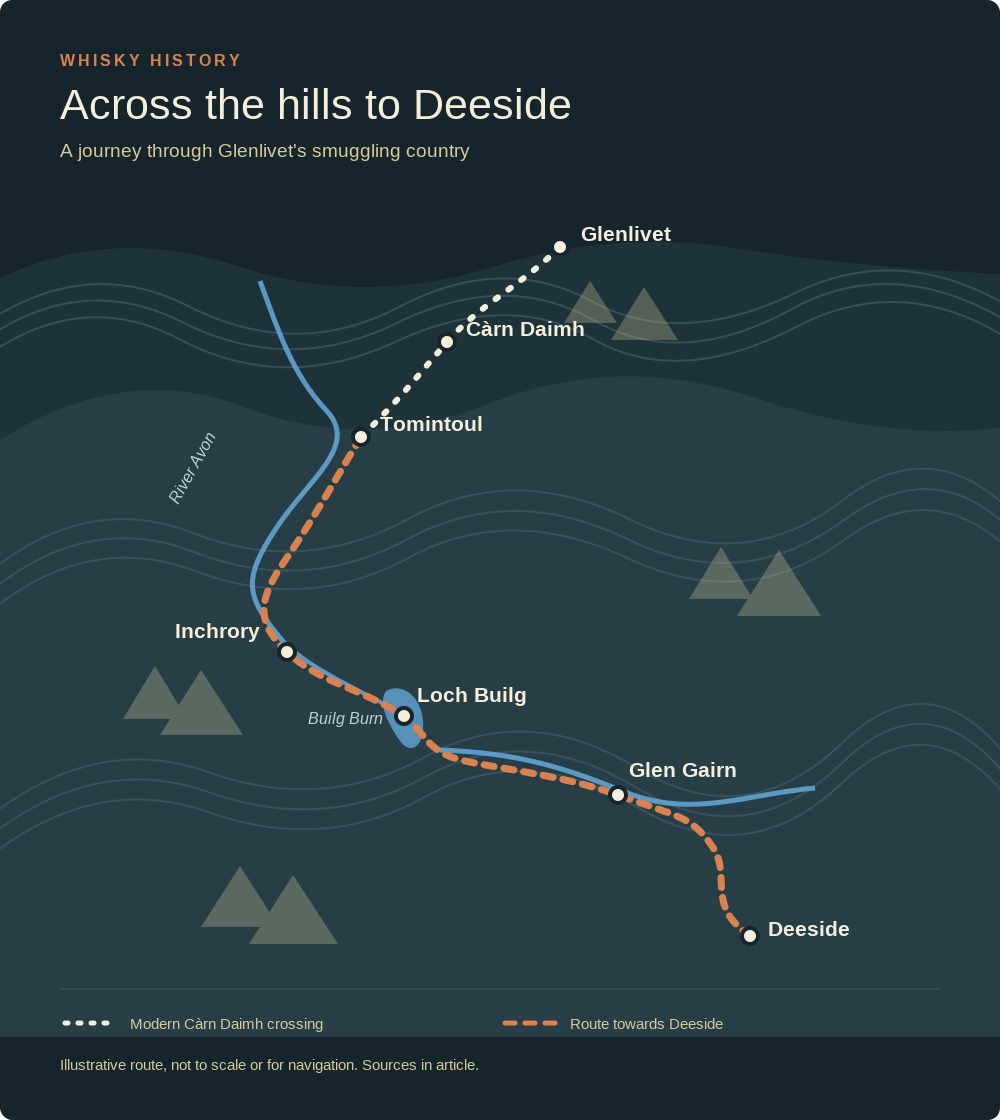
Route schematic based on Broom’s 1999 account and the Glenlivet Estate’s description of its long-distance routes. It is not to scale or a walking guide.
The estate separately identifies a historic Deeside route via Inchrory, in upper Avonside, and Glengairn, among several old routes associated with smugglers. The detail matters at the northern end: the modern Speyside Way spur crosses Càrn Daimh between the distillery and Tomintoul, and Broom’s party followed it, but that does not establish the exact line taken by an 18th-century convoy. Similarly, Broom records leaving the Gairn for Deeside without naming every turn. The diagram shows his sequence of places, rather than inventing a precise track or a single fixed destination.
The hills offered alternatives as well. The estate identifies the Ladder Road from the Braes of Glenlivet towards Donside and the Steplar Road towards the Cabrach. Together, these routes formed a working network through the hills rather than a single secret pass.
The military road between Tomintoul and Corgarff was another way through this country, though a party on a hill path had no obligation to use a road built for soldiers. Terrain was useful cover, if never a guarantee of safety: weather, darkness and the sheer weight of the load made a crossing hard work for people and animals alike.
Pack ponies carried small casks or kegs. The National Trust for Scotland’s collections include vessels shaped for carrying and describe lines of ponies used in the trade (National Trust for Scotland). Ponies could manage tracks where wheeled transport had no hope, though they were still ponies, which meant they required people to load them, guide them and persuade them to keep walking in the rain. Moving whisky was a collective job, and reaching a buyer depended on a chain of local knowledge well beyond the still itself.
The gauger and the still
Excise officers, commonly called gaugers, looked for untaxed spirit, equipment and the people responsible. Illicit distillers could move or hide their apparatus, while enforcement relied on tip-offs as much as searches. Bribery and local protection appear in historical accounts, though it would be too neat to assume every officer was on the take or that every encounter turned into a breathless chase across the heather. Much of it was quieter, slower and considerably damper than the legend suggests.
Nor were all illegal stills tucked into picturesque caves. Some operated in or around farm buildings, where a still could sit quietly beside ordinary farm work as if it had every right to be there; others used more remote shelters. Archaeologists have investigated sites across the Highlands, including remains at Mar Lodge and Ben Lawers. Their finds help separate the physical graft of distilling from stories that grew taller in the retelling (National Trust for Scotland).
The practical demands were considerable: grain had to be malted, dried and mashed, the resulting liquid fermented, and the wash heated in a still. Concealment is one thing; concealing a process that needs water, grain and a steady supply of fuel is quite another. Fuel mattered just as much as secrecy.
What did the whisky taste like?
It is tempting to picture every smuggled dram as raw, throat-stripping spirit, harsh and unaged. Some of it would have been drunk young, certainly, but age and quality cannot safely be assigned to the entire trade. Glenlivet whisky in particular gained a reputation for quality, and customers sought it out on purpose rather than merely out of defiance toward the Crown. A transport cask tells us how the spirit travelled; it does not, by itself, tell us how long every batch had already been kept.
Today’s Scotch rules, including the minimum three years in oak, belong to a later legal framework. Applying those standards backwards makes the historical drink look far tidier and more uniform than the evidence allows. Our guide to casks, warehousing and blending explains the later role of maturation.
The 1823 Excise Act and George Smith
Legal distilleries existed before 1823. What the Excise Act changed were the terms on which more producers could join them: it cut duty and set new licensing terms. Stills of at least 40 gallons had already been permitted under conditions in 1816; the 1823 Act retained a 40-gallon minimum (1816 Act; 1823 Act). The response was brisk. An archaeological study of the Cabrach reports 111 licensed Scottish distilleries in 1823 and 263 by 1825, which suggests a great many people had been waiting for the paperwork to become marginally less hostile (Internet Archaeology).
At Upper Drumin in Glenlivet, George Smith moved from illicit distilling to licensed production in 1824. The National Trust for Scotland describes him as a gentleman farmer, which is a polite way of saying he had resources that should not be assumed for every tenant with a small still. Archaeological work at his original site has traced the buildings and water infrastructure of a business that expanded before moving to Minmore in 1859, the site of today’s Glenlivet distillery (National Trust for Scotland).
The Act did not switch the illegal trade off overnight. Enforcement and legal competition gradually wore it down, though illicit distilling lingered in some areas. Nor was the door into licensed production equally wide for everyone: premises, equipment, fees and working capital all cost money. Some former illicit distillers took licences, while the opportunities available to others varied (Internet Archaeology).
What happened to the communities?
Losing illicit income could leave a precarious farm household much more exposed, yet it would be misleading to blame Highland eviction or emigration on the Excise Act alone. Rising rents, shifts in estate management, agricultural improvement and the spread of sheep farming all belonged to a longer, uneven history of displacement. The balance varied from one estate and community to another, so any direct causal claim needs evidence for the particular place and family.
Legalisation changed who could make whisky openly and at what scale. It also changed what survived on paper and in stone. An illicit still might leave little more than a disturbed patch of ground; a licensed distillery left buildings, ledgers and, eventually, a brand with its own story to tell. Those surviving records make the commercial successor far easier to spot than the people whose work came before it.
From hill tracks to railway lines
Taking out a licence did not shrink the hills. Whisky and grain still had to travel between distillery and market. Later, railways changed the geography and scale of that movement, even where a cart still had to haul casks as far as the station. The journey from ponies and carts to trains, and eventually lorries, changed where distilleries could operate.
The Glenlivet trails belong to a much larger story: a practical way to move the output of a farming economy through a landscape the people working it knew intimately. The legal industry that followed inherited skills and a hard-won reputation from those hills, even if the rewards of its growth were not shared out evenly among the people who had built the earlier trade.