Scotch Can Only Be Made in Scotland
Why Scotch whisky can only be made in Scotland: the Scotch Whisky Regulations 2009, Geographic Indication rules, and the five legal categories.
It might seem self-evident that Scotch whisky must come from Scotland, but the value of the name means it is defended closely, in law and in court.
Just as Champagne must come from the Champagne region of France, and Cognac from its defined area around the Charente and Charente-Maritime, “Scotch Whisky” is a strictly defined Geographical Indication (GI). It is protected by UK law, in the EU, and through trade agreements and registrations abroad; the Scotch Whisky Association says it has specific GI protection in more than 85 markets.
Here is what the law requires of every bottle labelled “Scotch”.
The Legal Definition: Scotch Whisky Regulations 2009
In the United Kingdom, Scotch whisky is governed by statutory instrument: The Scotch Whisky Regulations 2009 (UK SI 2009 No. 2890).
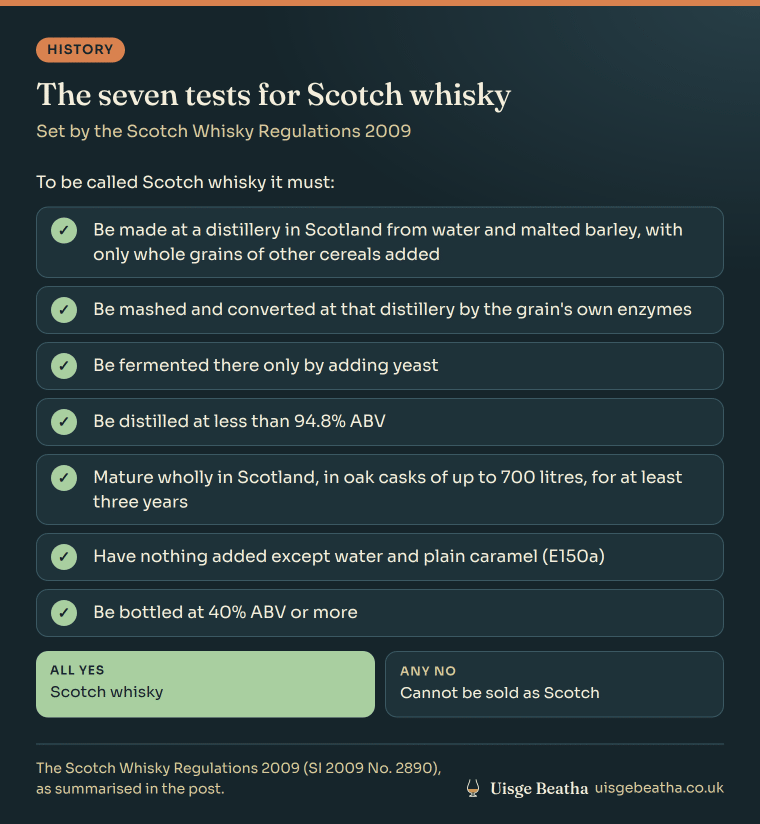
To legally carry the name Scotch Whisky, the spirit must satisfy all of the following requirements:
- Produced in Scotland: Must be produced at a distillery in Scotland from water and malted barley (to which only whole grains of other cereals may be added).
- Internal Processing: The raw materials must be processed, mashed, and converted to a fermentable substrate solely by endogenous enzyme systems at that Scottish distillery.
- Fermentation: Must be fermented at that distillery only by the addition of yeast.
- Distillation Ceiling: Must be distilled at an alcoholic strength of less than 94.8% ABV (189.6 US proof) so that the distillate retains the aroma and taste derived from the raw materials used.
- Oak Cask Maturation in Scotland: Must be matured wholly in an excise warehouse in Scotland in oak casks with a capacity not exceeding 700 litres, for a period of not less than three years.
- No Other Additives: The spirit must keep the colour, aroma and taste that come from its raw materials, production and maturation. The only permitted additions are water and plain caramel colouring (E150a). See our guide to spirit caramel (E150a) in whisky.
- Minimum Bottling Strength: Must be bottled at a minimum alcoholic strength of 40% ABV (80 US proof).
The Five Legal Categories of Scotch Whisky
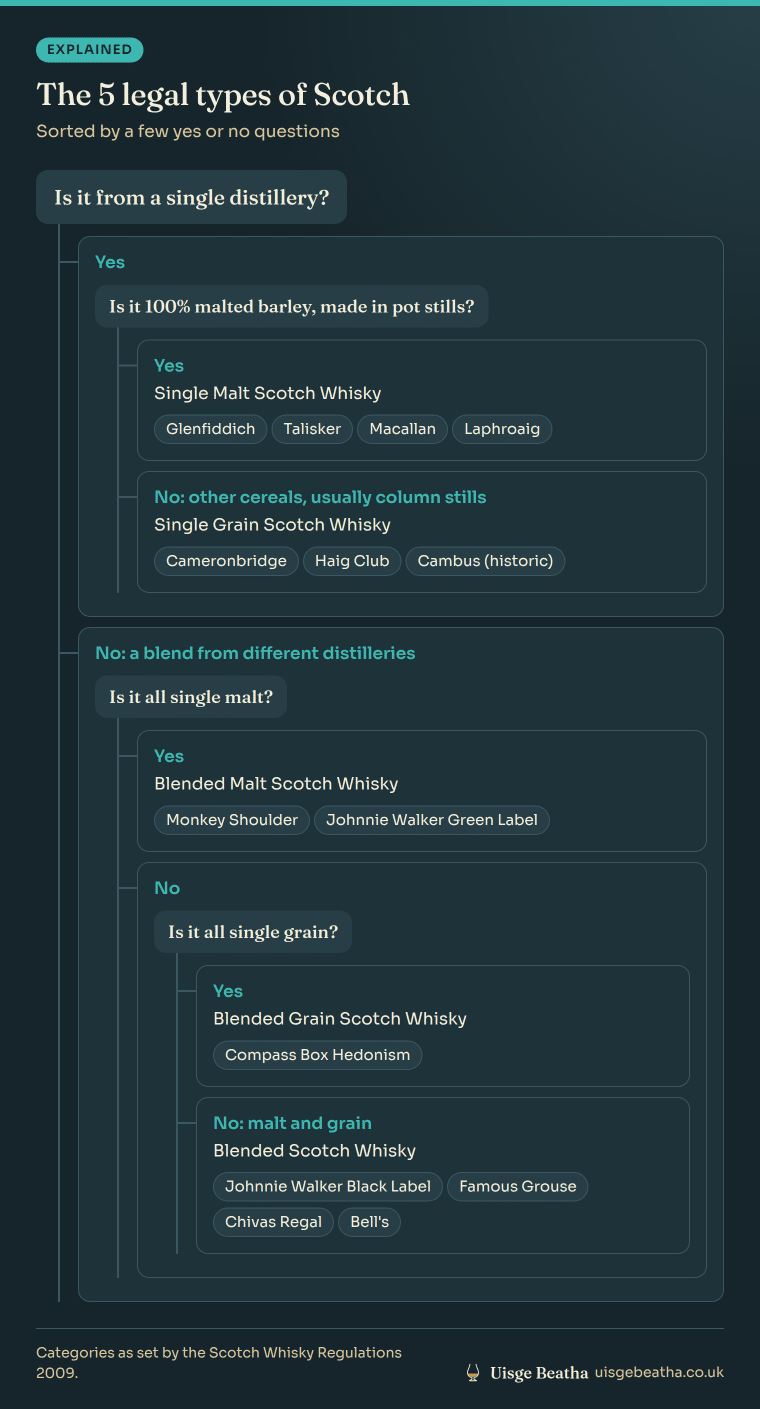
The 2009 Regulations divide all Scotch into five categories, and the label must state which one applies:
On smaller screens, scroll sideways to see every column.
| Category | Legal Definition | Example Expressions |
|---|---|---|
| Single Malt Scotch Whisky | Distilled in one or more batches in pot stills at a single distillery, from water and malted barley only. | Glenfiddich 12, Laphroaig 10, Macallan 12 |
| Single Grain Scotch Whisky | Distilled at a single distillery from malted barley with or without other whole cereals (typically wheat or maize), usually via continuous column stills. | Haig Club, Cameron Brig |
| Blended Malt Scotch Whisky | A blend of two or more Single Malt Scotch Whiskies from different Scottish distilleries (formerly called “vatted malts” or “pure malts”). | Monkey Shoulder, Compass Box Peat Monster |
| Blended Grain Scotch Whisky | A blend of two or more Single Grain Scotch Whiskies from different Scottish distilleries. | Compass Box Hedonism |
| Blended Scotch Whisky | A blend of one or more Single Malt Scotch Whiskies with one or more Single Grain Scotch Whiskies. | Johnnie Walker Black Label, Bell’s, Chivas Regal |
International Enforcement: Defending the Scotch GI
Scotch is Scotland’s largest food and drink export: the SWA puts 2025 exports at £5.3bn. The Scotch Whisky Association (SWA) watches spirits markets worldwide for misuse of the name.
The SWA takes legal action against spirits that pass themselves off as Scotch:
- Producers elsewhere, often of cane spirit or locally made whisky, cannot label products as “Scotch”, and the SWA challenges Scottish names and imagery (tartans, bagpipes, glens) used to suggest Scottish origin. See how to read a whisky label for the “Glen Buchenbach” case.
- Bottling rule: since 23 November 2012, Single Malt Scotch Whisky may not leave Scotland in casks or other bulk containers; it must be bottled and labelled in Scotland first. Blended Scotch can still be exported in bulk for bottling abroad.
Spelling: Whisky vs. Whiskey
The Scotch Whisky Regulations use the spelling “whisky” (without an ’e’), and Scotch producers always do. The spelling with an ’e’ (“whiskey”) is the usual one for Irish and most American whiskeys. “Scotch whiskey” on a label suggests it was not written by a Scotch producer, and is worth a second look.
Compare Scotch Whiskies
Compare current prices on Scotch single malts and blends at the UK retailers we check:

Glen Moray Elgin Classic Single Malt Whisky
40.0% ABV · 70cl
from £23.99 1 retailer
£28.94 delivered
Compare prices
Glenmorangie X
40.0% ABV · 70cl
from £24.95 1 retailer
£29.90 delivered
Compare prices
Loch Lomond Original Single Malt Whisky
40.0% ABV · 70cl
from £24.99 1 retailer
£29.94 delivered
Compare prices
Speyburn 10 Year Old
10 years · 40.0% ABV · 70cl
from £25.00 3 retailers
£29.99 delivered
Save up to £2.88
Compare prices
Glen Moray Sherry Cask Finish - Elgin Classic Single Malt Whisky
40.0% ABV · 70cl
from £25.95 1 retailer
£30.90 delivered
Compare prices
Glen Moray Peated - Elgin Classic Single Malt Whisky
40.0% ABV · 70cl
from £26.04 1 retailer
£30.99 delivered
Compare pricesAbout the author
