That Might Not Be the Best Whisky in the World
How entry fees, point-threshold medals, narrow categories and clickbait headlines manufacture 'best whisky in the world' claims, and what to check first.
Every few months, a supermarket whisky is reported as one of the best in the world. Two examples from 2019 show how it happens:
- Lidl’s Queen Margot, an eight-year-old blended Scotch, won the World Whiskies Awards category for best blended Scotch aged under 12 years. Several outlets reported it as the “best whisky in the world”. As Scotchwhisky.com pointed out at the time, more than 120 whiskies won their categories at those awards, and category winners go on to compete for the overall titles.
- Aldi won four golds and a silver at The Spirits Business Scotch Whisky Masters in June 2019, reported as four of its whiskies being “named best in the world”.
For a shopper, the headlines suggest that a budget bottle has been judged better than established single malts. Usually it has not. The headlines come from commercial incentives, narrow categories and the way medals are awarded.
Here is how spirits competitions work, and how to read an award claim.
1. The “Olympic Gold” Fallacy: How Medal Thresholds Work
When most people hear that a spirit won a “Gold Medal”, they instinctively imagine an Olympic podium: hundreds of competitors entered, one stood victorious, and the rest took silver, bronze, or went home empty-handed.
In commercial spirits competitions, this is almost never how medals are awarded:
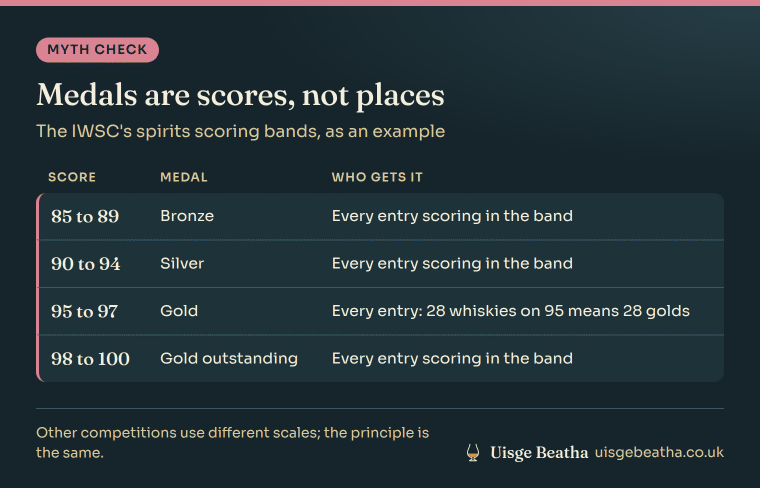
Most competitions award medals against point thresholds, not by ranking. At the IWSC, for example, a spirit scoring 85 to 89 gets bronze, 90 to 94 silver, 95 to 97 gold and 98 to 100 gold outstanding. If 28 whiskies in a flight all score 95, all 28 get a gold medal. Other competitions use different scales, but the principle is the same.
A single competition can hand out hundreds of golds. “Won gold” means the whisky reached that competition’s standard, not that it beat everything else in the room.
2. Hyper-Specific Category Slicing
How can a budget blend be reported as having “beaten the world’s best”? Usually because it won a narrow category.
Major competitions, such as the International Wine & Spirit Competition (IWSC), San Francisco World Spirits Competition (SFWSC), World Whiskies Awards (WWA) and The Spirits Business Scotch Whisky Masters, divide entries into categories by style, age and sometimes price. In 2019 the World Whiskies Awards had four blended Scotch categories by age alone: under 12 years, 13 to 20 years, 21 years and over, and no age statement.
An inexpensive supermarket blend does not compete against a 21-year-old Glenfarclas, an 18-year-old Talisker or a vintage Springbank. It competes against other blends of a similar age or price.
When it wins that category, the press release says it won at an international competition. If a headline then drops the category, “best blended Scotch under 12 years” becomes “best whisky in the world”.
3. Pay-to-Play: The Business Behind Spirits Competitions
Spirits competitions are not charitable academic institutions; they are commercial events designed to generate substantial revenue:
- Entry Fees: Each entry costs money. The IWSC’s 2026 spirits fee was £162 to £174 per entry before VAT, and its Kentucky judging charged US$310 to US$425. Producers also send sample bottles.
- Medal Use: Putting a medal on a label or in advertising often means buying the competition’s medal stickers or paying to use its artwork, an extra cost on top of the entry.
- Selection Bias: Only producers and retailers willing to pay enter. Many well-known distilleries and independent bottlers never enter some competitions at all, so a category result says nothing about whiskies that were not there.
4. When Do Awards Actually Matter?
Competitions are not worthless. Read carefully, they can point you to whiskies worth trying:
Look for “Best in Class” / “Trophy” Winners
Give less weight to ordinary gold and silver medals. Trophies, Best in Show and overall titles (for example “World’s Best Single Malt” at the World Whiskies Awards) are where entries are compared head to head. Check which award it was, which year, and how wide the category was.
Seek Out Independent Blind Panels
Look for competitions that publish their full judging panels, adhere strictly to double-blind tasting protocols (where judges have no knowledge of price, region, or producer), and publish transparent scoring notes.
Appreciate Value for What It Is
Supermarket whiskies from Aldi, Lidl, Sainsbury’s and Waitrose are often well made and good value for an everyday bottle (see our supermarket whisky guide).
Enjoy an inexpensive supermarket malt for what it is. Just don’t expect it to taste like a single cask bottling costing several times as much because a headline called it the best in the world. To compare what you get at each price, see our whisky under £30 and whisky under £50 guides.
About the author
