The Glencairn Glass: Design, History and Nosing Performance
How the Glencairn glass became the standard nosing glass for whisky: who designed it, how the bowl works, and how it compares with a tumbler.

Until the turn of the 21st century, whisky had no widely recognised tasting glass of its own. While wine, Champagne, brandy, and port all enjoyed dedicated, scientifically engineered stemware, whisky drinkers were largely offered heavy cut-crystal tumblers or delicate stemmed copitas borrowed from the Spanish sherry trade.
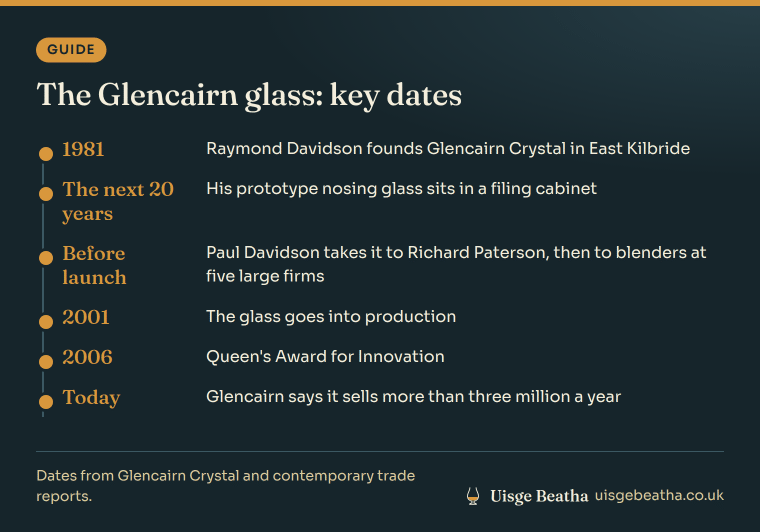
That changed in 2001 with the launch of the Glencairn Glass, made by the Scottish family firm Glencairn Crystal in East Kilbride. Glencairn says it now sells more than three million a year, and the glass won a Queen’s Award for Innovation in 2006. It is now the usual glass at distilleries, tasting panels and whisky shows.
The Origin: Raymond Davidson’s Prototype
Raymond Davidson founded Glencairn Crystal in 1981. He had noticed that blenders in Scotland nosed from tulip-shaped copitas (dock glasses). Copitas concentrate aroma far better than tumblers, but their thin stems make them impractical for busy bars and everyday use.
Davidson sketched a hybrid design:
- Keeping the curved tulip bowl and tapered mouth of the blender’s copita to focus aromas.
- Replacing the delicate stem with a short, solid base that sits firmly in the hand and stands up to bar use.
The prototype then sat in a filing cabinet for almost 20 years. His son Paul Davidson found it and took it to Richard Paterson, master blender at Whyte & Mackay (Dalmore). The family then took it to master blenders from five of the largest whisky companies in Scotland, who helped settle its size and shape before it went into production in 2001.
Anatomy and Performance: Why the Glencairn Works
        ┌────────┐
        │  Rim   │  ◄ 1. Narrow rim (tapered to concentrate volatiles)
        └──┬──┬──┘
          /    \    ◄ 2. Inward chimney (funnels aroma towards the nose)
         /      \
        │        │  ◄ 3. Wide belly (maximises liquid surface area for aeration)
        └────────┘
           │  │
         ┌─┴──┴─┐   ◄ 4. Solid base (sturdy, easy to hold)
         └──────┘
- Aroma Concentration (The Chimney Effect): The wide lower bowl allows spirit to breathe and aerate when swirled. As ethanol and congeners evaporate, the inward-sloping neck funnels volatile esters, phenolics, and aldehydes toward the rim, concentrating subtle top notes that would vanish in a straight-sided tumbler.
- Visual Inspection: The clear, wide bowl shows off the colour, and a gentle tilt shows the “legs” without spilling. Colour says more about the cask (and any added caramel) than about age: see spirit caramel (E150a) in whisky.
- Solid Base: The Glencairn has no stem. Its short, heavy base fits naturally between thumb and forefinger, which gives a steady grip and keeps the hand a little away from the bowl.
Glencairn vs The Old Fashioned Tumbler
On smaller screens, scroll sideways to see every column.
| Feature | The Glencairn Glass | The Lowball Tumbler |
|---|---|---|
| Primary Use | Analytical tasting, nosing, neat drams | Casual drinking, highballs, whisky on the rocks |
| Aroma Delivery | Concentrated, layered, directional | Diffused, flattened, rapidly dispersed |
| Alcohol Vapour | Controlled evaporation | Fast dissipation into ambient room |
| Ice Compatibility | Poor (designed for room temperature or water) | Excellent (holds large ice spheres or cubes) |
| Durability | High (lead-free crystal with a solid base) | Very high (thick-walled glass) |
Tasting in a Glencairn: Best Practice
- Pour Size: Glencairn designs the glass for a pour of up to 35ml with room to add water. A 25ml or 35ml pour (the two usual UK pub measures) sits around the widest part of the bowl, which gives the most surface area.
- Nosing Position: Bring the glass up slowly and keep your mouth slightly open, which makes the alcohol less sharp on the nose.
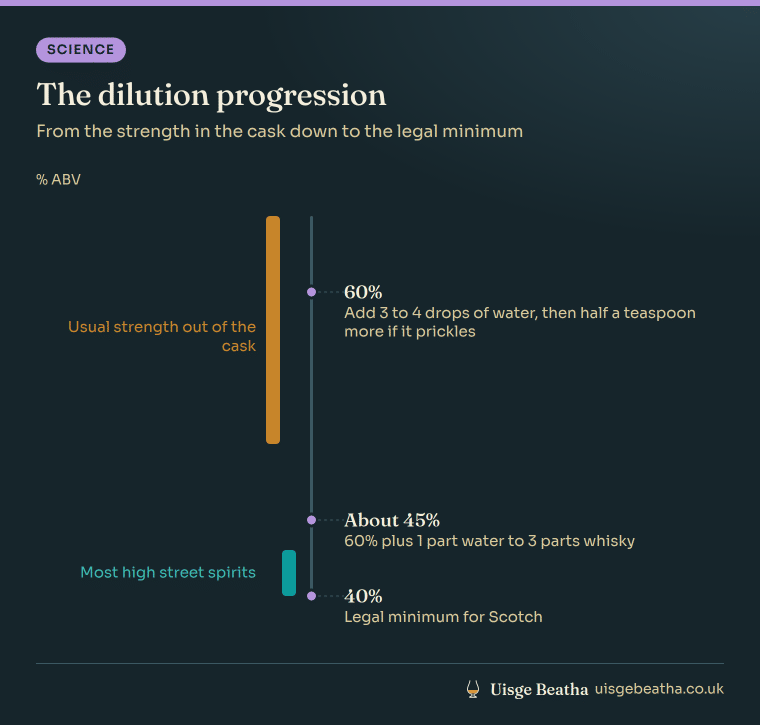
- Watering: With cask strength whiskies (50% ABV and above), add water a few drops at a time with a pipette or teaspoon. Water often brings out aromas the alcohol was masking; our cask strength guide sets out how much to add.
Explore Single Malts Ideal for Nosing
Test your glassware with benchmark Scottish single malts:

Glen Moray Elgin Classic Single Malt Whisky
40.0% ABV · 70cl
from £23.99 1 retailer
£28.94 delivered
Compare prices
Glenmorangie X
40.0% ABV · 70cl
from £24.95 1 retailer
£29.90 delivered
Compare prices
Loch Lomond Original Single Malt Whisky
40.0% ABV · 70cl
from £24.99 1 retailer
£29.94 delivered
Compare prices
Speyburn 10 Year Old
10 years · 40.0% ABV · 70cl
from £25.00 3 retailers
£29.99 delivered
Save up to £2.88
Compare prices
Glen Moray Sherry Cask Finish - Elgin Classic Single Malt Whisky
40.0% ABV · 70cl
from £25.95 1 retailer
£30.90 delivered
Compare prices
Glen Moray Peated - Elgin Classic Single Malt Whisky
40.0% ABV · 70cl
from £26.04 1 retailer
£30.99 delivered
Compare pricesAbout the author
