The Norlan Whisky Glass: Design, Science and Review
The Norlan whisky glass explained: who designed it, its double-walled borosilicate build, what its makers claim, and how it compares with the Glencairn.
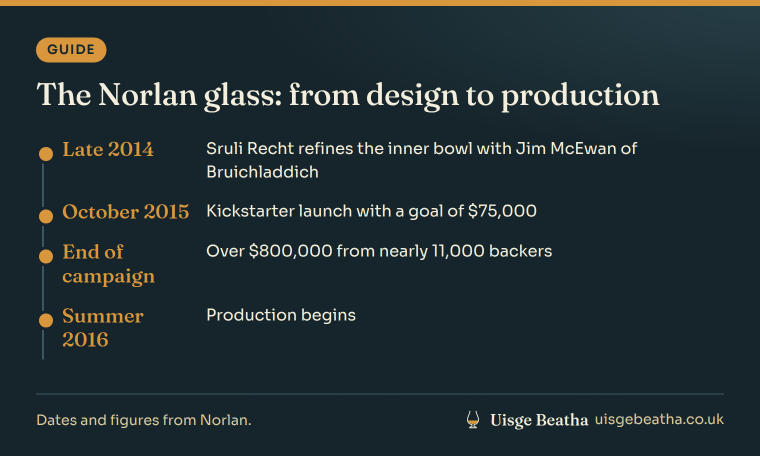
When the Norlan Whisky Glass launched on Kickstarter in October 2015, it set out to raise $75,000 and ended with over $800,000 from nearly 11,000 backers. Norlan calls it the most successfully funded drinking-glass campaign at the time.
It promised the nosing focus of a copita with the feel of a tumbler, and it drew attention from design writers as well as whisky drinkers.
How does it compare with the Glencairn, and what do its makers actually claim?
The Design Thesis
Norlan was founded by Shane Bahng and Brian Fichtner, and the glass was designed by the Iceland-based designer Sruli Recht. Recht used fluid dynamics modelling and worked with the synthetic biologist Martin Hanczyc; in late 2014 he refined the inner bowl with Jim McEwan, then master distiller at Bruichladdich. Production began in summer 2016.
Their design addressed two perceived flaws in traditional glassware:
- The Sensory Compromise: Tumblers feel comfortable, but their wide openings let aroma spread into the room. Narrow tulip nosing glasses focus aroma well, but they focus the alcohol vapour too, which can prickle the nose.
- The Social Compromise: Narrow nosing glasses make you tilt your head back to finish the pour, which the designers called antisocial. The Norlan’s wider mouth is meant to let you sip without tipping your head.
Engineering and Construction: Double-Walled Borosilicate
The Norlan is made from lightweight, double-walled borosilicate glass. Norlan gives its weight as about 4.4oz (roughly 125g) and its capacity as about 5.9 US fl oz (roughly 175ml) to the rim, with a recommended pour of 0.7 to 1.4 fl oz (about 20ml to 40ml).
    ┌───────────────────────────┐
    │ ─── Outer Wall (Tumbler)  │
    │   ┌───────────────────┐   │
    │   │  Inner Wall (Bowl)│   │
    │   │                   │   │
    │   │      [Fluid]      │   │
    │   │       /\ /\       │   │  ◄ Protrusions inside the bowl
    │   └───────────────────┘   │
    └───────────────────────────┘
- Inner Bowl: A curved bowl with fin-shaped protrusions near the base. Norlan says that when you swirl the glass these create wave-like movements, which increase the surface of liquid exposed to air so that more ethanol evaporates before you nose it. That is the maker’s claim from its own modelling; we have not seen an independent measurement of it.
- Outer Wall: A plain tumbler shape.
- Thermal Barrier: The air gap between the two walls insulates the whisky, so the hand warms it less than it would through a single wall.
Pros and Cons
Where the Norlan Succeeds
- Looks: The double walls make the whisky appear to float inside the glass.
- Cask Strength Whiskies: With whiskies at 55% to 60% ABV, the wider opening lets alcohol vapour spread out more than a narrow copita does, so the nose is less likely to prickle.
- Temperature: Holding the glass for a long time warms the whisky less than a single-walled glass would.
Where the Norlan Compromises
- Rim: The two walls join at a rounded rim, which feels thicker on the lip than the rim of a crystal copita or Glencairn.
- Weight and Hand Feel: At about 125g it is very light. Some people prefer the heavier feel of a crystal glass.
- Care: Norlan recommends a gentle hand wash with warm water and mild detergent, not the dishwasher.
Norlan vs Glencairn: Direct Comparison
On smaller screens, scroll sideways to see every column.
| Criteria | The Norlan Glass | The Glencairn Glass |
|---|---|---|
| Material | Double-walled borosilicate glass | Lead-free crystal |
| Rim Feel | Rounded lip where the walls join | Thinner, tapered rim |
| Aroma Concentration | Moderate (wider mouth spreads alcohol vapour) | High (narrow mouth concentrates aroma) |
| Care | Hand wash recommended | Robust; made for bar use |
| Cost | Usually costs more per glass | Usually costs less per glass |
| Ideal Usage | Sipping neat whisky in company | Tasting, comparing and note-taking |
The Verdict
The Norlan is a well-made piece of modern design that suits sipping neat whisky in company, and its wider mouth is gentler on the nose with cask strength bourbons or peated single malts.
For careful tasting, comparing single casks or picking out delicate aromas, the Glencairn and the stemmed copita remain the usual choice, with thinner rims and more focused aroma. For more on how glass shape changes what you smell, see the importance of the whisky glass.
Explore Single Malts Across Styles
Compare UK prices on single malts across our catalogue:

Glen Moray Elgin Classic Single Malt Whisky
40.0% ABV · 70cl
from £23.99 1 retailer
£28.94 delivered
Compare prices
Glenmorangie X
40.0% ABV · 70cl
from £24.95 1 retailer
£29.90 delivered
Compare prices
Loch Lomond Original Single Malt Whisky
40.0% ABV · 70cl
from £24.99 1 retailer
£29.94 delivered
Compare prices
Speyburn 10 Year Old
10 years · 40.0% ABV · 70cl
from £25.00 3 retailers
£29.99 delivered
Save up to £2.88
Compare prices
Glen Moray Sherry Cask Finish - Elgin Classic Single Malt Whisky
40.0% ABV · 70cl
from £25.95 1 retailer
£30.90 delivered
Compare prices
Glen Moray Peated - Elgin Classic Single Malt Whisky
40.0% ABV · 70cl
from £26.04 1 retailer
£30.99 delivered
Compare pricesAbout the author
