The Rise and Renaissance of Irish Whiskey
How Irish whiskey rebounded from two distilleries in 1980 to about 50 today, driven by Jameson, single pot still whiskey and new distilleries.
In our companion exploration of The Downfall of Irish Whiskey, we examined how a catastrophic convergence of geopolitical conflicts, American Prohibition, trade wars with Britain, and resistance to continuous distillation brought the once-dominant Irish whiskey industry close to extinction.
By 1980, the entire island of Ireland was reduced to just two operating distilleries (Irish Whiskey Association, 10 year report): the Old Bushmills Distillery in County Antrim and the New Midleton Distillery in County Cork, opened in 1975. Both were owned by one company, Irish Distillers (IDL).
Since then, Irish whiskey has staged one of the biggest revivals in spirits. Global sales rose from just under 5 million cases in 2010 (Irish Whiskey Association) to a record 16.15 million nine-litre cases in 2024, according to the Irish Whiskey Association (RTÉ), and the island now has 50 operational Irish whiskey distilleries, up from four in 2010, according to Drinks Ireland.
Here is how it came back.
1. The Rebel of Riverstown: John Teeling and Cooley (1987)
The first crack in the two-distillery monopoly came in 1987, when academic and entrepreneur Dr John Teeling bought a redundant state-owned potato alcohol plant in Riverstown, County Louth. Teeling converted it into Cooley Distillery, often described as the first new independent Irish whiskey distillery in nearly a century (Irish Whiskey Association). Beam bought Cooley in 2012 (Beam, via Food Ingredients First), and its brands are now part of Suntory Global Spirits.
What Cooley changed:
- It used double pot distillation, alongside triple.
- It introduced a peated Irish single malt: Connemara.
- It revived historic brands: Tyrconnell and Kilbeggan.
- It brought Locke’s Distillery in Kilbeggan (dating to 1757) back into use (Kilbeggan).
Cooley challenged the prevailing consensus that Irish whiskey had to be mild, gentle, and triple-distilled. In 2008, Cooley was named World Distiller of the Year by the International Wine and Spirit Competition (IWSC) (The Irish Times), a sign that an independent Irish distillery could compete with the established names.
2. Global Distribution and the Jameson Phenomenon (1988)
In 1988, French drinks group Pernod Ricard acquired Irish Distillers (The Spirits Business) after a high-profile takeover battle, and put Irish whiskey into its worldwide distribution network.
The biggest beneficiary was Jameson:
- By 2010, it reached 3 million cases (Drinks Industry Ireland).
- In the year to June 2022, it passed 10 million cases for the first time (10.4 million) (RTÉ).
Jameson’s triple-distilled blend introduced millions of drinkers across North America, Europe and Asia to the category, and many went on to try aged and smaller-batch Irish whiskeys.
3. The Renaissance of Single Pot Still Whiskey
While blended Irish whiskey drove volume, drinkers took a growing interest in Ireland’s own traditional style: Single Pot Still Irish Whiskey.
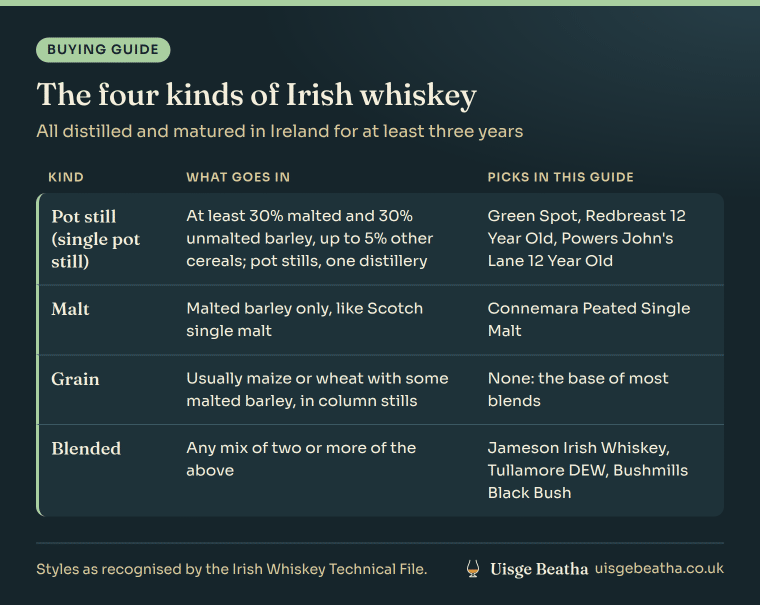
Single pot still whiskey is an Irish style, made at one distillery in pot stills from a mash of at least 30% malted barley and at least 30% unmalted barley, with up to 5% of other cereals such as oats or rye, under the Irish Whiskey Technical File:
- The Unmalted Barley Effect: Usually credited with an oily, creamy texture and a peppery, spicy character.
- The Range: Kept alive through the lean decades at Midleton, single pot still releases like Redbreast 12 and 15 and the Spot Whiskies (Green Spot, Yellow Spot, Red Spot, Blue Spot) became the best-known examples of the style. Midleton Very Rare, often mentioned alongside them, is a blend.
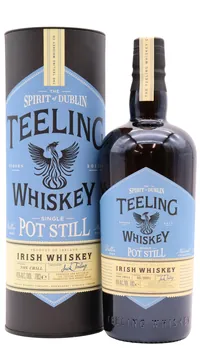
Teeling Single Irish Pot Still Whiskey
46.0% ABV · 70cl
from £39.95 shelf price 4 retailers
£45.90 delivered
Price gap up to £5.05
Compare prices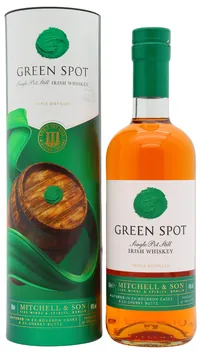
Green Spot Irish Whiskey 70cl
40.0% ABV · 70cl
from £43.90 shelf price 4 retailers
£48.85 delivered
Price gap up to £6.05
Compare prices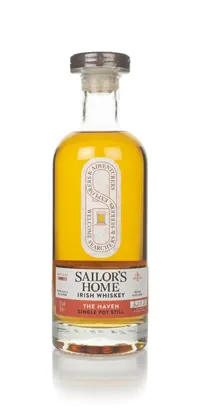
Sailor's Home The Haven Single Pot Still Whiskey
43.0% ABV · 70cl
from £46.50 shelf price 1 retailer
£51.45 delivered
Compare prices4. The 21st-Century Craft Distillery Explosion
What began as a slow revival in the late 1980s accelerated into an unprecedented craft distilling boom after 2012:
Dublin’s Historic Liberties Revived
Dublin was once a centre of world distilling, home to large Victorian distilleries like John Jameson’s Bow Street and George Roe’s Thomas Street. In 2015, Jack and Stephen Teeling (sons of John Teeling) opened the Teeling Whiskey Distillery in Newmarket, in the Liberties, described as the first new distillery in Dublin in about 125 years (Teeling). It was followed by Pearse Lyons Distillery in the restored St James’ Church (2017), the Dublin Liberties Distillery (2019) and Diageo’s Roe & Co.
Regional Terroir and Farm Distilling
- Dingle Distillery (2012): Founded by the late Oliver Hughes and two partners (Dingle) in the town of Dingle, County Kerry, as a small-batch pot still distillery.
- Waterford Distillery (2015): Established by Mark Reynier, who had led the revival of Bruichladdich, in a former Guinness brewery in Waterford, with production built around single-farm-origin barley (The Spirits Business). The company went into receivership in November 2024, and in March 2026 the receivers agreed to sell the distillery and brand to Tennessee Distilling Group, which plans to invest in it (Interpath).
- Tullamore D.E.W. (2014): Built by William Grant & Sons in County Offaly, returning distilling to the historic home of Tullamore for the first time since 1954 (Shelflife).
- Great Northern Distillery (2015): Established in Dundalk by John Teeling to supply bulk grain and pot still spirit to emerging independent bottlers (The Whiskey Wash).
- The Causeway Distillery (2023): Bushmills, owned by Proximo Spirits since 2015 (Drinks International), opened a £37m second distillery beside the old one, doubling production at the site (The Irish News).
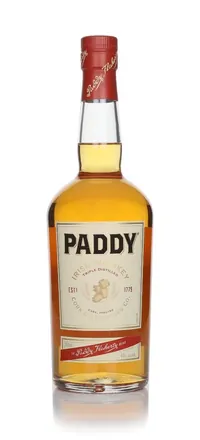
Paddy Blended Irish Whisky 40% 70cl
40.0% ABV · 70cl
from £21.24 shelf price 1 retailer
£26.19 delivered
Compare prices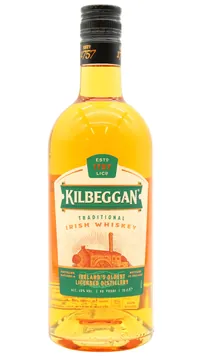
Kilbeggan Traditional
40.0% ABV · 70cl
from £21.50 shelf price 4 retailers
£26.45 delivered
Price gap up to £6.45
Compare prices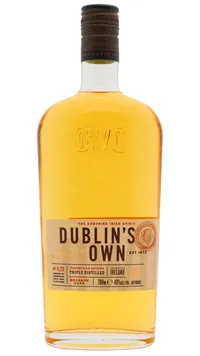
Dublin's Own Irish Blended Whiskey
70cl
from £22.50 shelf price 2 retailers
£27.45 delivered
Price gap up to £7.45
Compare pricesThe Landscape Today
On smaller screens, scroll sideways to see every column.
| Year | Operational distilleries | Global sales |
|---|---|---|
| 1980 | 2 (Midleton and Bushmills) | Not published |
| 2010 | 4 | Just under 5 million cases |
| Now | 50 (Drinks Ireland) | 16.15 million cases (2024) |
Sales are nine-litre cases, as reported by the Irish Whiskey Association.
The growth has slowed: value has not kept pace with volume, US tariffs on EU goods (capped at 15% under a 2025 EU and US deal) hit Irish whiskey from the Republic until the US President said in September 2026 that he would remove them (RTÉ), and Waterford’s receivership showed that not every new distillery survives. But from two distilleries in 1980, the island now makes blends, single pot still, single malt and grain whiskey at around 50 sites. For a starting point, see our Irish whiskey for beginners guide or compare UK prices on Irish whiskey.
Sources and review
About the author
