The 'Water of Life': Whisky's Monastic Origins
Whisky's history from Mediterranean alembics to Celtic monasteries, via the 1405 Annals of Clonmacnoise and the 1494 Exchequer Rolls, and what they say.
Scotch and Irish whiskey are now multibillion-pound industries. Their origins are usually traced to medieval monasteries, where distillation was practised as medicine and alchemy long before it made drinks for sale. No one knows for sure who first distilled grain in Ireland or Scotland; what we have are a few early records, and a good deal of tradition.
The monks’ word for the spirit was aqua vitae, the “water of life”.
From Alchemy to Monastic Medicine
The alembic still was known to Greek alchemists in Roman Egypt, and scholars of the Islamic world, such as those writing under the name Jābir ibn Ḥayyān (Geber) and Abū Bakr al-Rāzī (Rhazes), refined it between the 8th and 10th centuries. The word itself comes from the Arabic al-anbīq. They used it for perfumes, essential oils and medicines.
Through Moorish Spain and the medical school of Salerno in southern Italy, where distilling alcohol from wine is recorded in the 12th century, the knowledge spread into Western Europe and its monasteries:
- In Continental Europe, monks distilled wine into grape brandy and herbal remedies (the forebears of modern eau de vie, Chartreuse, and Benedictine).
- In the British Isles and Ireland, however, vineyards were virtually non-existent. Monks faced prohibitive costs to import Mediterranean wine for distillation.
The usual account is that Irish and Scottish monks turned their stills to what they had: fermented mash brewed from malted barley and oats. Whether they were the first to distil grain is not recorded, and spirits from grain were also made elsewhere in Europe.
The First Documentary Evidence: Ireland 1405 & Scotland 1494
Whisky history has plenty of folklore. Two medieval records are the ones most often cited:
1. Ireland, 1405: The Annals of Clonmacnoise
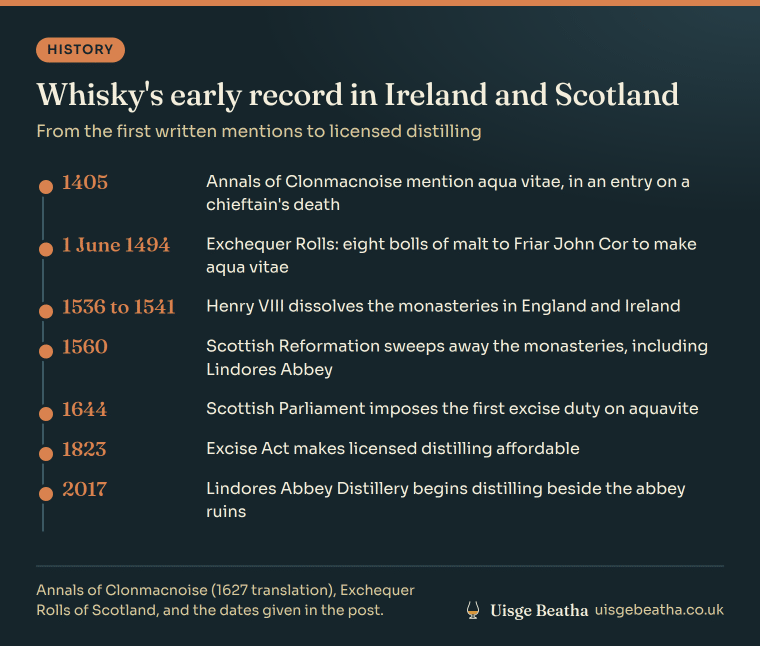
One of the earliest Irish references to aqua vitae as a drink is in the Annals of Clonmacnoise, which survive in an English translation made by Conell Mageoghagan in 1627. The entry for 1405 records the death of a local chieftain:
“Richard Magrannell, Chieftain of Moyntyreolas, died at Christmas by taking a surfeit of aqua vitae.”
The translation adds that it was “to him aqua mortis” (water of death). The entry does not say what the spirit was made from, but it shows aqua vitae was known in Gaelic Ireland by the early 15th century.
2. Scotland, 1494: Friar John Cor and the Exchequer Rolls
Eighty-nine years later, the earliest known Scottish record of making aqua vitae was set down in the Crown’s accounts, the Exchequer Rolls (Rotuli Scaccarii Regum Scotorum).
An entry dated 1 June 1494, in the reign of King James IV, records:
"Et per liberacionem factam fratri Johanni Cor per preceptum compotorum rotulatoris,
ut asserit, de mandato domini regis ad faciendum aquavite infra hoc compotum,
viii bolle brasii."

("And by delivery made to Friar John Cor by order of the comptroller, as he asserts,
by the lord King's command, to make aqua vitae, within this account, eight bolls of malt.")
Friar John Cor is usually identified as a monk of Lindores Abbey, a Tironensian house (a reformed Benedictine order) on the banks of the River Tay at Newburgh in Fife. The roll itself does not name his abbey; Lindores Abbey Distillery points to the abbey’s records, in which a John Cor appears as one of its officers.
A boll was an old Scottish dry measure. Lindores Abbey Distillery estimates that eight bolls of malt would make about 400 bottles of today’s whisky, which suggests the spirit was made for the royal household rather than only for an infirmary.
From Latin to Gaelic: The Etymology of Whisky
The word itself came into English through the Gaelic languages:
Latin: Aqua Vitae ("Water of Life")
  │
  ├──► Classical Gaelic / Old Irish: Uisce Beatha
  │      └── Modern Irish: Uisce Beatha  ──► "Whiskey"
  │
  └──► Scottish Gaelic: Uisge Beatha
         ├── 16th/17th Century Scots: Usquebaugh / Usquabae
         ├── 18th Century Abbreviation: Usky / Uiskie
         └── Modern English: "Whisky"
The word whisky is an English shortening of the Gaelic uisge beatha, keeping only uisge (water); our guide to Gaelic distillery names explores how these roots appear on distillery labels today.
The Reformation and the Spread into the Highlands
Early aqua vitae was often flavoured with herbs and spices, such as thyme, mint and aniseed, partly to cover the taste of rough spirit, and medieval physicians prescribed it as a medicine. That was the belief at the time, not a claim about whisky today.
The 16th century broke up the monasteries:
- In England and Ireland (1536–1541), Henry VIII ordered the Dissolution of the Monasteries.
- In Scotland (1560), the Scottish Reformation led by John Knox swept away monastic establishments, including Lindores Abbey.
The traditional account is that monks turned out of their abbeys took their distilling knowledge with them to farms and estates. Records of the period are thin, but by the 17th century distilling was clearly widespread on Scottish farms, often as a way to use surplus barley.
Taxes, Smugglers, and the Modern Legacy
In 1644 the Scottish Parliament imposed the first excise duty on aquavite. Over the next 180 years, rising duties drove much distilling underground, with illicit stills hidden from the “gaugers” (excise officers), until the Excise Act of 1823 made licensed distilling affordable and the modern industry began.
In 2017, Lindores Abbey Distillery began distilling in Newburgh, Fife, beside the ruins of the abbey linked to Friar John Cor. For how whisky has changed since, see the whisky timeline.
About the author
