The Whisky Nosing and Tasting Guide
A step-by-step guide to nosing and tasting whisky: the glass, colour, nosing technique, adding water, the finish and the main aroma families.

Tasting whisky uses several senses, but the nose does most of the work. The tongue picks up only the basic tastes (sweet, sour, salty, bitter and savoury, or umami), while the nose has around 400 types of smell receptor and can tell apart a very large number of odours. Much of what we call flavour is smell (more in the science of nosing).
Whether it is an everyday blend or a single cask, taking the same steps each time makes it easier to pick out what came from the grain, the fermentation, the still and the cask.
1. Choosing the Right Glassware
The shape of your glass fundamentally dictates how aromas reach your olfactory receptors:
- Tulip-shaped nosing glasses (Glencairn or copita): The tapered neck and narrow rim gather aroma as the spirit evaporates and direct it towards the nose. See the importance of the whisky glass for a comparison of shapes.
- Why tumblers fall short for tasting: Traditional wide-mouthed cut-crystal tumblers allow alcohol fumes to disperse quickly into the room, making it difficult to detect delicate top notes like green apple or citrus blossom.
- Glass care: Always ensure glassware is completely dry and free from dishwasher rinse-aid residue or cupboard odours, which can ruin delicate aromas.
2. Visual Assessment
Begin by holding the glass against a neutral, well-lit white background:
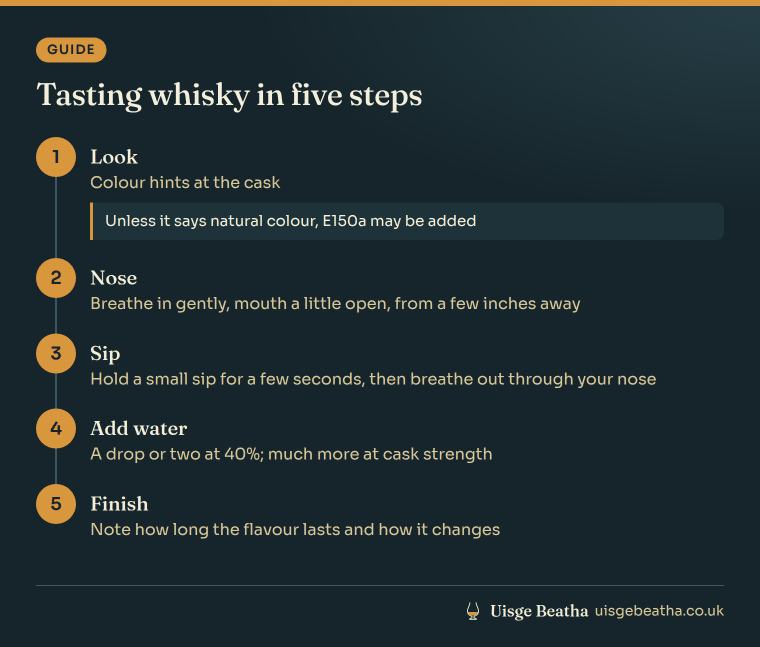
- Colour & Cask: Natural colour gives clues about maturation. Pale straw or lemon gold often points to refill American oak ex-bourbon casks. Deep copper, amber or mahogany suggests European oak sherry casks or new (virgin) oak.
- The Caramel Question (E150a): Plain caramel colouring (E150a) is allowed in Scotch and in many other whiskies, though not in US straight bourbon, and is used mainly to keep batches looking the same. Unless a bottle says “natural colour”, a dark hue is no guarantee of age or sherry casks. See spirit caramel (E150a) in whisky.
- “Legs” or Tears: Swirl gently and watch the droplets run down the glass. Tears form because alcohol evaporates from the thin film on the glass faster than water (the Marangoni effect). They say something about strength, and little about age or quality.
3. The Art of Nosing (Orthonasal Olfaction)
At 40% to 60% ABV, alcohol vapour can easily overwhelm the nose if you sniff too hard.
- Keep Your Mouth Slightly Open: Breathe in gently, with your mouth a little open. Many tasters find this makes the alcohol less sharp.
- Vary the Distance: Start with the rim a few inches away, then bring it closer. Lighter, fruity notes (pear, green apple) often show first at a distance, and heavier smoke and wood notes closer in.
- Left and Right Nostril Checks: Airflow through the nose shifts between the nostrils during the day (the nasal cycle), so some tasters nose with each nostril in turn.
- Nose Fatigue: If everything starts to smell the same, take a break. A common tip is to sniff your own clean skin (the inside of your elbow) rather than coffee beans, which add another strong smell.
4. The Palate (Taste & Retronasal Olfaction)
Take a small sip, just enough to coat the palate, and hold it in your mouth for several seconds before swallowing:
- Initial Mouthfeel (Texture): Is the spirit light and crisp, or oily, waxy and mouth-coating? Whiskies bottled without chill filtration, usually at 46% ABV or more, are often described as fuller in texture (see chill filtration and NCF).
- Taste Balance: Look for the basic tastes on the tongue: sweetness, sourness, saltiness and bitterness (dry wood tannin, for example).
- Retronasal Breathing: After swallowing, breathe out gently through your nose. Air from the back of the mouth carries aroma up to the smell receptors from behind, which often brings out notes you did not catch on the nose.
5. Adding Water: The Science of Dilution
Blenders routinely add water when nosing, and so can you. Use still, room-temperature water:
- Less Alcohol Heat: Water lowers the alcohol concentration, so the alcohol prickles the tongue and nose less.
- More Aroma at the Surface: Computer simulations by Karlsson and Friedman (Scientific Reports, 2017) found that guaiacol, a smoky compound, sits mostly at the surface of the liquid at up to about 45% alcohol, but is drawn into the body of the liquid at 59% and above. Diluting a strong whisky may therefore put more of it where it can reach your nose.
- How Much Water? Add water gradually with a pipette or clean teaspoon. Cask strength whiskies (55% to 60% ABV) can take much more than a 40% bottling, which needs a drop or two at most. Our cask strength guide has a step-by-step method.
6. The Finish
The finish refers to the sensations and flavours that persist after the spirit has been swallowed:
- Duration: Note how long the flavour lasts: a short finish fades in seconds, a long one can last for minutes. Length is something to note, not a measure of quality on its own.
- Evolution: Pay attention to how flavours transform. A finish might begin with rich dark chocolate and toasted oak before drying into lingering sea salt, black pepper, and gentle hearth smoke.
The Primary Aroma Families
On smaller screens, scroll sideways to see every column.
| Aroma Category | Common Descriptors | Key Sources |
|---|---|---|
| Fruity & Estery | Green apple, pear, pineapple, banana, citrus peel | Fermentation length & yeast metabolism |
| Floral & Herbal | Heather, honeysuckle, grass, mint, eucalyptus | Fermentation, distillation & the spirit cut |
| Malty & Cereal | Digestive biscuit, toasted barley, porridge, wort | Malted barley & mashing regime |
| Peaty & Phenolic | Campfire smoke, tar, medicinal TCP, ash, brine | Malt kilned over peat smoke |
| Vanilla & Coconut | Vanilla custard, coconut cream, caramel, fudge | American oak cask lactones & vanillin |
| Sherried & Dried Fruit | Raisin, prune, sultana, dark chocolate, walnut | Ex-Oloroso & Pedro Ximénez sherry casks |
| Spicy & Woody | Clove, cinnamon, nutmeg, ginger, dry oak tannin | Oak tannins and wood compounds, especially European oak |
Explore Whisky by Flavour Profile
To put this into practice, browse by style and compare UK prices:
About the author
