What is the Angels' Share? Whisky Evaporation Explained
How the angels' share works in whisky maturation: evaporative loss, humidity, warehouse microclimates, and why older whisky costs more, cask by cask.
While whisky rests in a wooden cask, a small part of it slowly evaporates through the oak. Distillers call this loss the angels’ share. The name gives a heavenly explanation to a problem that also appears, less poetically, on an inventory sheet.
It is a real cost to the distiller, but it comes with the process that makes whisky mature. The same slow exchange of air and vapour through the staves that lets spirit escape also lets oxygen in, which helps the spirit soften and develop fruity, ester-rich notes over time.
Why does whisky evaporate through wood?
Unlike glass or stainless steel, an oak cask is slightly porous. Coopers build casks from seasoned staves of American white oak (Quercus alba) or European oak (Quercus robur), held together by metal hoops without glue or nails.
Spirit soaks into the staves, and some of it works its way through the wood and evaporates from the outside, while a little air finds its way in. As temperatures change through the seasons, the liquid expands and contracts, which drives more of this exchange.
How much spirit is lost each year?
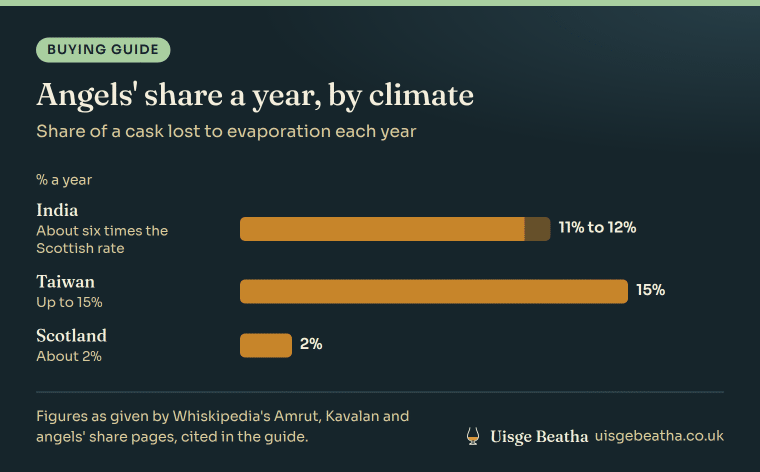
The rate depends mainly on climate (temperature and humidity) and on the warehouse. The angels, it seems, do not take the same share everywhere:
- Scotland: In Scotland’s cool, damp climate, a cask loses about 1% to 2% a year. Ireland’s climate is similar.
- Kentucky and Tennessee: Bourbon warehouses see hot summers and cold winters, and annual losses are commonly cited at around 3% to 5%.
- Hot climates (India and Taiwan): In India, home to distilleries such as Amrut and Paul John, losses are about 11% to 12% a year; at Kavalan in Taiwan they can reach 15%. At those rates a cask can lose close to half its contents in five years, which is why whisky from these places is rarely aged for long.
Does ABV rise or fall during ageing?
Whether a cask’s strength goes up or down depends largely on humidity:
In Scotland, strength slowly falls
Scottish warehouses are cool and humid. With the air around the casks already damp, water evaporates from the cask relatively slowly, and alcohol escapes a little faster than water. Both the volume and the strength fall slowly over the years. Scotch whisky must be bottled at no less than 40% ABV, so a cask that drops below that can no longer be sold as Scotch whisky.
In hot, dry warehouses, strength often rises
Where the air is hot and dry, as on the upper floors of many Kentucky warehouses, water evaporates through the wood faster than alcohol. The volume falls while the strength climbs, sometimes past 65% ABV after several years.
Warehouse styles: dunnage, palletised and racked
How casks are stored changes the conditions around them, and with it the angels’ share:
On smaller screens, scroll sideways to see every column.
| Warehouse style | Construction | Temperature and humidity | Effect on evaporation |
|---|---|---|---|
| Traditional dunnage | Low stone walls, earth floors, slate roofs; casks stacked about three high | Cool, damp, stable all year | Usually slower, steadier loss; strength falls gently |
| Palletised | Modern buildings, casks stood upright on pallets | Fairly even conditions | Consistent maturation from cask to cask |
| Racked / rickhouse | Tall metal or timber racks over several storeys (common in the USA) | Hotter, drier at the top; cooler at the bottom | Large differences between floors; upper floors lose water fastest |
Why older whisky costs more
The angels’ share compounds year after year, which is one reason older whiskies cost more. At 1% to 2% a year, this is roughly how much of a Scottish cask is left:
On smaller screens, scroll sideways to see every column.
| Age | Left in the cask at 2% a year | Left in the cask at 1% a year |
|---|---|---|
| 12 years | about 79% | about 89% |
| 18 years | about 70% | about 83% |
| 25 years | about 60% | about 78% |
| 30 years | about 55% | about 74% |
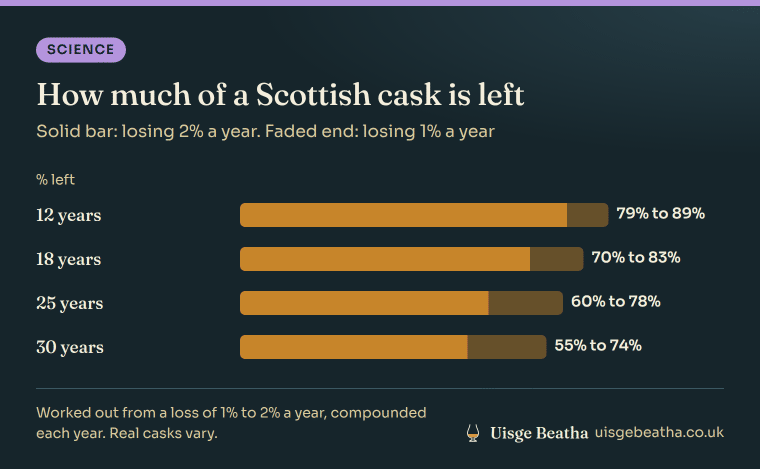
- Less whisky to bottle: After 18 years a cask has lost roughly a sixth to nearly a third of its spirit, and after 30 years between a quarter and almost half.
- Years of storage: The distillery has to store, insure and check the cask for decades before it earns anything.
- Fewer casks make it: Some casks fall below 40% ABV or become over-oaked, and are never bottled as old single malts.
Our guide why old whisky is expensive covers the other reasons, from storage costs to the leaner production years that today’s oldest whiskies come from.
Compare prices by age statement
See how age shows up in prices across our catalogue:
- 10 Year Old Whiskies
- 12 Year Old Whiskies
- 15 Year Old Whiskies
- 18 Year Old Whiskies
- 30 Year Old Whiskies

JP Wiser's Blended Canadian 18 year old Whisky
18 years · 70cl
from £51.95 2 retailers
£56.90 delivered
Save up to £1.00
Compare prices
Auchentoshan 18 Year Old
18 years · 43.0% ABV · 70cl
from £59.95 3 retailers
£65.90 delivered
Save up to £42.05
Compare prices
Jura 18 Year Old
18 years · 44.0% ABV · 70cl
from £60.00 2 retailers
£64.99 delivered
Save up to £16.50
Compare prices
Chivas Regal 18 Year Gold Signature Whisky 70cl
18 years · 40.0% ABV · 70cl
from £67.95 3 retailers
£72.90 delivered
Save up to £3.05
Compare prices
Speyburn Living Souls Scotch Single Malt 18 year old Whisky
18 years · 46.5% ABV · 70cl
from £73.50 2 retailers
£78.45 delivered
Save up to £16.45
Compare prices
Speyburn 18 Year Old
18 years · 40.0% ABV · 70cl
from £74.00 3 retailers
£78.95 delivered
Compare pricesAbout the author
