Whisky Myths Dispelled
Separate fact from folklore: what the evidence says about adding water, ice, age statements, bourbon rules, who can taste whisky, and ageing in the bottle.
Whisky comes with a lot of tradition, and with it a fair amount of folklore, fixed tasting rules and marketing myth. Some of these ideas have been repeated so often that they have acquired the comfortable air of a rule, whether or not anyone can find the rule.
The bottle, meanwhile, continues to contain whisky, apparently indifferent to the argument.
From water and ice to what an age statement actually measures, here are six common whisky myths, checked against the chemistry, the law and the sensory research. There is room for a preference; it need not arrive dressed as a scientific finding.
Myth 1: “Adding water to whisky ruins it”
The reality: A little water changes how a whisky smells and tastes, and there is chemistry to explain why.
In 2017 Björn Karlsson and Ran Friedman, chemists at Linnaeus University in Sweden, published a study in Scientific Reports on guaiacol, one of the compounds behind smoky notes in whisky. Using computer simulations of water and ethanol mixtures, they found that:
- At up to about 45% ethanol, guaiacol tends to sit with the ethanol at the surface of the liquid, where it can reach the air above the glass.
- At about 59% ethanol and above, guaiacol is increasingly surrounded by ethanol and drawn into the body of the liquid.
So diluting a strong whisky moves more guaiacol to the surface, which the authors suggest could make its aroma and taste more noticeable. The study modelled one compound, not a tasting panel, but it fits what many drinkers find.
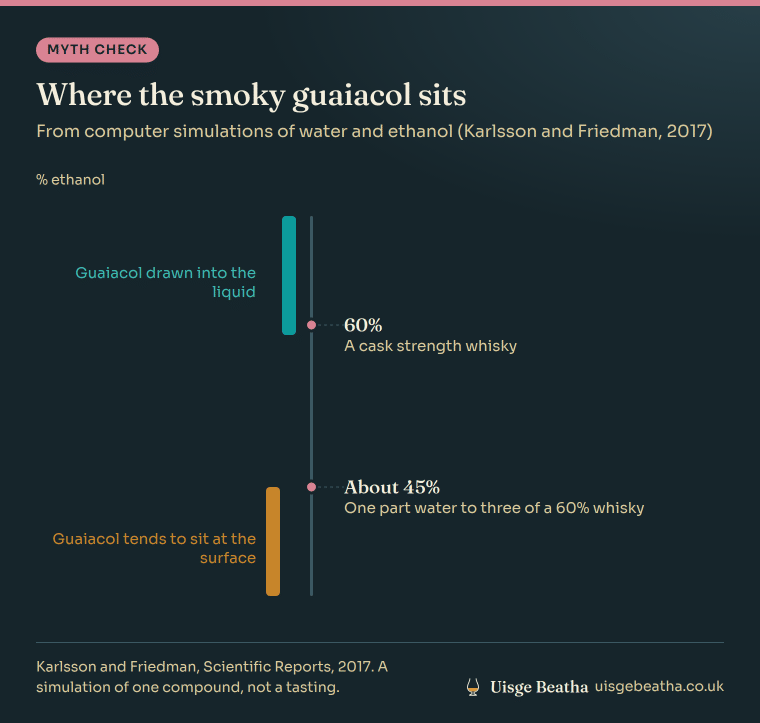
Adding a little water at room temperature also takes the edge off the alcohol on the nose, which can make other aromas easier to pick out. You do not need much: one part water to three parts of a 60% ABV cask strength whisky brings it to about 45%. Add a few drops at a time and taste as you go; our guide to cask strength whisky shows how strength changes with each splash.
Myth 2: “Older whisky is always better whisky”
The reality: The age on a bottle measures time in the cask, not quality.
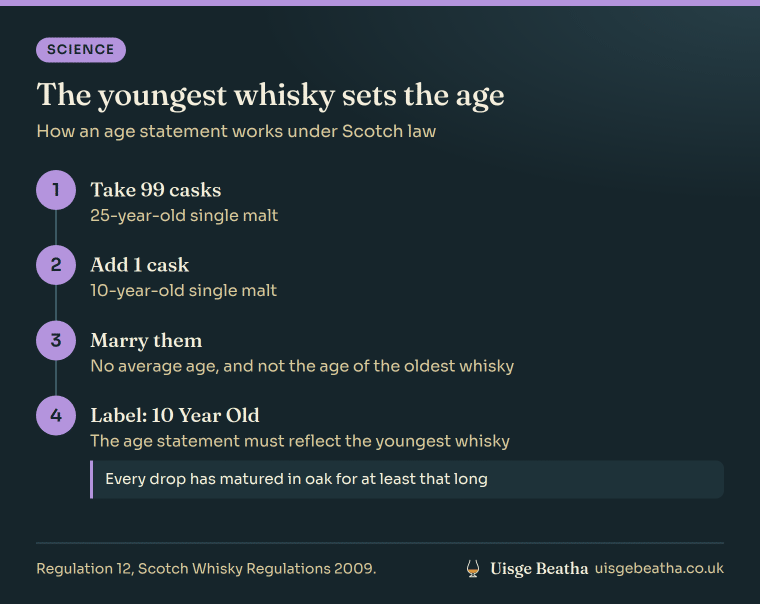
Under the Scotch Whisky Regulations 2009, an age statement gives the age of the youngest whisky in the bottle. Maturation in oak softens new spirit, the charred inside of the cask absorbs harsh sulphur compounds, and the wood adds vanilla, caramel and spice, but the process does not improve a whisky indefinitely:
- Over-oaking: Left too long in an active first-fill cask (especially in a warm climate), a whisky can take on so much tannin that it turns bitter, dry and astringent, and the distillery’s own character is lost.
- A peak, not a straight line: Every cask has a point where it tastes best, depending on its size, its previous contents, its char and the warehouse. A well-balanced 10- or 12-year-old can be more enjoyable than a tired, over-extracted 30-year-old.
Myth 3: “Ice belongs everywhere (or nowhere)”
The reality: Temperature changes what you smell and taste. How you drink your whisky is your choice; the trade-off is simple.
When you add ice:
- Less aroma: Cold whisky gives off fewer aroma compounds, so you smell less.
- Less sweetness: Cold also dulls the tongue’s sense of sweetness and other subtle flavours.
- More water: As the ice melts it dilutes the whisky, and a non-chill filtered whisky may turn hazy.
The verdict: To pick out every aroma in a whisky, try it at room temperature, with or without a few drops of water. For a long, cold drink, a highball or a cocktail, ice does exactly what it should.
Myth 4: “Bourbon is just cheap corn whiskey”
The reality: Bourbon is a tightly defined American whiskey with its own legal standard.
Under US federal regulations (27 CFR 5.143), bourbon whisky must be:
- Made in the United States from a fermented mash of at least 51% corn.
- Distilled to no more than 160 proof (80% ABV), which keeps more of the grain’s character.
- Stored in new charred oak barrels, entering them at no more than 125 proof (62.5% ABV).
- Bottled at no less than 80 proof (40% ABV).
- Free of added colouring or flavouring. Scotch whisky may contain plain caramel colouring (E150a); bourbon may not.
New charred oak gives up its colour, vanillin and other wood compounds quickly, and Kentucky’s hot summers speed up the exchange between spirit and wood, so bourbon tends to pick up oak character faster than Scotch matured in cooler Scottish warehouses.
Myth 5: “Whisky is a man’s drink”
The reality: Women have long worked in whisky, and sensory research gives men no advantage.
Studies of smell identification, including work by Richard Doty’s group at the University of Pennsylvania, have found that women on average score as well as or slightly better than men.
Several of the best-known blenders in Scotch whisky today are women:
- Rachel Barrie: Master Blender for GlenDronach, BenRiach and Glenglassaugh, often described as the first woman to become a master blender in Scotch whisky.
- Stephanie Macleod: Master Blender for Dewar’s, named Master Blender of the Year by the International Whisky Competition six years running to 2024.
- Dr Emma Walker: Master Blender for Johnnie Walker since 2022, the first woman to hold the role.
- Kirsteen Campbell: appointed in 2019 as the Macallan’s first female Master Whisky Maker.
Tasting whisky well depends on attention and practice, not gender.
Myth 6: “Whisky keeps ageing in the bottle”
The reality: Unlike some wines, whisky does not mature in the bottle.
Maturation needs the cask: contact with the wood and slow exchange of air through the staves. Once whisky is bottled and sealed in glass, that stops:
- A 12-year-old single malt bottled in 1980 and opened today is still a 12-year-old whisky.
- Glass does not react with the spirit, and at 40% ABV or more there is no living yeast or other microorganism to keep changing it.
Kept upright (so the strong spirit does not sit against the cork), out of direct sunlight and at a steady temperature, a sealed bottle stays much as it was bottled. An opened bottle with a lot of air in it can change slowly over months or years as aromas fade and oxidise. Our guide to maturation and age statements covers what does change whisky, in the cask.
About the author
