Whisky Nosing Kits, Flavour Wheels and Sensory Training
How to train your nose for whisky tasting: evaluating commercial nosing kits, navigating aroma wheels, and building a sensory vocabulary at home.
Tasting notes such as “stewed damson plums, polished mahogany, sea lavender and crushed allspice” can sound daunting or pretentious to a beginner.
Yet naming aromas is not a gift reserved for master blenders. It is largely a learned skill that links a smell to a word. When people struggle to name what they smell, it is often the “tip-of-the-nose” feeling: the smell is familiar, but the word will not come.
Three aids help: aroma kits, flavour wheels and a kitchen cupboard of everyday smells. Here is how each works. For the tasting method itself, see the whisky nosing and tasting guide.
1. Aroma Kits: Are They Worth It?
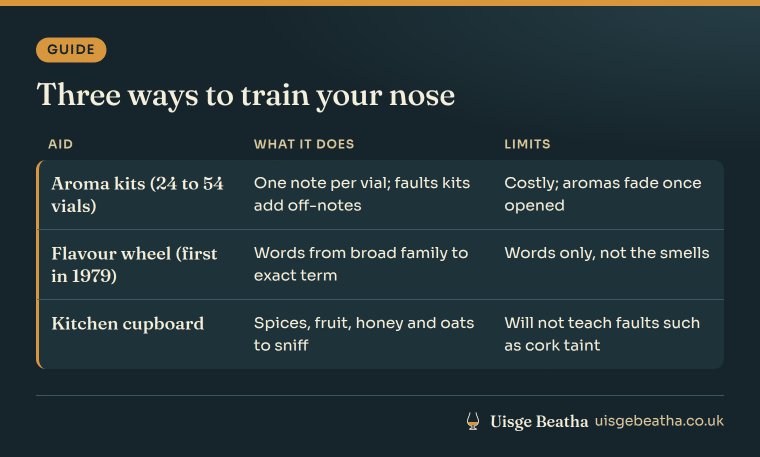
Aroma training sets give you small vials of reference aromas to sniff on their own. Two widely sold whisky sets, as of 2026:
- Aroma Academy Whisky Aroma Kit (Aroma Academy, Scotland): 24 aromas, with a booklet, smelling strips and record sheets. The firm also sells a Faults Aroma Kit of 30 aromas covering common faults in wine, cider, beer and spirits.
- Le Nez du Whisky (Jean Lenoir, France): 54 aromas in floral, fruity, woody, phenolic and other families, with a book by the whisky writer Charles MacLean.
The Advantages
- Calibration: Each vial holds one note on its own, so you learn what a single compound or aroma smells like (isoamyl acetate for banana, for example, or guaiacol for smoke).
- Fault Detection: Faults kits include off-notes such as TCA (cork taint), sulphur (rotten egg) and rancid butter, which helps judges and anyone who tastes a lot to spot a flawed cask or a corked bottle.
The Drawbacks
- Cost: Full kits cost far more than a bottle of everyday whisky, which is a lot for an occasional taster.
- Shelf Life: Aromas fade once opened. Jean Lenoir guarantees the Le Nez du Whisky aromas for five years; keep vials closed, cool and out of the light.
- Missing the Alcohol Matrix: Smelling an isolated aroma droplet on a paper strip is very different from detecting that same compound dissolved in a 46% ABV ethanol-and-water solution.
2. The Whisky Flavour Wheel
The first whisky flavour wheel came from Pentlands Scotch Whisky Research, now the Scotch Whisky Research Institute (SWRI). Sheila Burtles, Jim Swan, George Shortreed and Paul Rickards published it in 1979 in a paper on the flavour terminology of Scotch whisky (SMWS Unfiltered). Flavour wheels arrange descriptors in rings, from broad families in the middle to exact terms at the edge. The diagram below is a simplified example, not the SWRI wheel itself.
                    ┌── Primary Tier (Broad Category)
                    │     ┌── Secondary Tier (Sub-family)
                    │     │     ┌── Tertiary Tier (Exact Descriptor)
                    ▼     ▼     ▼
               [Cereal] ──► Malt ──► Horlicks, Malted Barley, Wort
               [Fruity] ──► Fresh Fruit ──► Green Apple, Pear Drop
               [Floral] ──► Heather ──► Dried Flowers, Honey
               [Peaty]  ──► Medicinal ──► Iodine, Antiseptic, Bandages
               [Woody]  ──► Vanilla ──► Custard, Coconut, Toffee
               [Feinty] ──► Leathery ──► Tobacco Leaf, Old Leather
               [Sulphury]─► Rubbery ──► Struck Match, Spent Fireworks
How to Use the Wheel During a Tasting
When nosing a dram, start from the hub and work outward:
- First, identify the broad family: Is the aroma predominantly Fruity, Peaty, or Woody?
- Move to the second ring: If it is Fruity, is it Fresh Fruit (orchard), Dried Fruit (sherry), or Cooked Fruit (jammy)?
- Reach the outer perimeter: If it is fresh orchard fruit, is it crisp Green Apple, ripe Pear, or White Peach?
Working from broad to narrow makes the choice less overwhelming and helps you settle on a precise word. A wheel gives you the words, not the smells, so it works best alongside a kit or the kitchen cupboard below.
3. The Kitchen Cupboard: Training at Home
You do not need a kit to build a vocabulary. Much of what you need is already in the kitchen, though it will not teach you faults such as cork taint; for those you need a faults kit:
The Spices (Oak Extraction)
Keep whole spices in small, clean glass jars:
- Whole cloves & cinnamon sticks: Clove’s main aroma compound, eugenol, is also found in oak; both spices are common notes in European oak and sherry cask whisky.
- Vanilla pods & toasted coconut flakes: Benchmarks for American white oak lactones and vanillin.
- Freshly cracked black pepper: A note often used for Talisker and other coastal malts.
The Fruits (Fermentation Esters)
- Green apple peel & pear skins: Benchmark light, ester-driven Speyside and Lowland malts.
- Dried raisins, prunes, and dates: Benchmarks for Oloroso and Pedro Ximénez sherry casks.
- Orange peel / marmalade: A citrus note often found in Highland single malts such as Glenmorangie and Oban.
Honey and Malt
- Porridge oats / digestive biscuits: The baseline cereal character of Scottish malted barley.
- Heather honey: A floral, waxy note often used for Dalwhinnie and Highland Park.
Practical Training Exercise: Comparative Flights
One of the quickest ways to improve is comparative tasting.
Rather than nosing one whisky on its own, pour three small measures (about 15ml each) side by side from contrasting styles:
- Glass A (Light & Unpeated): Glenkinchie 12 or Deanston 12
- Glass B (Rich & Sherried): GlenDronach 12 or The Balvenie 12 DoubleWood
- Glass C (Peated & Maritime): Ardbeg 10 or Laphroaig 10
Moving between the glasses makes the cereal, dried fruit and peat smoke stand out in a way they may not in a single glass. To place your three on a map of smoke and cask, see our whisky flavour map.
Explore Benchmark Single Malts by Style
Compare UK prices on single malts by style:

Glen Moray Elgin Classic Single Malt Whisky
40.0% ABV · 70cl
from £23.99 1 retailer
£28.94 delivered
Compare prices
Glenmorangie X
40.0% ABV · 70cl
from £24.95 1 retailer
£29.90 delivered
Compare prices
Loch Lomond Original Single Malt Whisky
40.0% ABV · 70cl
from £24.99 1 retailer
£29.94 delivered
Compare prices
Speyburn 10 Year Old
10 years · 40.0% ABV · 70cl
from £25.00 3 retailers
£29.99 delivered
Save up to £2.88
Compare prices
Glen Moray Sherry Cask Finish - Elgin Classic Single Malt Whisky
40.0% ABV · 70cl
from £25.95 1 retailer
£30.90 delivered
Compare prices
Glen Moray Peated - Elgin Classic Single Malt Whisky
40.0% ABV · 70cl
from £26.04 1 retailer
£30.99 delivered
Compare pricesAbout the author
