Whisky Tasting: The Science of Nosing and Aromas
How smell works with whisky: the two routes aroma takes, where whisky aromas come from, nosing without alcohol sting, and what water does, step by step.

When you taste a single malt or a blend, your nose does much of the work. You will often read that 80% of flavour is smell, but that figure has no solid study behind it: a 2015 review by Charles Spence found the share varies by person and by food, and no single number holds. What is clear is that the tongue registers only the basic tastes (sweet, sour, salty, bitter and umami), while the nose, with around 400 types of smell receptor, can tell apart a very large number of odours. Published estimates run from about 10,000 to over a trillion, and are disputed.
Scotch is bottled at 40% ABV or more, and cask strength releases often at 50% to 60%, so sniffing too hard brings alcohol sting rather than aroma. Knowing how smell works makes it easier to pick out grain, fermentation and oak without that sting.
The Olfactory Mechanism: Orthonasal vs Retronasal
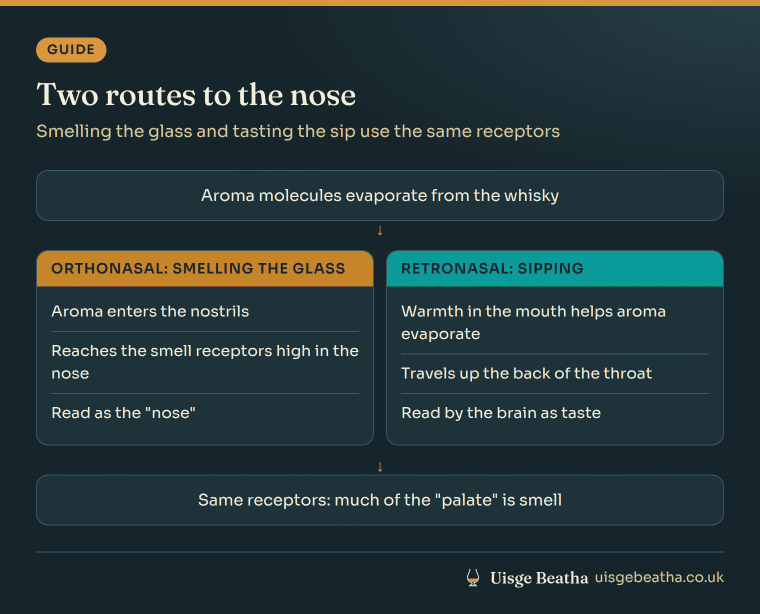
Aroma perception occurs via two distinct anatomical pathways:
- Orthonasal Olfaction (Inhaling Through the Nose): When you smell the glass, aroma molecules evaporate, enter your nostrils and reach the olfactory epithelium, the patch of smell receptors high in the nasal cavity. This is the “nose” in a tasting note.
- Retronasal Olfaction (Exhaling While Tasting): When you sip, warmth in the mouth helps aroma compounds evaporate. As you swallow and breathe out, they travel up the back of the throat (the nasopharynx) and reach the same receptors from behind. The brain reads this as taste, which is why much of the “palate” and “finish” in a tasting note is really smell.
Where Do Whisky Aromas Come From?
A mature single malt contains hundreds of volatile compounds. They come from the grain, the fermentation, the still and the cask; the only additive allowed in Scotch is plain caramel for colour, which is not added for aroma:
On smaller screens, scroll sideways to see every column.
| Compound Family | Typical Aromas | Production Origin |
|---|---|---|
| Esters (e.g., isoamyl acetate, ethyl hexanoate) | Pear drop, green apple, banana, pineapple | Fermentation length & yeast metabolism |
| Aldehydes | Cut grass, fresh green leaves, crisp malt | Fermentation & the distillation cut |
| Phenols & Cresols | Peat smoke, iodine, antiseptic, medicinal TCP | Peat smoke during kilning of the malt |
| Guaiacols | Smoked bacon, sweet wood smoke | Peat smoke & toasted or charred oak |
| Oak Lactones | Coconut cream, fresh sawdust, sweet vanilla | Extraction from American white oak casks |
| Pyrazines | Roasted nuts, toast, cocoa | Kilning & toasted oak |
Step-by-Step: The Professional Nosing Technique
To nose a dram without tiring your nose, try these four steps:
1. Let the Spirit Rest
Alcohol vapour builds up in the space above a freshly poured whisky. Many tasters let the glass sit for a few minutes before nosing, and some find the first sniff after a short rest less sharp.
2. Part Your Lips
Avoid pushing your nose deep into the glass and sniffing hard with your mouth shut. At 40% ABV and above, alcohol vapour stimulates the trigeminal nerve, which is felt as a sting, and the nose tires quickly. Instead, keep your mouth slightly open and breathe in gently. Many tasters find the alcohol much less sharp this way.
3. Move Across the Rim
Some tasters hold the glass at an angle and nose it in layers. This is a tasting habit rather than measured science, but it slows you down:
- Top of the rim: Lighter, fruity notes (apple, lemon, pear).
- Centre of the bowl: Malt, honey and cereal notes.
- Bottom of the rim: Oak, vanilla, wood spice and smoke.
4. Resetting Your Olfactory Baseline
Nose several whiskies in a row and your sense of smell adapts, so later glasses seem fainter. Take short breaks. A common tip is to sniff the clean skin of your inner arm, a smell you are used to, rather than coffee beans, which add another strong aroma; the evidence for either is thin, but a break and fresh air help.
The Science of Adding Water
Adding a few drops of water to your whisky is normal practice, and blenders do it routinely when nosing samples.
Water lowers the alcohol strength, so there is less alcohol sting on the nose and tongue. It also seems to change where some aroma compounds sit. Computer simulations by Karlsson and Friedman (Scientific Reports, 2017) found that guaiacol, a smoky compound, sits mostly at the surface of the liquid at up to about 45% alcohol, where it can evaporate into the glass, but is drawn into the body of the liquid at 59% and above. Other compounds with similar chemistry may behave the same way, though that study looked only at guaiacol.
Blenders commonly cut cask samples to around 20% ABV in the sample room, which removes most of the alcohol prickle. For how much water to add at home, see our cask strength guide.
Explore Single Malts by Style
Compare UK prices on single malts by style:

Glen Moray Elgin Classic Single Malt Whisky
40.0% ABV · 70cl
from £23.99 1 retailer
£28.94 delivered
Compare prices
Glenmorangie X
40.0% ABV · 70cl
from £24.95 1 retailer
£29.90 delivered
Compare prices
Loch Lomond Original Single Malt Whisky
40.0% ABV · 70cl
from £24.99 1 retailer
£29.94 delivered
Compare prices
Speyburn 10 Year Old
10 years · 40.0% ABV · 70cl
from £25.00 3 retailers
£29.99 delivered
Save up to £2.88
Compare prices
Glen Moray Sherry Cask Finish - Elgin Classic Single Malt Whisky
40.0% ABV · 70cl
from £25.95 1 retailer
£30.90 delivered
Compare prices
Glen Moray Peated - Elgin Classic Single Malt Whisky
40.0% ABV · 70cl
from £26.04 1 retailer
£30.99 delivered
Compare pricesAbout the author
