Boutique-y Whisky labels and batches explained
How Boutique-y Whisky numbers its batches, why some labels carry a region and a number instead of a distillery, and what the label art gives away.
That Boutique-y Whisky Company sells most of its whisky in small numbered batches under hand-drawn labels, and the name on the front does not always say which distillery made it. This page explains how the names, the batch numbers and the labels work, using the bottlings the company describes on its own site. For what is in stock and the current prices, see the That Boutique-y Whisky Company bottler page.
How the numbered labels work
Most Boutique-y bottlings name the distillery, such as the Aultmore 13 Year Old Batch 18. The others carry a region and a number instead: Highland #1 and #2, Speyside #1 to #4, Islay #3, Secret Distillery #1. The same name is used again each time the company bottles more whisky from that source, and the batch number says which bottling it is. Two bottles with the same name can be years apart in age and several points apart in strength, so the batch is the part of the label that matters when you compare one with another.
Every label is drawn by hand by the illustrator Emily Chappell. On the company’s page about her, she says she starts with the distillery’s folklore, old labels and packaging, draws in pencil and then ink at three times the printed size, and adds the colour digitally (About the artist). The company says that even its unnamed-distillery labels hold clues (About us).
Why some distilleries cannot be named
An independent bottler buys casks, but the distillery’s owner may still refuse to let its name appear on someone else’s label. On its page for the 50 year old Speyside #1, the company says family-owned distillers can be protective of their names, and lists Laphroaig, Glenmorangie, Glenfiddich, Balvenie and Glenfarclas as distilleries that restrict independent bottlers from using them (producer). Whisky from those distilleries reaches independent labels as a region and a number, or as a teaspooned blended malt.
Teaspooning and the Blended Malt numbers
Teaspooning is how a single malt stops being one. A touch of whisky from a second distillery is added, and the result can only be sold as a blended malt, which keeps the first distillery’s name off the label. The company’s page for Blended Malt #1 says the whisky came almost entirely from one well-loved Speyside distillery before it was spooned, and its label shows a crowd of whisky lovers honouring a spoon. Batch 4 is a 26 year old at 47.3%, 322 bottles (producer).
Blended Malt #6 Batch 1, a 24 year old at 48.8% with 695 bottles, was made the same way with a teaspoon from a distillery the company will not name. Its label is a decoy by the company’s own account: a high street in “Souptown” with Glen Coacher Taxis, Highlander Blooms Florist and two American bombers coming in to land on a runway through the town (producer). The Blended Malt #3 21 Year Old Batch 3 is another of the numbered blended malts.
The Blended Whisky numbers are a different thing again: blends of malt and grain whisky. Blended Whisky #2 Batch 3 is a 22 year old at 41.8%, released in May 2018 with 1,650 bottles, and its label shows a disembodied glove meeting a giant soft planetoid (producer).
Reading the unnamed labels
The company has not named the distilleries behind the bottlings below on any label. Where a retailer or reviewer has, this page says who, and for which batch.
Highland #2
Highland #2 Batch 2 is a 19 year old from a single hogshead laid down in August 2000, bottled at 48.1% for the company’s Cinema Series. Its label is a version of the Highlander film poster, cast with the cats from the company’s Clynelish label and with a barbarian standing for the first Duke of Sutherland (producer). Clynelish was founded by the Marquess of Stafford, who became the first Duke. Kensington Wine Market in Calgary, which had the first Highland #2 bottled for its shop, sells Batch 2 as an undeclared Clynelish and a sister cask to a Boutique-y Clynelish 20 year old bottled for the shop (Kensington Wine Market).
Speyside #4
The company’s description of Speyside #4 as a 26 year old at 45.8% calls it “this Glenl—” before correcting itself to an unnamed Speyside distillery, one of the two largest malt distilleries in the world. The cask was laid down in October 1998. For this bottling the company dropped its usual Speyside #4 label and used its label for the named distillery instead, to give, in its words, a few more clues (producer). The company’s Return to Oz announcement also lists a Speyside #4 Batch 1, a 24 year old at 47.8% with 3,589 bottles (producer). Kensington Wine Market has its own 24 year old Speyside #4 cask at 47.8%, 220 bottles, and says it is Glenlivet (Kensington Wine Market).
Speyside #1 and Speyside #2
Both carry a “Doge” label, the internet meme of a dog with broken-English captions. Speyside #1 Batch 5 is a 50 year old from a refill butt, bottled at 52.5% for the company’s 10th birthday, with the Doge theme redrawn by Emily Chappell. The company’s description slips into “This Glenfarcla…” before calling it an unnamed Speysider (producer). Speyside #2 Batch 1 is a 25 year old at 51.6%, 2,145 bottles, which the company classes as top secret, with “Wow! What is?” on the label (producer).
Speyside #3
The Speyside #3 label shows several ghosts sharing a dram. The Scotch Noob, reviewing Batch 1, an 8 year old at 50.7%, reads it as Glenrothes, which keeps a tradition of a toast to its distillery ghost (The Scotch Noob). The Whisky Lady, another reviewer, lists Batch 2, a 6 year old at 49.3%, as Glenrothes too (The Whisky Lady).
Secret Distillery #1
The company describes Secret Distillery #1 as coming from a distillery known for well-sherried whisky. Batch 2 is a 9 year old at 51.7%, 1,220 bottles (producer). OCD Whisky, reviewing the 28 year old Batch 7, says it is the secret that Glenfarclas does not want known (OCD Whisky).
Islay #3
Islay #3 is a heavily peated whisky from a famous Islay distillery. Batch 1 was a 7 year old at 49.2%, 830 bottles, released in August 2018 (producer). Batch 5 is a 13 year old with Oloroso cask maturation, 255 bottles at 47.8%. Its page notes the old belief that an unnamed Islay malt is always Caol Ila, and says the label is rather like both the company’s Laphroaig label and its Williamson label (producer). Williamson is the name independent bottlers use for teaspooned Laphroaig, but no published source names the distillery behind Islay #3. Batch 6 is a 29 year old distilled in 1993 (513 bottles, 52.1%) and Batch 7 a 13 year old distilled in 2009 (572 bottles, 58.1%), both partly finished in Oloroso octaves (producer). There is a page here for the Islay #3 13 Year Old Batch 5.
Highland #1
Highland #1 Batch 1 is a 42 year old distilled in 1977, bottled at 43.5% with 473 bottles, from what the company calls an undisclosed Highland distillery (producer). Nobody has published a reading of this one.
For undisclosed and teaspooned names used by other bottlers, such as Williamson and Burnside, see our guide to independent bottlers.
The series
Some batches come out together as a themed release, each with its own set of labels.
The Cinema Series, filed on the company’s site as TBWC At The Movies, redraws film posters. Highland #2 Batch 2 is its Highlander. The Aultmore label is based on Fight Club, with a “Bath Night” theme because, the company says, the whisky tasted soapy when the team first tried it; it was re-racked into a first-fill bourbon cask in 2019 (producer).
Alongside its Boutique-y Records releases, the company put out a Scotch Collection of six bottlings, among them Highland #1 Batch 1, a Cambus single grain 25 year old from a sherry butt laid down in May 1993 (414 bottles, 50.1%) and a Jura 20 year old from a single hogshead (180 bottles, 48.8%) (producer).
World of Smoke gathered nine smoky Scotch whiskies, including Islay #3 Batches 6 and 7, a Caol Ila 14 year old re-racked into first-fill Oloroso octaves (525 bottles, 54.9%) and an Ardmore 19 year old finished in a first-fill PX sherry cask (174 bottles, 50.2%) (producer).
The 10th Birthday release included the 50 year old Speyside #1 Batch 5.
Return to Oz, announced in January 2023, was a second round of Australian whisky; Overeem and Riverbourne were back from the company’s first Australian releases. Chief’s Son Batch 1 is a 5 year old at 52.1% from an ex-Apera (Australian sherry-style) cask, 462 bottles. Corowa Batch 1 is a 4 year old at 48.5% from an ex-Tawny (Australian port-style) cask, 592 bottles. Overeem Batch 3 is a 5 year old at 50% from an ex-Apera cask, 522 bottles. Riverbourne Batch 2 is a 2 year old at 51% from a 100 litre cask made from American and French oak, 260 bottles. Tria Prima Batch 1, the first independent bottling from that distillery, is a 2 year old at 51.2% from a first-fill Grant Burge Tawny cask, 232 bottles (producer). From the earlier Australia Series there are pages here for the Bakery Hill 5 Year Old, the Belgrove 4 Year Old Rye and the Tin Shed 3 Year Old.
Bottles on this page
The bottles discussed above that we have a page for, with prices from the UK retailers we check.
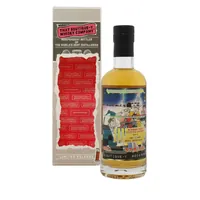
Islay #3 13 Year Old Batch 5 That Boutique-y Whisky Company
13 years · 47.8% ABV · 70cl
from £124.00 shelf price 2 retailers
£124.00 delivered
Compare prices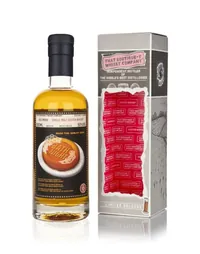
That Boutique-y Whisky Company Aultmore 13 Year Old Batch 18 50cl
13 years · 50.0% ABV · 50cl
from £74.95 shelf price 1 retailer
£79.90 delivered
Compare prices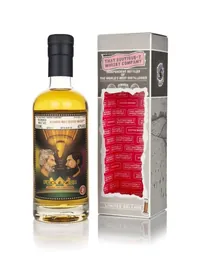
That Boutique-y Whisky Company Blended Malt #3 21 Year Old Batch 3 50cl
21 years · 47.0% ABV · 50cl
from £124.95 shelf price 1 retailer
£124.95 delivered
Compare prices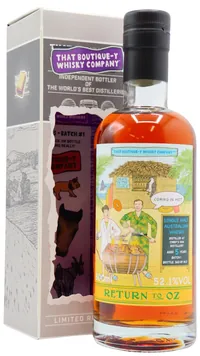
Chief’s Son That Boutique-y Whisky Company Batch #1 5 Year Old Whisky 50cl
5 years · 50cl
from £123.95 shelf price 2 retailers
£123.95 delivered
Price gap up to £16.00
Compare prices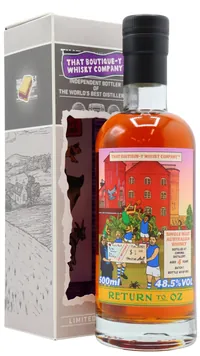
Corowa That Boutique-y Whisky Company Batch #1 4 Year Old Whisky 50cl
4 years · 50cl
from £99.95 shelf price 2 retailers
£105.90 delivered
Price gap up to £10.00
Compare prices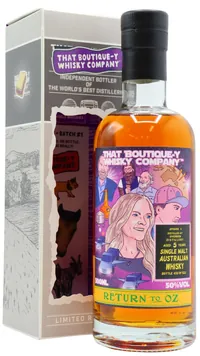
Overeem 5 Year Old - Batch 3 (That Boutique-y Whisky Company) Single Malt Whisky 50cl
5 years · 50cl
from £149.95 shelf price 2 retailers
£149.95 delivered
Price gap up to £12.00
Compare prices
Tria Prima 2 Year Old Batch 1 That Boutique-y Malt Company Return To Oz 50cl
2 years · 51.2% ABV · 50cl
from £100.00 shelf price 2 retailers
£100.00 delivered
Compare prices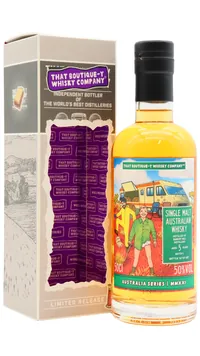
Bakery Hill 5 Year Old Australia Series That Boutique-y Whisky Company Limited Edition 50cl
5 years · 50.0% ABV · 50cl
from £89.95 shelf price 4 retailers
£95.90 delivered
Price gap up to £49.00
Compare pricesQuestions
Do Boutique-y labels give away an unnamed distillery?
Why does the Boutique-y Aultmore label show a shark and a velociraptor?
What does the batch number on a Boutique-y bottle mean?
What is teaspooned whisky in a Boutique-y Blended Malt?
About the author
