English whisky distilleries
English whisky distilleries, from The English Whisky Co in Norfolk to Bimber in London, with the new GI rules.
English whisky is the youngest of the great whisky categories. England distilled whisky into the 19th century, but when London’s Lea Valley distillery fell silent in the early 1900s the craft died out for almost a century. The revival began in Cornwall in 2003 and Norfolk in 2006, and by April 2026 the drinks press counted 70 registered English whisky distilleries. Our English whisky country page compares the bottles; this page maps and explains the distilleries behind them.
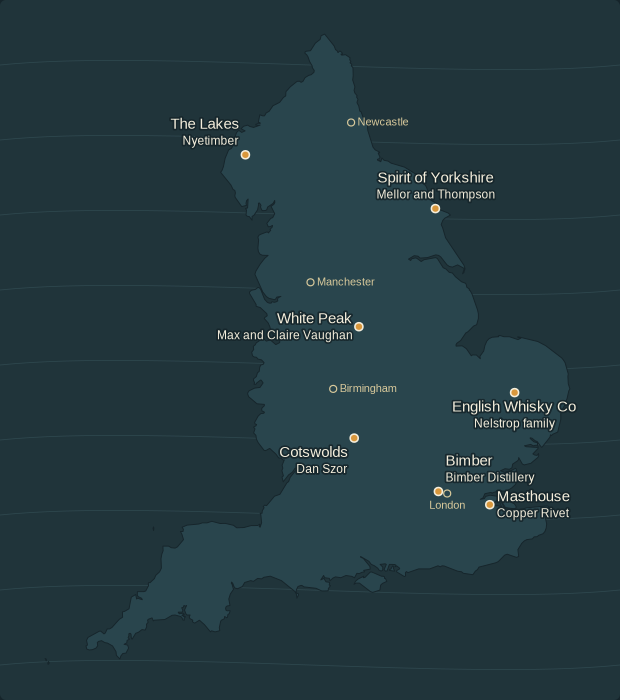
The map is schematic and marks the eight distilleries in England covered here. Henstone now distils just over the border in Powys in Wales, and the revived London Distillery Company has not published its current still site, so neither is marked. The markers are approximate and the boundaries shown are not authoritative.
A young category shaped by one adviser
Most English distilleries share a common inheritance: the late Dr Jim Swan, the whisky scientist who advised many of the new wave before his death in 2017. His STR cask treatment, shaving, toasting and re-charring wine barrels, underpins the fruity, cask-forward style of Filey Bay, White Peak and others, and it is one reason English single malts often taste older than their years. The other shared trait is provenance: nearly every distillery works with barley grown within sight of the stills, in Norfolk, Yorkshire, the Cotswolds, Kent or Derbyshire.
The legal definition
The rules are now written down. English Whisky has been a UK geographical indication since 1 October 2026: the spirit must be mashed, fermented, distilled and matured in England for at least three years in casks of no more than 700 litres. The Scotch Whisky Association appealed on 8 October 2026, and on 12 November 2026 the UK register still listed the name as registered. The background is in our guide to whisky legal definitions.
The distilleries
The English Whisky Co, Roudham, Norfolk
The English Whisky Co distils at St George’s Distillery at Roudham, near East Harling on the edge of the Breckland. Farmer James Nelstrop and his son Andrew founded it in 2006, and the BBC reported its first bottling in December 2009 as the first English single malt in about a century. The distillery draws water from the Breckland aquifer beneath the site and malts barley grown on the family farms. James Nelstrop died in 2014 and Andrew Nelstrop now runs the company; its whisky appears under The English branding, with chapter-numbered releases alongside the core range. In 2025 the distillery released Cask 001, an 18-year-old from the first cask filled in 2006, described by the producer as the oldest English whisky ever bottled.
Cotswolds, Stourton, Warwickshire
Cotswolds was founded in 2014 by Dan Szor, a New Yorker who moved from a London finance career to a barley-growing corner of the Cotswolds. The distillery stands at Stourton, near Shipston-on-Stour, on the edge of the Cotswolds Area of Outstanding Natural Beauty, and its first whisky followed in 2017. It is the biggest English whisky distillery by production: the company and its lender Santander put its annual output at around half a million litres in 2025.
The Lakes, Setmurthy, Cumbria
The Lakes stands in a converted Victorian farmstead at Setmurthy on the shore of Bassenthwaite Lake in the north west of the national park. Paul Currie, a co-founder of the Arran distillery, opened it with partners on 15 December 2014. Its first whisky was The One, a blend built on sourced malt and grain, and the first single malt distilled on site followed in 2018; the flagship Whiskymaker’s Reserve series began in 2019. Nyetimber, the English sparkling wine producer, bought the business in June 2024, and although the visitor centre closed in April 2026, the company says production continues unchanged, led by whisky maker Brendan McCarron.
Spirit of Yorkshire, Hunmanby
Spirit of Yorkshire distils Filey Bay single malt at Hunmanby Grange, a farm between the Yorkshire Wolds and the resort of Filey, in a stillhouse a short walk from the Wold Top brewery that David Thompson’s family runs. Thompson and the farmer Tom Mellor founded the distillery in 2016 with advice from Jim Swan, and its barley is grown on the farm. Trade press billed the first Filey Bay release in 2019 as Yorkshire’s first single malt whisky.
White Peak, Ambergate, Derbyshire
White Peak was founded by Max and Claire Vaughan in 2016 in a former wire and cable works at Ambergate, on the banks of the River Derwent in the Derwent Valley Mills World Heritage Site. Local press covered the planning application as Derbyshire’s first whisky distillery. The first spirit was casked in the spring of 2018 and the Wire Works single malt went on sale from 2021. The distillery also makes Shining Cliff gin and a rum, and it works with live brewer’s yeast from the nearby Thornbridge brewery.
Bimber, Park Royal, London
Bimber distils on the Sunbeam Road industrial estate in Park Royal, west London, near North Acton. Dariusz Plazewski and Ewelina Chruszczyk founded it in August 2015; the name is Polish for moonshine, a nod to the founders’ family stills. The first single malt, The First, sold out its 1,000 bottles within hours of its September 2019 release.
Masthouse, Chatham, Kent
Masthouse is the whisky of the Copper Rivet Distillery in Pumphouse No. 5, a Grade II listed Victorian pumphouse at Chatham Historic Dockyard on the River Medway. Bob Russell and his sons Matthew and Stephen set up the distillery and began distilling in August 2016, with barley grown in Kent, including the Belgravia variety from the Isle of Sheppey. The first Masthouse single malt launched in November 2020, and the range now runs from a pot-and-column malt to the core single malt.
Henstone, near Oswestry and Welshpool
Henstone was established in 2017 by Chris and Alexandra Toller at the Stonehouse brewery just outside Oswestry in Shropshire, a few miles east of the Welsh border; the Parrs, who ran the brewery, were co-founders. Its first whisky, an ex-bourbon single cask of 400 bottles, went on sale in January 2021. In 2023 Mike Harris acquired half the company and funded a move to Dingle Farm near Trewern, Welshpool; that farm sits just inside Powys in Wales, which is why Henstone falls off the England map, though it remains listed as a member of the English Whisky Guild.
Oxford Artisan, Headington, Oxford
The Oxford Artisan Distillery distilled from 2017 at the old city council depot on Cheney Lane in Headington, next to South Park, using grain from four organic farms around Oxford. Tom Nicolson and Tagore Ramoutar founded the company; Diageo took a minority stake through its Distill Ventures fund in 2022 and Nicolson left. In 2024 the business was renamed Fielden, ceased distilling in Oxford and announced a move to a larger site in Yorkshire, and the brand was then sold to the agency GHF, which relaunched it. Trade press has since reported plans for new owners to restart distilling at the Oxford site by 2027. Bottles distilled in Oxford still circulate, so the era on the label is worth a glance.
The London Distillery Company, a history
The London Distillery Company has no page on this site, but it belongs in the story. Registered in 2011 by Darren Rook and Nick Taylor, it was London’s first new whisky distillery in over a century, first in a former dairy cold room by Ransomes Dock in Battersea and from 2015 in a Bermondsey railway arch, and it also made Dodd’s gin and Kew Organic Gin under licence from the Royal Botanic Gardens. The company went into administration in January 2020 and its gin brands passed to the British Honey Company. New owners, Gleann Mór Spirits, revived the company in January 2025 and released Renascence, a single malt from spirit distilled between 2011 and 2020, followed by a 10-year-old in 2026. The company has not published the site of its current stills, so it is not marked on the map.
Buying English whisky in the UK
- Read the style words on the label: “single malt” means malted barley from one distillery, “single grain” covers whiskies from other grains, and some English bottles, such as The Lakes’ The One, are blends of English malt and grain whiskies.
- Do not be put off by the lack of an age statement: the category is young, and the cask regime does more of the talking. Age statements are appearing as the first casks mature.
- Check where the whisky was actually distilled. Oxford Artisan bottles predate the move to Yorkshire, and Henstone’s releases so far were distilled in Shropshire, before the move to Powys.
- Compare delivered price rather than shelf price: most English single malts are stocked by relatively few UK shops, so delivery can outweigh a small shelf saving.
- Confirm the individual bottle on our price pages for current offers, and use the distillery links above for each producer’s range.
Sources and review
Reviewed 23 November 2026 against current producer and press sources: Wikipedia’s list of whisky distilleries in England, The English Distillery (Wikipedia), Master of Malt on The English Distillery, Forbes on the Cask 001 release, The Spirits Business on The Lakes under Nyetimber ownership, The Spirits Business on Filey Bay’s first release, The Whiskey Wash on Spirit of Yorkshire, Whiskipedia on White Peak, The Spirits Business on Bimber’s first whisky, The Spirits Business on Copper Rivet’s first whisky, Whisky Magazine on Copper Rivet’s Masthouse launch, Henstone’s producer site, Just Drinks on Henstone’s sale and relocation, Whisky Magazine on Henstone’s first whisky, The Oxford Artisan Distillery (Wikipedia), The Spirits Business on Fielden’s sale to GHF, Harpers on the battle to preserve the Oxford site, ProBrewer on plans to restart the Oxford distillery, The London Distillery Company (Wikipedia), The Grocer on the 2020 administration and British Honey rescue, The Whiskey Wash on the revived company’s 10-year-old, the UK register entry for English Whisky and OpenStreetMap, used for the marker coordinates at Roudham, Stourton, Setmurthy, Hunmanby, Ambergate, Park Royal and Chatham. Distillery dates, production details and ownership can change, so this page will be reviewed when the English producer directory is expanded.