Indian whisky distilleries
The Amrut, Paul John, Rampur and Indri distilleries behind India's single malts, how hot-climate maturation works, and what UK buyers should check.
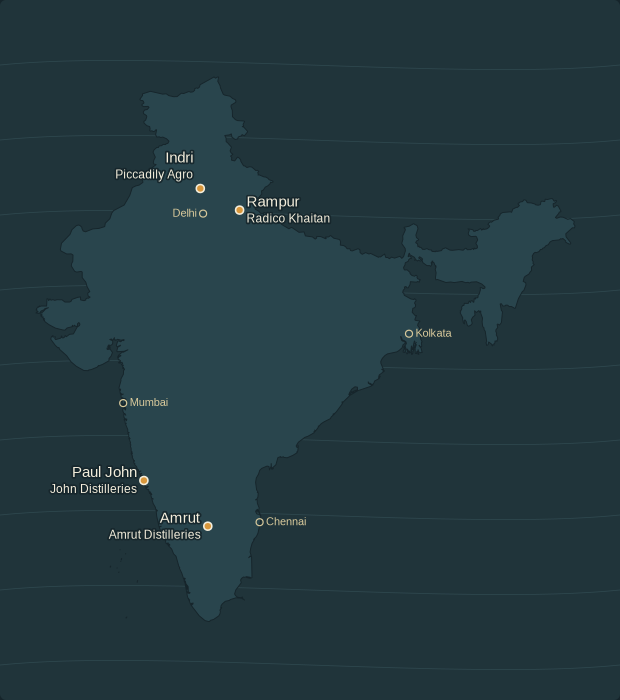
Indian single malt is a young category with a clear cast of producers. Four distilleries make almost all of the Indian single malts sold by UK shops: Amrut near Bengaluru, Paul John in Goa, Rampur in Uttar Pradesh and Indri in Haryana. They differ in climate, barley and cask policy, and those differences show up in the glass.
The map is schematic and marks the four distilleries covered here. The markers are approximate and the boundaries shown are not authoritative.
Why Indian single malt developed
India drinks more whisky than any other country, but for most of its history that whisky was not malt whisky. Under India’s fragmented, state-controlled rules, most domestic “whisky” is IMFL, Indian-made foreign liquor, made from cheap neutral spirit derived from molasses with no minimum age requirement. A little grain or malt whisky is often added for flavour, and the result can legally be called whisky in India. Molasses was plentiful because of the country’s long sugar industry, and historical grain shortages pushed producers towards it.
Malt whisky as a UK or EU buyer understands it is a different drink: a mash of malted barley, distilled and matured in oak casks for at least three years. That gap between the domestic spirit and the international definition is exactly where India’s single malt producers work. Amrut began experimenting with barley whisky in the early 1980s when almost every Indian distiller was using molasses, and its single malt debuted in Glasgow in 2004.
The other force is climate. Bengaluru, Goa and the northern plains are hot for much of the year, and the heat drives whisky in and out of the cask wood far faster than a Scottish winter does. Maturation is quicker, but the angel’s share, the fraction lost to evaporation each year, runs at roughly 10 to 13 per cent in India against about 2 per cent in Scotland. Producers plan around it: casks are filled with ageing curves in mind, and long age statements are rare because little spirit would survive them.
Amrut, Bengaluru
Amrut is made by Amrut Distilleries, the family company founded by J.N. Radhakrishna Rao Jagdale as Amrut Laboratories in 1947 and incorporated as a distillery in 1948, the year after independence. The current main distillery was built in 1987 at Kambipura on Mysore Road, about 20 kilometres from central Bengaluru.
The company spent its first decades making brandy, rum and blended whisky, including supplies for the armed forces canteen service. It began working with barley in the early 1980s, a deliberate break from the molasses norm, and launched a blended malt in 1986. The first single malt was readied soon after but went into blends, because India in the 1980s had no single malt market. Only when the family looked abroad did the whisky stand alone: Amrut Single Malt debuted in Glasgow on 24 August 2004, chosen as the hardest possible testing ground. The whisky that made the brand famous, Amrut Fusion, mixes unpeated Indian barley spirit with peated barley spirit from Scotland, and in 2010 it was named the third best whisky in the world in Jim Murray’s Whisky Bible.
Bengaluru’s altitude and warmth shape the spirit. Amrut’s master blender Surinder Kumar has estimated that one year of barrel ageing in India equals about three in Scotland, and the distillery’s annual angel’s share runs at 11 to 12 per cent, which is why the oldest Amrut releases are special editions rather than standard stock. The barley is grown in Punjab and Rajasthan and trucked roughly 2,500 kilometres to the distillery.
Paul John, Goa
Paul John is the single malt of John Distilleries, founded by Paul P. John in 1992 and built on Original Choice, a blended whisky that became one of India’s biggest brands. The company decided in 2008 to enter the premium end and began distilling single malt at its Goa distillery in the Cuncolim Industrial Estate in Salcete, South Goa, where a visitor centre now runs tours and tastings.
The first bottling, Single Cask 161, launched in London on 4 October 2012, and the founding range of Brilliance, Edited and Bold followed in May 2013, running from unpeated to peated. The distillery runs two sets of copper pot stills, one for wash and one for spirit, producing around 6,000 litres a day. Maturation happens in a climate-controlled underground cellar of around 10,000 barrels as well as on-ground warehouses.
Goa’s coastal heat is central to the style. Summers sit around 33 degrees and the angel’s share is reported at 8 to 10 per cent a year, with The Whisky Exchange putting it as high as 12 to 13 per cent, against about 2 per cent in Scotland. The malt is Indian six-row barley, a huskier, lower-yielding grain than Scottish two-row, and the peated variants use imported Islay and Aberdeen peat.
Rampur, Uttar Pradesh
Rampur is made at the Rampur Distillery, established in 1943 in the city of Rampur on the plains of western Uttar Pradesh, and bought by the Khaitan family in 1972, the core of what is now Radico Khaitan, one of the country’s largest spirits groups. Radico stepped into premium whisky only in 2016, when it launched Rampur Indian Single Malt, and the producer describes its malt spirit as distilled in traditional copper pot stills.
The distillery’s position gives it the most dramatic seasons of the four: hot summers, cold winters and a wide annual swing in temperature, which the producer credits with driving whisky deeply into the wood. The core Rampur Select is matured in American oak, the Double Cask adds a sherry finish to bourbon-barrel maturation, and Rampur Asava is finished in Indian Cabernet Sauvignon casks, a first for the producer. Because the distillery made blending spirit for decades before the single malt arrived, its oldest casks of dedicated malt whisky are younger than the company behind them.
Indri, Haryana
Indri is the youngest of the four and the fastest to make its name. The distillery belongs to Piccadily Agro Industries, a northern group whose roots go back to a 1953 liquor distribution business; a sugar mill and distillery were established at Indri, a village in Karnal district, Haryana, in 1994, and the site opened a dedicated malt distillery in 2011, with the first single malt spirit laid down in 2012. The site also holds a cooperage and a bottling plant, and Wikipedia lists its malt production capacity at 30 kilolitres a day.
Indri Trini, released in 2021 and named for the three woods it matures in, was billed as India’s first triple-cask single malt: ex-bourbon, ex-French red wine and Pedro Ximenez sherry casks. The Diwali Collector’s Edition releases that followed have kept the brand in the awards lists.
Indri sits in Karnal district on the plains of Haryana, in the Yamuna catchment, a drier and more seasonal setting than Goa or Bengaluru, with hot summers, cold winters and monsoon humidity; the producer reports an angel’s share of 10 to 12 per cent. The spirit starts with Indian six-row barley, and the stills are designed for a light, floral, fruity new make that the heavy cask regime then colours.
Buying Indian single malt in the UK
- Check the label says single malt. Indian blends and IMFL bottles can sit near the single malts in search results, and they are a different category of drink.
- Treat age statements with local knowledge: with a double-digit angel’s share, a five-year-old Indian malt has done the maturation work of a far older Scotch, which is why most bottles carry no age at all.
- Compare delivered price rather than shelf price. These bottles are stocked by relatively few UK shops, so delivery can outweigh a small shelf saving.
- Read the producer’s cask description before choosing. The four houses lean on very different cask policies, from Amrut’s mixed-oak and Intermediate Sherry releases to Indri’s triple cask and Rampur’s wine finishes, and the cask is the biggest style clue on the label.
- Confirm the individual bottle on our price pages for current offers, and use the distillery links above for each producer’s range.
Sources and review
Reviewed 23 November 2026 against current producer and press sources: Amrut Distilleries (Wikipedia), Amrut Distilleries, Paul John (Wikipedia), John Distilleries (Wikipedia), Paul John’s distillery tour and visitor centre address, John Distilleries’ Paul John and Rampur timeline, Radico Khaitan, Whisky Advocate on India’s single malt distilleries, Indri’s producer site, Indri (Wikipedia), Whiskipedia on Indian whisky and OpenStreetMap, used for the marker coordinates at Kambipura, Cuncolim, Rampur and Indri. Distillery dates, production details and ownership can change, so this page will be reviewed when the Indian producer directory is expanded.