Irish whiskey distilleries
The Irish distilleries behind Jameson, Redbreast and Bushmills, the single pot still style, and how the category fell to two distilleries before reviving.
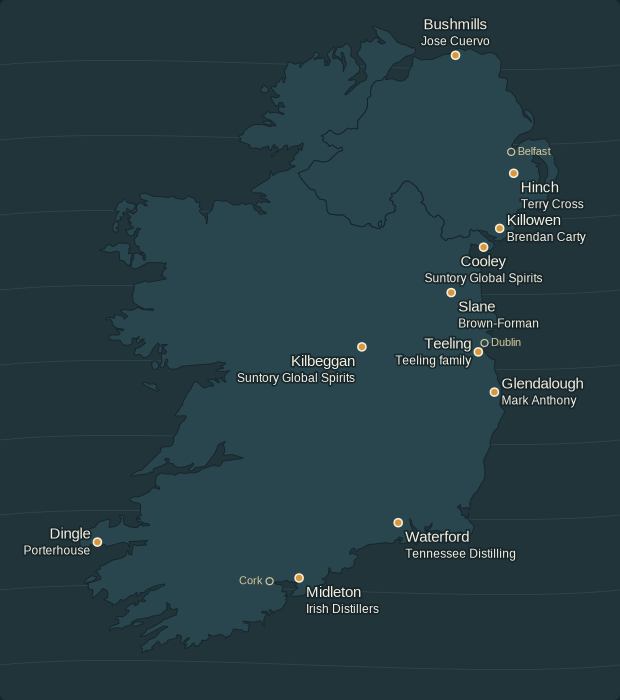
Irish whiskey is an all-island category, made in both the Republic of Ireland and Northern Ireland under one legal definition. The eleven distilleries covered here span that island: the two that carried the category through its 20th-century collapse, and the craft wave that restored it. They make blends, single malts, single grains and the distinctly Irish single pot still style.
The map is schematic and marks the eleven distilleries covered here. The markers are approximate and the boundaries shown are not authoritative.
The single pot still style
Single pot still is Ireland’s own contribution to whisky style. The mash mixes malted barley with a large share of unmalted barley, and the spirit is distilled in a pot still. The unmalted share is a tax story: in the 19th century, malted grain attracted a heavy duty, so Dublin distillers padded their mashes with raw barley and came to prefer the heavier, spicier spirit that resulted. When the tax logic vanished, the style stayed.
Today the style’s reference points are Midleton’s Redbreast and the Spot range, bottled for the Dublin wine merchant Mitchell & Son, with Powers John’s Lane as the third pillar. Teeling has released its own single pot still, and the style now appears across the new wave. For a buyer, the phrase on the label is the marker: “single pot still” is a protected category name, not a marketing phrase.
Decline and revival
Ireland was the world’s whisky-making centre in the 19th century, exporting pot still whiskey across the British Empire and to America. From the 1880s the ground shifted: Scottish producers embraced the column still and blended whisky, while much of the Irish trade held to pot still single distillery production and lost shelf space. The 1898 Pattinson crash, the First World War, the disruption of independence and the Anglo-Irish trade war of the 1930s cut exports further, and American Prohibition removed the largest growth market. The survivors consolidated: the Dublin and Cork houses merged into Irish Distillers, which moved all production to a new plant beside Midleton in 1975.
By then only two distilleries still worked on the island: New Midleton and Bushmills. John Teeling broke the duopoly in 1987 when he converted a former State alcohol plant at Cooley in County Louth into a malt and grain distillery, and distilling returned to Kilbeggan’s Locke’s distillery in 2007. The modern revival belongs to the 2010s: Teeling opened in Dublin in 2015, Waterford in 2016, and Dingle, Slane, Hinch, Killowen and dozens of others followed, so that industry listings now count several dozen distilleries on the island. Our history of the rise and downfall covers the period in two parts.
The legal definition: technical file and GI
“Irish whiskey” is a protected geographical indication, not a loose description. An Irish whiskey technical file, registered under EU spirits rules in 2014 and updated since, sets the terms: the spirit must be distilled and matured on the island of Ireland, matured for at least three years in wooden casks of no more than 700 litres, distilled at under 94.8 per cent ABV, and bottled at no less than 40 per cent ABV. The file recognises the categories a buyer meets on a shelf: single pot still, single malt, single grain, and blends of them, with “single” meaning one distillery.
Because the definition names the island of Ireland, the geographical indication crosses the border. A bottle distilled and matured in County Antrim or County Down is Irish whiskey to the same standard as one from Cork or Dublin.
Northern Ireland’s place in the category
Northern Ireland kept distilling through the collapse. Bushmills in County Antrim worked continuously while every other Irish house closed, and its triple-distilled single malt remains a category anchor. The County Down countryside south of Belfast has since become one of the island’s densest new-distillery corners: Hinch at the Killaney Estate, Killowen in the Mourne foothills, and neighbours such as Echlinville and Rademon whose bottles are increasingly found in UK shops. All of it is Irish whiskey under the technical file, whatever the politics of the map.
The distilleries
Midleton, County Cork
Midleton is the engine room of Irish whiskey. Irish Distillers, part of Pernod Ricard, opened the New Midleton distillery in 1975 to replace the old distillery of 1825 and to take over production from Jameson’s Bow Street plant in Dublin. It makes Jameson, Redbreast, Powers, the Spot range and Midleton Very Rare, and it triple distils its pot still and malt spirit. For most UK buyers, Midleton’s output is the default taste of Irish whiskey, whether blended or single pot still.
Bushmills, County Antrim
Bushmills sits by the River Bush near the Giant’s Causeway, and the company traces licensed distilling on the site to 1784. It was the only Irish distillery to work through the 20th-century collapse, and it makes malt whisky only, triple distilled in pot stills. Jose Cuervo has owned it since 2015, taking over from Diageo. The house style is gentle and honeyed, with sherry cask finishes across the range.
Cooley, County Louth
Cooley began in 1987 when John Teeling converted a former State alcohol plant on the Cooley peninsula near Dundalk into a whiskey distillery, the first new Irish distillery in decades. It double distils its malt, the opposite habit to Midleton, and its brands include Tyrconnell and the peated Connemara, the island’s main peated malt. Beam bought the distillery in 2012; the owner now trades as Suntory Global Spirits.
Kilbeggan, County Westmeath
Kilbeggan is Locke’s distillery on the River Brosna, where licences to distil date to 1757. The distillery fell silent in 1957 and was later restored; distilling resumed in 2007 with small 19th-century pot stills inside the old stone buildings. Cooley brought the brand back, and Suntory Global Spirits owns the site today. It now works as both a distillery and a museum of the pre-collapse trade, which makes it the clearest place to see how Irish whiskey was made in its 19th-century prime.
Teeling, Dublin
Teeling opened in Newmarket in Dublin’s Liberties in 2015, described in press coverage as the city’s first new whiskey distillery in more than a century. Jack Teeling founded the company after selling Cooley to Beam, and its early releases drew on spirit distilled at Cooley while the Dublin stills came up to age. The distillery now distils on site, makes single pot still as well as malt, and its visitors centre anchors the Liberties whiskey district. The Teeling name runs deep: the family distilled in Dublin as far back as 1782.
Dingle, County Kerry
Dingle stands on the Dingle peninsula in County Kerry, founded in 2012 by Oliver Hughes and his partners behind the Porterhouse brewing and pub group. The first cask was filled in 2012 and the first whiskey, Dingle Original, followed in 2016. It is a small, coastal, pot still operation whose single malt batch releases sell out quickly, and it is one of the clearest expressions of the Kerry maritime climate on the island.
Waterford
Waterford occupies a converted Guinness brewery on Grattan Quay by the River Suir, founded by Mark Reynier after he left Bruichladdich. First spirit ran in 2016, and the distillery built its name on “single farm origin” releases that treat each partner farm’s barley as its own vintage, bottling the brand as “Waterford Whisky” without the usual Irish “e”. The company entered receivership in 2024, and its assets were bought by the American Tennessee Distilling Group in 2026, so ownership on current bottles is worth a glance.
Slane, County Meath
Slane opened in 2017 in a restored 18th-century stable block on the Slane Castle estate in County Meath, a partnership between the Conyngham family and Brown-Forman. Its standard release is triple casked across virgin oak, seasoned oak and ex-bourbon casks. The distillery runs on a visitor model built around the castle and its concert site.
Glendalough, County Wicklow
Glendalough was founded in 2011 by five friends from Wicklow and Dublin and is based in County Wicklow, named for the monastic valley in the mountains behind it. This is the sourcing case on the map: Glendalough’s released whiskeys have so far been distilled at Cooley in County Louth and then matured and finished at its own Wicklow warehouses, while the company distils gin and poitín on site and has been building its own dedicated whiskey distillery. Mark Anthony Brands International took a majority stake in 2018. Read the label era on any bottle, because the distillery of record changes as its own spirit comes of age.
Hinch, County Down
Hinch is a modern distillery and visitor attraction on the Killaney Estate between Carryduff and Ballynahinch in County Down, founded by the Northern Irish entrepreneur Dr Terry Cross with support from Invest NI. It began distilling in late 2020 and officially opened in 2021, also making the Ninth Wave gin. Its first single malts distilled, matured and bottled entirely on the site arrived in 2025, so most Hinch releases to date have blended older sourced stock with the house spirit.
Killowen, County Down
Killowen is a small farm distillery at Attical in the Mourne foothills near Kilkeel, founded by Brendan Carty, and it is the most craft-scale operation on this page. It releases poitín, gin and small-batch whiskeys, including bonded cask releases, from a tiny still house in the middle of farm country. It does not yet have a page on this site, so it is marked on the map but not linked.
Buying Irish whiskey in the UK
- Start with the style words on the label: “single pot still” points to the spicy, unmalted-barley style, “single malt” to an all-malted barley spirit, and “blend” to the island’s volume trade. Each can be excellent, but they are different drinks at different prices.
- Check which distillery actually distilled the spirit. Some new-wave brands still bottle sourced stock while their own distillate matures, and the label or our distillery pages are the quickest way to tell.
- Do not assume triple distillation: it is common, not compulsory, and Cooley’s malt shows what double distillation does to the Irish template.
- If you want smoke, Ireland offers little of it: Connemara from Cooley is the peated outlier, and peated single malts from the new wave are occasional releases rather than the norm.
- Compare delivered price rather than shelf price, especially for the small-batch County Down and Kerry releases that few UK shops stock.
Sources and review
Reviewed 23 November 2026 against current producer and press sources: Irish whiskey (Wikipedia), the Irish whiskey distilleries data set at oralytics.com (distillery addresses and coordinates), Bushmills, Midleton and Irish Distillers via Jameson, Teeling Whiskey, Waterford Whisky coverage in The Spirits Business, The Irish Times on Glendalough’s stake sale to Mark Anthony, The Spirits Business on Hinch, the Irish News on Hinch Distillery, Hinch Distillery, Dingle Distillery, Slane Irish Whiskey, Kilbeggan, Glendalough Distillery, Stories & Sips on the Irish distilleries, The Whiskey Wash on Irish whiskey history and OpenStreetMap, used for marker coordinates cross-checked against the addresses above. Distillery dates, production details and ownership can change, so this page will be reviewed when the Irish producer directory is expanded.