On this page
GuideBeginners
Best bourbon for beginners: start with the mash bill
A beginner's guide to bourbon for UK drinkers, comparing wheated, high-rye and classic mash-bill styles with live prices from the retailers we check.
If you are standing in a UK bottle shop staring at American whiskey, you might suspect bourbon is just Scotch that went to summer camp in Kentucky and came back overly enthusiastic. It is sweet, it smells of toasted vanilla, and the labels are covered in fancy cursive fonts claiming every bottle was personally approved by someone’s great-uncle in 1884.
The good news: bourbon is one of the friendliest, most rewarding spirit categories for beginners. The even better news: under US federal law, it is also one of the most strictly regulated spirits on earth.
What actually makes it bourbon?
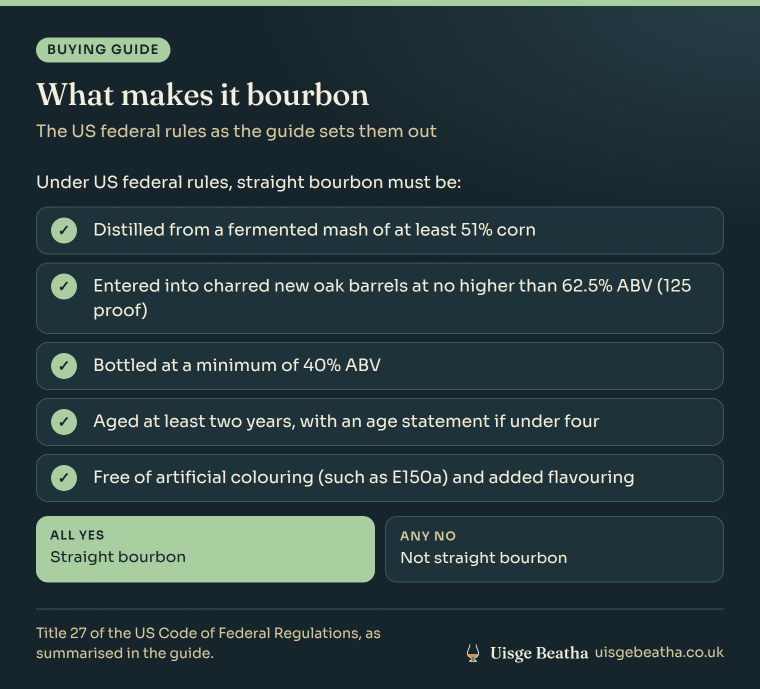
Under Title 27 of the US Code of Federal Regulations, straight bourbon is not just whiskey made in America. It must be distilled from a fermented mash of at least 51% corn, entered into charred new oak barrels at no higher than 62.5% ABV (125 proof), and bottled at a minimum of 40% ABV. To be called straight bourbon it must also be aged at least two years in those barrels, and carry an age statement if it is under four years old. Most importantly for anyone suspicious of food colourings: unlike blended Scotch or Canadian whisky, straight bourbon allows zero artificial colouring (like E150a spirit caramel) and zero added flavouring. The colour, vanillin, and wood sugars come purely from the charred white oak barrel and the grain.
In practice, the colour of a straight bourbon comes from oak and grain, not caramel, and a good bottle need not be expensive. Because bourbon matures in the fierce temperature swings of the American South, it extracts colour and flavour from virgin oak in four to six years. Hot warehouses speed up oak extraction compared with a cold Scottish warehouse.
The three flavour routes: choose by the grain
Bourbon recipes (known as the mash bill) are divided by the secondary grain used alongside corn (at least 51%) and malted barley (usually about 5% to 15%, to provide natural enzymes for fermentation).
1. The gentle, soft start: wheated bourbon
When distillers swap rye for wheat, the sharp peppery bite vanishes, leaving a softer, sweeter, bready character rich in honey and vanilla fudge.
- Maker’s Mark: £35.00 at The Whisky Shop. The benchmark Kentucky wheated bourbon from Maker’s Mark, famously dipped in red wax at Loretto. Bottled at 45% ABV.
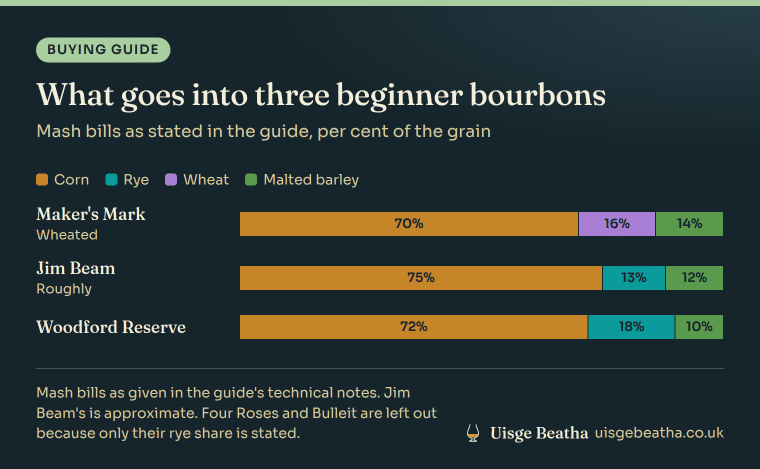
- Maker’s uses a 70% corn, 16% soft red winter wheat, and 14% malted barley mash bill. Bottled at 45% ABV (90 proof), giving it enough body to carry the sweetness without feeling watery.
- Rebel Kentucky Straight Bourbon: currently unavailable. A lighter, wallet-friendly wheater bottled at 40% ABV.
- Formerly Rebel Yell. A classic wheated recipe matured in new charred oak barrels. At 40% ABV, it’s mild and accessible, though serious sippers will want the extra weight of Maker’s.

2. The traditional benchmark: standard rye bourbon
Traditional bourbons use rye as the secondary grain (typically 10% to 20%). The result is a balance of sweet corn, rich vanilla, and a gentle tingle of cinnamon and nutmeg.
- Jim Beam: £19.50 at Master of Malt. The world’s best-selling bourbon from Clermont, Kentucky. 40% ABV.
- Beam doesn’t publish its mash bill, but it is commonly reported as roughly 75% corn, 13% rye and 12% barley, fermented with a family yeast strain kept since the end of Prohibition. The heavy char of the new barrels gives it classic caramelised oak.
- Woodford Reserve: £35.50 at Master of Malt. A refined Kentucky straight bourbon from Woodford Reserve, bottled at 43.2% ABV.
- A blend of pot-still whiskey from Scottish-built copper pot stills at Versailles, Kentucky, and column-still whiskey from Brown-Forman’s Shively distillery in Louisville. The mash bill is 72% corn, 18% rye, and 10% malt. That slightly higher rye gives it a pleasing herbal structure.


3. The spicy, lively route: high-rye bourbon
If you dislike overly sweet drinks and prefer ginger, black pepper, and mint, look for a high-rye bourbon (20% to 35% rye).
- Four Roses Bourbon: £23.95 at Master of Malt. The entry bottling from Four Roses, blending several of its ten recipes. 40% ABV.
- Four Roses is unique: they run two distinct mash bills (Mash Bill B is 35% rye; Mash Bill E is 20% rye) across five different yeast strains, producing 10 individual recipes. This entry bottling blends several of them for a remarkably balanced floral profile.
- Bulleit Bourbon: £29.95 at Hard To Find Whisky. Known for its distinctive medicine-bottle shape and distinctive spice.
- With 28% rye in its mash bill, Bulleit gives you immediate cracked pepper, rye bread, and clove notes on the mid-palate.


How to actually drink it
There is no rulebook. A simple way to start is three sips:
- Neat in a tumbler: Take a tiny sip to taste the pure liquid.
- With three drops of water: Water breaks the surface tension and releases the aromatic esters (the fruity, floral aromas).
- Over one large ice cube: As the ice melts slowly, the chill tames the alcohol heat and highlights the vanilla and oak sweetness. If you prefer it in an Old Fashioned with Angostura bitters and an orange twist, that is a perfectly good way to drink it.
With a stronger bourbon, nose it neat before adding any mixer, so you know what the mixer is changing.
Sources and review
Questions
Is bourbon sweeter than Scotch?
What does wheated bourbon mean?
What is bottled in bond?
Can beginners drink bourbon in cocktails?
About the author
