On this page
GuideBeginners
Best Japanese whisky for beginners
Light Japanese blends to start with, the single malts to try next, and how to tell whether a bottle meets the Japanese whisky standard, at live UK prices.

Start with a light Japanese blend such as Suntory Whisky Toki or Nikka Days, drunk as a highball or with a little water. If you like it, move on to Suntory’s no-age-statement single malts, Hakushu Distiller’s Reserve and Yamazaki Distiller’s Reserve, or the Hibiki Japanese Harmony blend. All of these are bottled at 40% or 43% ABV.
Check the label first
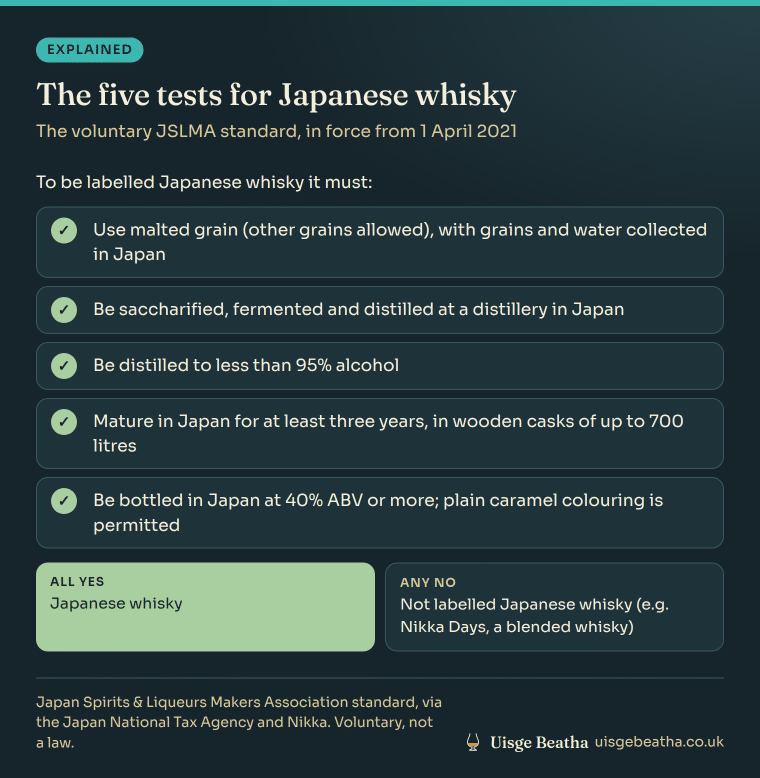
“Japanese whisky” has a definition, but it is an industry standard rather than law. The Japan Spirits and Liqueurs Makers Association (JSLMA) standard, applied in full from April 2024, says the whisky must be fermented, distilled and matured for at least three years in Japan, in wooden casks of no more than 700 litres, and bottled in Japan at 40% ABV or more. Some long-running blends sold by Japanese companies have included whisky from other countries, and those cannot be labelled “Japanese whisky” under the standard. Whiskipedia covers the standard and its gaps.
A Japanese brand name or a Japanese-looking label does not prove where the whisky was made. If origin matters to you, look for the words “Japanese whisky” or the JSLMA’s “JW” logo on the label.
Light blends to start with
Suntory Whisky Toki: £29.50 at Master of Malt. A 43% ABV blend of malt whisky from Suntory’s Hakushu and Yamazaki distilleries with grain whisky from its Chita distillery. Suntory launched it in 2016 as a highball whisky, and its suggested serve is one part Toki to three parts soda.
Nikka Days: £37.99 at Tyndrum Whisky. A light 40% ABV blend from Nikka, which is owned by Asahi. Nikka says Days does not meet all the JSLMA criteria for Japanese whisky, and some UK shops list it as a world blend, so check the label if the standard matters to you.
The Chita Suntory Whisky 70cl: £49.49 at Master of Malt. A 43% ABV single grain whisky from the Chita distillery, founded in 1972 in Aichi Prefecture. Grain whisky is usually lighter than malt, which suits a highball. Whiskipedia on Chita.

Suntory Whisky Toki
43.0% ABV · 70cl
from £29.50 4 retailers
£34.45 delivered
Save up to £5.50
Compare prices
Nikka Days
40.0% ABV · 70cl
from £37.99 4 retailers
£42.49 delivered
Save up to £7.01
Compare prices
The Chita Suntory Whisky 70cl
43.0% ABV · 70cl
from £49.49 4 retailers
£54.44 delivered
Save up to £5.51
Compare pricesSingle malts and a blend to try next
Hakushu Distiller’s Reserve: £64.95 at Hard To Find Whisky. A 43% ABV single malt with no age statement (NAS) from Hakushu, which Suntory founded in 1973 in the Southern Japanese Alps. Hakushu’s house style is usually described as fresh and green, and some of its malt is peated. Whiskipedia on Hakushu.
Yamazaki Distiller’s Reserve: £74.95 at Master of Malt. A 43% ABV NAS single malt from Yamazaki, between Kyoto and Osaka, which Suntory opened in 1923 as Japan’s first malt whisky distillery. Suntory blends it from several cask types, including Mizunara, a Japanese oak. Whiskipedia on Mizunara casks.
Hibiki Japanese Harmony: £74.95 at Hard To Find Whisky. Suntory’s 43% ABV NAS blend of malt and grain whiskies from its own distilleries. It is usually described as richer than Toki and is often drunk neat or with a little water.

Hakushu Distiller's Reserve
43.0% ABV · 70cl
from £64.95 4 retailers
£70.90 delivered
Save up to £5.00
Compare prices
Yamazaki Distiller's Reserve
43.0% ABV · 70cl
from £74.95 4 retailers
£79.90 delivered
Save up to £5.05
Compare prices
Hibiki Japanese Harmony
43.0% ABV · 70cl
from £74.95 4 retailers
£79.95 delivered
Save up to £2.05
Compare pricesHow to drink it
A highball is a good first serve. Chill a tall glass with ice, add one part whisky and three or four parts cold soda water, stir once and add a strip of lemon peel. A bottle at 43% ABV can take the larger amount of soda. Neat, a few drops of water open the whisky up and take the edge off the alcohol.
Age-stated Japanese single malts, such as Yamazaki 12 Year Old, are scarce because producers made less whisky in the 1990s and 2000s. Read why old whisky is expensive for the reasons, or see every bottle in Japanese whisky.
Sources and review
Where to go next
Questions
Is Japanese whisky good for beginners?
Is a highball a proper way to drink whisky?
Is Toki good neat?
What makes a whisky Japanese?
Why is Japanese whisky expensive?
About the author
