On this page
GuideStyle and flavour
Best smoky whiskies: compare smoke styles
Smoky whiskies grouped by style, from gentle island smoke to Islay's most heavily peated malts, with what ppm does and doesn't tell you, at UK prices.
There is no single smokiest-and-best whisky, because smoke comes in styles. For gentle smoke, start with Talisker 10 Year Old or Bowmore 12 Year Old. For heavy Islay peat, Ardbeg 10 Year Old, Laphroaig Quarter Cask and Lagavulin 16 Year Old are the reference points. For the most heavily peated malt made in Scotland, look at Bruichladdich’s Octomore releases. The sections below group the bottles by style.
Where the smoke comes from
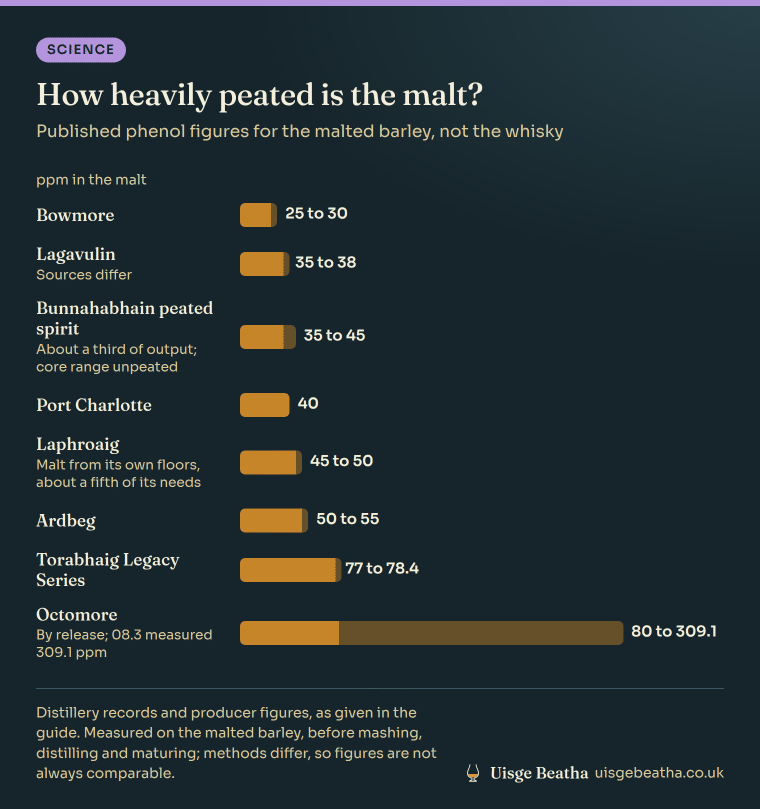
Smoke in whisky comes from peat, burned in the kiln that dries malted barley. The smoke leaves phenols on the grain, and some survive distilling and maturation. Distillers state peating as ppm (phenol parts per million) measured in the malt, not in the bottled whisky. Distillation and years in the cask both reduce it, so two whiskies made from the same malt can taste very different. Whiskipedia explains how peat is used and lists typical ppm by distillery.
Islay and smoke are not the same thing. Bunnahabhain and most Bruichladdich bottlings are unpeated, and several mainland and island distilleries make peated whisky.
Gentle smoke
These use moderately peated malt or balance the smoke with other flavours. They are the usual starting points.
Talisker 10 Year Old: £39.15 at Master of Malt. A single malt from the Isle of Skye at 45.8% ABV. Talisker’s malt is commonly cited at about 18 to 25 ppm.
Bowmore 12 Year Old: currently unavailable. An Islay single malt at 40% ABV. Bowmore still malts part of its own barley on traditional floor maltings, and its malt is commonly cited at about 25 ppm.
Caol Ila 12 Year Old: £49.95 at Hard To Find Whisky. An Islay single malt at 43% ABV. Caol Ila is Islay’s largest distillery, and much of its spirit goes into blends.
anCnoc 10 Year Old Peated: £44.00 at Master of Malt. A peated Highland single malt from Knockdhu, a distillery best known for unpeated whisky.

Talisker 10 Year Old
10 years · 45.8% ABV · 70cl
from £39.15 5 retailers
£44.10 delivered
Save up to £12.80
Compare prices
Caol Ila 12 Year Old
12 years · 43.0% ABV · 70cl
from £49.95 2 retailers
£55.90 delivered
Save up to £12.01
Compare prices
anCnoc 10 Year Old Peated
10 years · 40.0% ABV · 70cl
from £44.00 4 retailers
£48.95 delivered
Save up to £9.95
Compare pricesHeavy Islay smoke
These are the peated malts most people mean by “Islay whisky”: heavily peated spirit, usually matured mostly in ex-bourbon casks.
Ardbeg 10 Year Old: £40.52 at Master of Malt. Bottled at 46% ABV and non-chill-filtered. Ardbeg’s malt is commonly cited at 50 to 55 ppm.
Laphroaig Quarter Cask: £47.00 at The Whisky Shop. No age statement (NAS), 48% ABV. After ex-bourbon barrels it goes into quarter casks of about 125 litres. A small cask puts more of the whisky in contact with the wood, so the cask works faster. Laphroaig floor-malts about a fifth of what it uses on site; published figures for its malt range from about 40 to 60 ppm.
Lagavulin 16 Year Old: £72.95 at Master of Malt. A 16-year-old Islay single malt at 43% ABV. Lagavulin’s usual malt specification is given as 35 to 38 ppm, depending on the source.
Kilchoman Machir Bay: £44.25 at Master of Malt. A young NAS single malt at 46% ABV from Kilchoman, a farm distillery founded on Islay in 2005.
Port Charlotte 10 Year Old: £54.95 at Hard To Find Whisky. Bruichladdich’s heavily peated range, bottled at 50% ABV. Bruichladdich states 40 ppm for its Port Charlotte malt.

Ardbeg 10 Year Old
10 years · 46.0% ABV · 70cl
from £40.52 4 retailers
£45.47 delivered
Save up to £4.48
Compare prices
Laphroaig Quarter Cask
48.0% ABV · 70cl
from £47.00 2 retailers
£51.99 delivered
Compare prices
Lagavulin 16 Year Old
16 years · 43.0% ABV · 70cl
from £72.95 5 retailers
£77.90 delivered
Save up to £21.00
Compare prices
Kilchoman Machir Bay
46.0% ABV · 70cl
from £44.25 4 retailers
£49.20 delivered
Save up to £9.75
Compare prices
Port Charlotte 10 Year Old
10 years · 50.0% ABV · 70cl
from £54.95 5 retailers
£59.90 delivered
Save up to £14.05
Compare pricesThe most heavily peated
These are bottled stronger, so add water to taste.
Ardbeg Corryvreckan: £74.95 at Hard To Find Whisky. NAS, 57.1% ABV, matured in ex-bourbon and new French oak casks.
Ardbeg Uigeadail: currently unavailable. NAS, 54.2% ABV, a vatting of ex-bourbon and sherry-cask whisky.
Octomore 15.1: £138.50 at Master of Malt. Bruichladdich’s super-heavily peated series. Each Octomore release states its own ppm on the label, so check the figure for the edition you buy.

Ardbeg Corryvreckan
57.1% ABV · 70cl
from £74.95 4 retailers
£79.95 delivered
Save up to £8.05
Compare prices
Bruichladdich Octomore 15.1 Whisky 70cl
59.1% ABV · 70cl
from £138.50 3 retailers
£138.50 delivered
Save up to £61.45
Compare pricesSmoke with sherry-cask sweetness
A sherry cask or Pedro Ximénez (PX) cask adds dried fruit and sweetness to peated spirit, which some drinkers find a gentler way in. See the sherry-cask guide for what those casks do.
Ardbeg An Oa: £45.70 at Master of Malt. NAS, 46.6% ABV, made from whisky aged in PX casks, charred virgin oak and first-fill bourbon casks.
Bowmore 15 Year Old: £73.95 at Master of Malt. 43% ABV, with its final years in oloroso sherry casks.
Laphroaig 10 Year Old Sherry Oak Finish: £49.95 at Hard To Find Whisky. Laphroaig 10 finished in sherry casks and bottled at 48% ABV.

Ardbeg An Oa
46.6% ABV · 70cl
from £45.70 4 retailers
£50.65 delivered
Save up to £11.30
Compare prices
Bowmore 15 Year Old
15 years · 43.0% ABV · 70cl
from £73.95 2 retailers
£78.90 delivered
Save up to £10.05
Compare prices
Laphroaig 10 Year Old Sherry Oak Finish
10 years · 48.0% ABV · 70cl
from £49.95 4 retailers
£55.90 delivered
Save up to £5.05
Compare pricesSmoke from outside Islay
Ledaig 10 Year Old: £39.50 at Master of Malt. The peated malt from Tobermory distillery on Mull, at 46.3% ABV. Ledaig’s malt is commonly cited at 30 to 40 ppm.
Connemara Peated Single Malt: £33.45 at Master of Malt. A peated Irish single malt at 40% ABV, made at Cooley distillery, and one of the few peated Irish whiskeys.
Compass Box The Peat Monster: £51.12 at Master of Malt. A blended malt at 46% ABV, built from peated Islay and other malts.

Ledaig 10 Year Old
10 years · 46.3% ABV · 70cl
from £39.50 4 retailers
£44.45 delivered
Save up to £8.45
Compare prices
Connemara Peated Single Malt Irish Whiskey
40.0% ABV · 70cl
from £33.45 2 retailers
£38.40 delivered
Save up to £6.50
Compare prices
Compass Box The Peat Monster
46.0% ABV · 70cl
from £51.12 3 retailers
£56.07 delivered
Save up to £12.88
Compare pricesFor every peated bottle on the site, see peated whisky or the narrower heavily peated list.
The whisky flavour map below places every in-stock bottle we can tag by smoke and cask, so you can see where these styles sit on the shelf.
This price comparison is temporarily unavailable while its data is refreshed. Browse current bottle comparisons instead.
Sources and review
Related guides
Questions
What is the smokiest whisky?
Is peat the same as smoke?
Are all smoky whiskies from Islay?
About the author
