On this page
GuideIf you like X
Best bourbon for Scotch drinkers: how to cross the Atlantic
How to cross from Scotch single malt to bourbon: the mash bills, casks and strengths that suit a malt drinker, with bottles and live UK prices.

If you have spent your adult life drinking Scotch single malts, your first encounter with standard American bourbon can be a shock to the system. Where is the subtle malted barley? Where is the coastal sea spray? Why does it feel like someone melted a bag of vanilla fudge over a cedar plank?
Scotch drinkers frequently write off bourbon as “too sweet” and retreat back to their Highland glens. But dismissing bourbon because you once drank a sugary 40% mixer in a loud bar is like dismissing all Scotch because someone gave you a sip of industrial blend with lukewarm water.
You don’t need a sweeter tooth to enjoy bourbon; you just need to know which mash bills and barrel regimes speak the language of a malt drinker.
The science: why bourbon tastes sweeter (and why it isn’t sugar)
The most common complaint from Scotch drinkers is that bourbon is too sweet. Yet Scotch allows distillers to add E150a spirit caramel colouring, while straight bourbon may not have any colouring or flavouring added. The sweetness is not added sugar.
The sweetness Scotch drinkers notice comes from two things:
- The Grain: Scotch is made from 100% malted barley (in single malts), which gives a bready, cereal, biscuity profile. Bourbon must be at least 51% corn (maize), which ferments into a spirit naturally higher in sweet aliphatic esters.
- The Cask: Most Scotch is matured in used oak casks, most of them ex-bourbon, that have already had their aggressive wood sugars stripped out by previous tenants. Bourbon is legally required to go into new charred oak containers, which in practice almost always means American white oak (Quercus alba). The blazing char layer caramelises the wood hemicellulose into wood sugars, creating massive doses of vanillin, lactones (coconut, toasted wood), and furfural (almond and baked bread).
If you want a bourbon that respects a Scotch palate, you avoid low-proof wheaters and look for high-rye content, wood-finishing complexity, or proper bottling proof.
Climate, cask and the three mash-bill families
Kentucky rackhouses see summer temperatures above 35°C and sub-zero winters. In the heat the spirit expands deep into the charred oak; in the cold it contracts back out. A cask in Kentucky is worked far harder than the same cask in a cool, steady Scottish warehouse, which is why a six- to eight-year-old bourbon can show the wood extraction and colour of a much older Scotch.
The secondary grain alongside the corn splits bourbon into three families:
- Traditional (around 70% to 75% corn, 10% to 15% rye, the rest malted barley): the industry standard, made by distilleries such as Jim Beam and Wild Turkey, balancing corn sweetness against gentle baking spice and cocoa.
- High-rye (18% to 35% rye): bottled by distilleries such as Four Roses and Woodford Reserve, with cracked black pepper, mint and dry herbal spice. This is the family that usually suits a Scotch drinker best.
- Wheated (wheat replaces the rye): Maker’s Mark is the benchmark. Wheat gives a rounder, creamier profile with very little pepper.
The three bridges from Scotch to bourbon
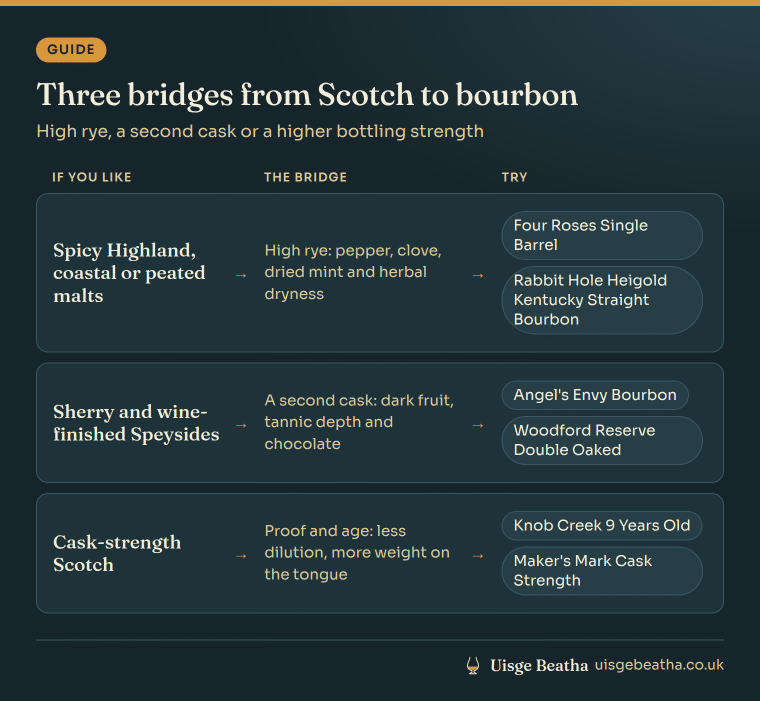
1. The High-Rye Bridge (for fans of spicy Highland, Coastal, or Peated malts)
Rye grain is the antidote to cloying corn sweetness. It contributes sharp black pepper, clove, dried mint, and herbal dryness that cuts through the vanilla.
- Four Roses Single Barrel: £44.90 at Master of Malt. A single barrel release from Four Roses, bottled at 50% ABV (100 proof).
- This uses Four Roses’ ‘OBSV’ recipe: Mash Bill B (60% corn, 35% rye, 5% malt) paired with Yeast Strain V (delicate fruitiness). At 50% ABV and 35% rye, the peppery bite and dry herbal backbone immediately reassure any Talisker or Clynelish drinker. No flab, no cloying syrup.
- Rabbit Hole Heigold Kentucky Straight Bourbon: £48.95 at Master of Malt. A modern high-rye recipe from Louisville, bottled at 47.5% ABV.
- Heigold uses 70% corn, 25% malted German rye, and 5% malted barley. Using malted rye rather than raw unmalted grain brings an oily, biscuity texture very familiar to single malt devotees.


2. The Secondary Cask Bridge (for fans of Sherry and Wine-finished Speysides)
If your comfort zone is Aberlour, Balvenie, or GlenDronach, virgin oak can sometimes feel abrasive. These releases use secondary fortified wine casks or toasted barrels to introduce dark fruit, tannic depth, and chocolate.
- Angel’s Envy Bourbon: £49.95 at Master of Malt. Kentucky straight bourbon finished in Portuguese ruby port wine casks. 43.3% ABV.
- After up to six years in new charred oak, this spends three to six months in 60-gallon ruby port barrels. The residual port wine adds red berry tannins and dark plum depth that softens the aggressive virgin wood tannins.
- Woodford Reserve Double Oaked: £55.00 at Master of Malt. Matured by Woodford Reserve in standard charred oak, then racked into a second, deeply toasted and lightly charred barrel. 43.2% ABV.
- The second barrel is heavily toasted before receiving a brief flash char. Toasting breaks down wood lignins into vanillin and guaiacol (smoke/spice) without creating bitter char charcoal.


3. The Proof & Age Bridge (for Cask-Strength and 100-Proof devotees)
Most supermarket bourbons are diluted down to the legal minimum of 40% ABV, which can leave them feeling watery and thin compared to a robust 46% or cask-strength Scotch. Step up the proof to get genuine mouthfeel and complexity.
- Knob Creek 9 Years Old: £38.02 at Master of Malt. Jim Beam’s premium small batch release, carrying a proud 9-year age statement at 50% ABV (100 proof).
- Nine years in a hot Kentucky rackhouse draws more from the oak than the same time would in a cool Scottish warehouse. At 50% ABV, it retains the wood oils and long-chain esters that give weight on the tongue.

Sources and review
Questions
What bourbon is least sweet?
Is straight bourbon sweeter because it has added sugar?
What is the closest bourbon to a Speyside single malt?
Should Scotch drinkers add water to bourbon?
About the author
