On this page
Independent whisky bottlers: how they work and the key names
What an independent bottler is, how it differs from a distillery bottling, why some labels hide the distillery, and the main bottling houses.
An independent bottler releases whisky made at a distillery it doesn’t control, under its own label. The release label is what identifies the whisky: which distillery made it (or which region, if the name is withheld), the cask, the age or dates, the strength and the bottler. Independent bottlings aren’t automatically better, cheaper, single cask or cask strength than distillery releases; each label has to be read on its own terms.
What is an independent bottler?
An official bottling (OB) is released by the company that owns the distillery. An independent bottling (IB) is released by another company. Independent bottlers may buy mature casks, or fill new spirit from other distilleries into their own casks and mature it themselves: Gordon & MacPhail’s 2020 company update describes filling spirit into cask at more than 100 Scotch distilleries over its history.
Some independent bottlers also own distilleries. Gordon & MacPhail owns Benromach and The Cairn, and said that from 2024 it would stop filling spirit into cask from distilleries it doesn’t own, while continuing to release its own-label whiskies from maturing stock for decades. So “independent bottler” describes a particular release, not a company that never distils.
Why do distilleries sell their casks to independent bottlers?
The reasons are commercial and vary by company, and few distillers publish them. Much malt whisky is made for blending: the UK government’s Scotch Whisky technical file says the product of individual distilleries is frequently blended, and that the greatest proportion of Scotch is drunk as blended Scotch. Whiskipedia’s guide to teaspooning describes distilleries selling surplus casks through brokers, blenders and independent bottlers. Whisky from a distillery with few official single malt releases may reach shelves mainly as independent bottlings.
What to look for on an independent label
Independent labels vary, so check each one for:
- The distillery or region. Is the distillery named, or only a region or a code name?
- Strength. Is it labelled cask strength, or reduced to a stated ABV?
- Filtration and colour. Look for explicit “non-chill filtered” and “natural colour” statements; don’t infer them from the bottler’s reputation.
- Cask details. Single cask releases often give a cask number and outturn; small-batch and blended releases may not.
Undisclosed distilleries and teaspooning
Some independent bottlings don’t name the distillery, giving only a region (“Speyside Single Malt”) or a code name. Whiskipedia explains that teaspooning lets a distillery sell whisky while protecting its brand: a small amount of another distillery’s malt is added, so the whisky is no longer legally a single malt. Under regulation 3 of the Scotch Whisky Regulations 2009, a blend of single malts from more than one distillery is a blended malt.
Teaspooned names to know
Whiskipedia lists these:
- Burnside: Balvenie with a teaspoonful of Glenfiddich.
- Wardhead: Glenfiddich with a teaspoonful of Balvenie.
- Westport: Glenmorangie with a teaspoon of Glen Moray.
For more teaspooned whisky names and an explanation of the practice, see Whiskipedia’s guide to teaspooned whiskies.
The great independent bottling houses
A few long-established independent houses appear on many shelves:
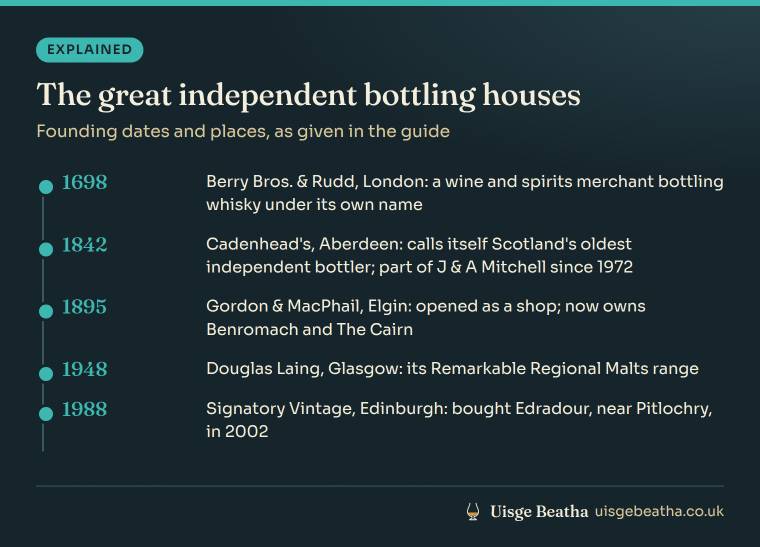
- Gordon & MacPhail (Elgin, 1895): opened as a shop in Elgin and became a bottler and distiller; it owns Benromach and The Cairn, and its Connoisseurs Choice and Discovery ranges bottle whisky from other distilleries.
- Cadenhead’s (Aberdeen, 1842): Cadenhead’s describes itself as Scotland’s oldest independent bottler. It has been part of J & A Mitchell & Co, the Campbeltown firm behind Springbank, since 1972.
- Signatory Vintage (Edinburgh, 1988): bought the Edradour distillery near Pitlochry in 2002.
- Douglas Laing (Glasgow, 1948): its Remarkable Regional Malts range includes Big Peat (Islay), Scallywag (Speyside), Rock Island (the Islands), Timorous Beastie (Highlands) and The Gauldrons (Campbeltown).
- Berry Bros. & Rudd (London, 1698): a wine and spirits merchant on St James’s Street that bottles whisky under its own name.
Independent bottlings to compare
Each line uses the bottler’s own description:
- Ledaig 12 Year Old (Gordon & MacPhail Discovery Series): £49.95 at Hard To Find Whisky. Peated single malt from the Tobermory distillery on Mull, which Gordon & MacPhail lists in its Smoky profile, from bourbon and sherry casks. 43% ABV.
- Miltonduff 10 Year Old (Gordon & MacPhail Discovery Series): £48.00 at The Whisky Shop. Speyside single malt from sherry casks, 43% ABV. Ballantine’s describes Miltonduff as one of the foundations of its blends.
- Rock Island Blended Malt (Douglas Laing): £41.95 at Hard To Find Whisky. A blended malt including malts from Islay, Arran, Jura and Orkney, 46.8% ABV, no chill filtration and no colour added.
- The Gauldrons Blended Malt (Douglas Laing): £47.95 at Hard To Find Whisky. A blended malt of Campbeltown malts, 46.2% ABV, without colouring or chill filtration.
- Berry’s 12 Year Old Sherry Cask Matured: £45.95 at Master of Malt. A Speyside single malt that Berry Bros. & Rudd lists as its Speyside Sherry Cask 12 Year Old, from Oloroso sherry butts, 45.3% ABV.

Ledaig 12 Year Old Gordon & MacPhail Discovery Series
12 years · 43.0% ABV · 70cl
from £49.95 3 retailers
£54.94 delivered
Compare prices
Miltonduff 10 Year Old Gordon & MacPhail Discovery Series
10 years · 43.0% ABV · 70cl
from £48.00 5 retailers
£52.95 delivered
Save up to £1.95
Compare prices
Rock Island Blended Malt
46.8% ABV · 70cl
from £41.95 3 retailers
£46.99 delivered
Save up to £0.05
Compare prices
The Gauldrons Blended Malt
46.2% ABV · 70cl
from £47.95 1 retailer
£53.90 delivered
Compare prices
Berry's 12 Year Old Sherry Cask Matured Single Malt Whisky
12 years · 45.3% ABV · 70cl
from £45.95 3 retailers
£50.90 delivered
Save up to £3.05
Compare pricesHow to shop independent bottlers
Compare like with like. An independent bottling and an official one from the same distillery can differ in age, cask, strength and filtration, so check the label facts above before comparing prices. Browse independent bottlings or single cask whisky to see current offers.
Sources and review
Questions
What is the difference between an independent bottler and an official distillery bottling?
Why do independent bottlers sometimes hide the distillery name?
Do independent bottlers own their own distilleries?
About the author
