On this page
Japanese whisky standards and distilleries explained
What the voluntary JSLMA standard requires before a whisky is labelled Japanese whisky, why imported whisky was used, main distilleries, and Mizunara oak.
Japanese whisky has gone from a curiosity outside Japan to one of the most closely watched categories in whisky. You can compare current UK prices on Japanese whisky.
That rise exposed an awkward fact. For years, a bottle sold as Japanese whisky could contain whisky distilled abroad, and the label did not have to say so.
In 2021 the main Japanese producers adopted a labelling standard. It is voluntary, not a law, and it applies to the word “Japanese whisky” on the label. Here is what it requires, which distilleries are behind the best-known bottles, and what Mizunara oak is.
The historical loophole: why imported whisky became “Japanese whisky”
Japanese whisky labelling became confusing because, until 2021, nothing defined the term. Japan’s tax rules define whisky for duty purposes, but they set no requirement for where it is distilled or matured. Commentators who have read the National Tax Agency’s definition report that a product taxed as whisky in Japan needs to contain only about 10% actual whisky, with the rest other spirits (nomunication.jp, March 2026).
That left room for blenders to import whisky from Scotland, Canada and elsewhere, blend it in Japan, sometimes with a small share of domestic spirit, and sell the result as Japanese whisky (Whiskipedia). Not every producer did this, and not every producer said clearly what was in the bottle.
The turning point: the JSLMA standards
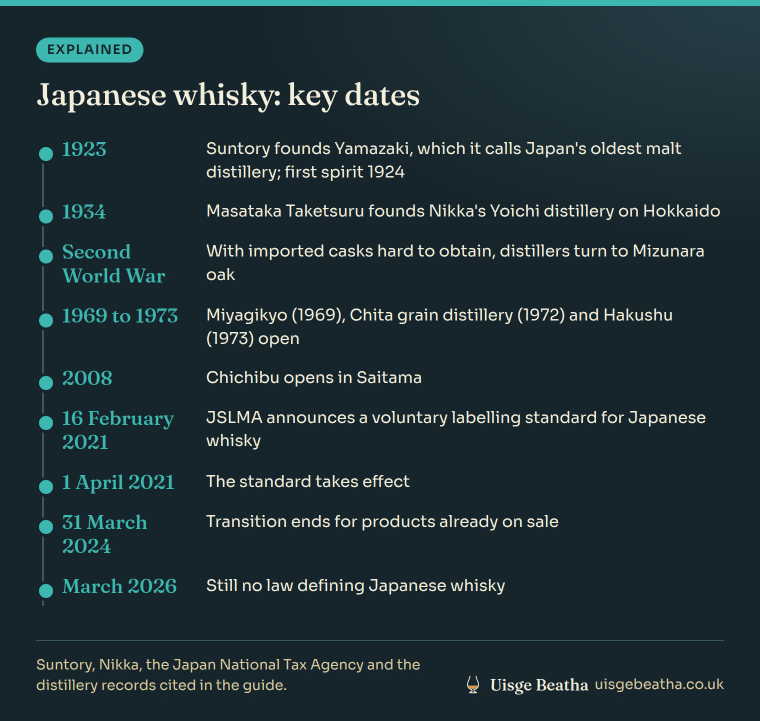
The Japan Spirits & Liqueurs Makers Association (JSLMA) announced its labelling standard for Japanese whisky on 16 February 2021, and it took effect on 1 April 2021. Products already on sale before then had a transition period to 31 March 2024 to change their labels (Japan National Tax Agency; Nikka).
The National Tax Agency calls it a voluntary standard. The association is government-approved but is not a government agency, and its members enforce the rules themselves (Whisky Magazine). A producer outside the association is not bound by it, and as of March 2026 Japan still had no law defining Japanese whisky.
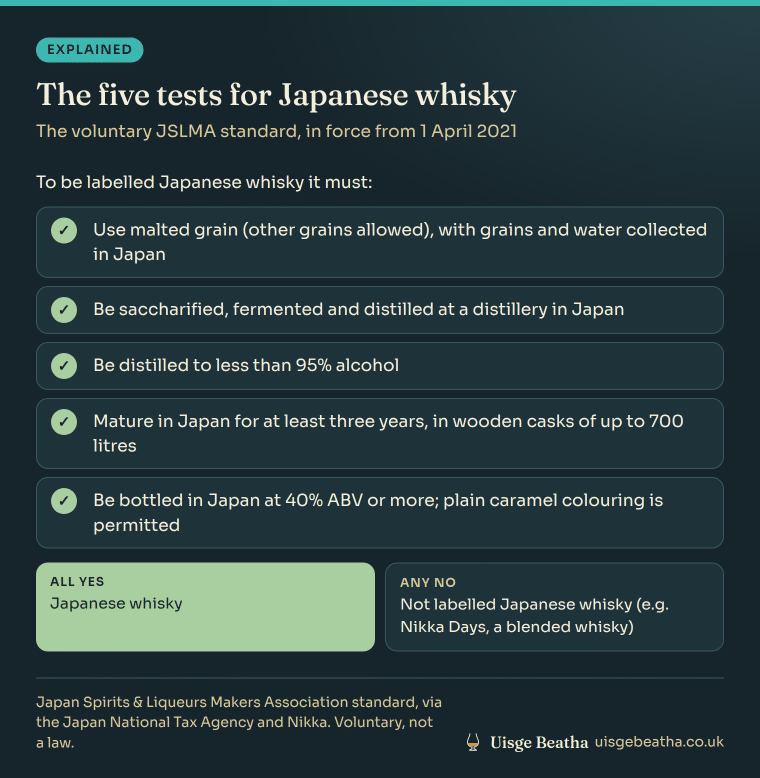
Under the standard, a whisky may be labelled “Japanese whisky” only if it meets all of these conditions (Nikka’s summary):
- Raw materials: Malted grain must be used. Other cereal grains may be added, and the grains and water must be collected in Japan.
- Production: Saccharification, fermentation and distillation must take place at a distillery in Japan.
- Distillation strength: Distilled to less than 95% alcohol.
- Maturation: Filled into wooden casks of no more than 700 litres and matured in Japan for at least three years.
- Bottling: Bottled in Japan at 40% ABV or more. Plain caramel colouring is permitted.
A whisky that does not meet the definition should not be labelled with terms such as “Japan whisky” or “Nihon whisky”, or use names and places that suggest it is Japanese whisky (Article 6 of the standard, as summarised by nomunication.jp). Because the standard is an industry rule, the clearest evidence for any one bottle is the producer’s own statement. Suntory, for example, says on its product pages that Yamazaki 12, Hakushu Distiller’s Reserve and Hibiki Japanese Harmony meet the association’s standard.
Japanese distilleries and “world whiskies”
1. Distilleries in Japan behind the best-known bottles
These distilleries mash, ferment and distil in Japan. Whether a particular bottle meets the JSLMA definition is set out by its producer, so check the label or the producer’s page.
- Suntory: Yamazaki (founded in 1923; Suntory calls it Japan’s first and oldest malt distillery), Hakushu (founded in 1973 in the forests of Mt. Kaikomagatake in the Southern Alps), Chita (a grain distillery on the Chita Peninsula, built in 1972). Hibiki is Suntory’s blended range, made from whiskies from these three distilleries.
- Nikka: Yoichi (Hokkaido, founded in 1934, with direct coal-fired pot stills) and Miyagikyo (west of Sendai, founded in 1969, with steam-heated stills and Coffey stills for grain whisky).
- Smaller producers: Chichibu (opened in 2008 in Saitama by Ichiro Akuto’s Venture Whisky), Mars Shinshu (Hombo Shuzo, in the Nagano Alps) and Kanosuke (Kagoshima, on Kyushu).
2. “World whiskies” (blends with imported whisky)
Some well-known releases from Japanese companies contain whisky distilled outside Japan, or do not meet every part of the standard. The better producers now say so on the label:
- Nikka Days: Nikka labels this release as blended whisky rather than Japanese whisky, and says it does not meet all JSLMA Japanese whisky criteria. It is a blended whisky, not a Japanese whisky under those rules.
- Ichiro’s Malt & Grain (White Label): Sold as a “World Blended Whisky”. Retailers describe it as a blend of Chichibu whisky with whiskies from several other countries, including Scotland, Ireland, the USA and Canada.
Mizunara oak (Quercus crispula)
Mizunara oak is the cask most closely associated with Japanese whisky.
Mizunara is an oak native to Japan and other parts of East Asia. It is hard to work: the trees grow crooked and knotty, the wood is wet, soft and porous, and Mizunara casks are more prone to leaking than casks of other oak. Japanese distillers turned to it during the Second World War, when imported casks were hard to obtain (Whiskipedia).
Whiskipedia records that the wood’s character develops slowly, often over about two decades, and that the aromas associated with it are incense, sandalwood and coconut. Suntory lists Mizunara among the casks for Yamazaki 12 and names it as a note in Hibiki Japanese Harmony.
Four Japanese whiskies and what their producers say
Here are four widely sold Japanese bottles, with current UK prices:
Yamazaki 12 Year Old: £120.00 at The Whisky Shop. Suntory’s flagship single malt, bottled at 43% ABV. Suntory says it is blended from whiskies aged in American, Spanish and Japanese Mizunara oak, and that it meets the JSLMA standard for labelling Japanese whisky. Suntory’s tasting note lists peach, pineapple, grapefruit, clove, candied orange, vanilla and Mizunara.
Hakushu Distiller’s Reserve: £64.95 at Hard To Find Whisky. A no-age-statement single malt from Suntory’s distillery in the forests of Mt. Kaikomagatake, bottled at 43% ABV. Suntory describes it as refreshing, citrusy and gently smoky, and says it meets the JSLMA standard.
Hibiki Japanese Harmony: £74.95 at Hard To Find Whisky. Suntory’s blended whisky, bottled at 43% ABV. Suntory says the Hibiki bottle’s 24 facets each represent a Japanese micro-season, and that this release meets the JSLMA standard. Its tasting note lists rose, lychee, rosemary, sandalwood, honey, candied orange peel and white chocolate.
Nikka Days: £37.99 at Tyndrum Whisky. A blended whisky at 40% ABV. Nikka describes it as a blend of grain whiskies and slightly peated malts, and states that it does not meet all the criteria of “Japanese whisky” defined by the JSLMA.

Yamazaki 12 Year Old
12 years · 43.0% ABV · 70cl
from £120.00 3 retailers
£120.00 delivered
Save up to £17.95
Compare prices
Hakushu Distiller's Reserve
43.0% ABV · 70cl
from £64.95 4 retailers
£70.90 delivered
Save up to £5.00
Compare prices
Hibiki Japanese Harmony
43.0% ABV · 70cl
from £74.95 4 retailers
£79.95 delivered
Save up to £2.05
Compare prices
Nikka Days
40.0% ABV · 70cl
from £37.99 4 retailers
£42.49 delivered
Save up to £7.01
Compare pricesFor how UK prices compare across the range, see our guide to Japanese whisky UK prices.
How Japanese whisky is served: highball and mizuwari
Suntory describes three common serves in Japan: the highball (whisky with sparkling water and ice), mizuwari (whisky diluted with cold water and ice) and oyuwari (whisky with hot water). None of them is a rule; the same whisky can be drunk neat, with water or in a long drink.
Sources and review
Questions
What are the JSLMA rules for Japanese whisky?
Is the JSLMA standard a law?
When did whisky making start in Japan?
What is Mizunara oak?
About the author
