On this page
Peat, phenols and ppm in whisky explained
What PPM means on a whisky label, how peat kilning adds smoky phenols, why the malt figure is not the smoke in the glass, and Islay malt specifications.
Peat smoke gets into whisky at one stage only: when malted barley is dried over a peat fire. The Scotch Whisky Association puts the smoky flavour of some Scotch down to exactly that. A ppm figure on a label tells you how many phenols were on that barley, not how smoky the whisky in the bottle is, so any figure is only useful if you know where it was measured. Browse peated whisky to compare bottles.
Peat smoke is one of the most recognisable smells in whisky. Some drinkers describe bonfires and barbecue; others describe antiseptic, bandages and tarmac. Since around 2010, some producers have turned it into a numbers race, printing figures such as “50 PPM” on labels. Bruichladdich’s Octomore range goes much further: barley peated to at least 80 ppm, and to over 300 ppm in its most heavily peated release.
What does PPM actually measure? Why doesn’t a whisky made from 100 ppm malt taste twice as smoky as one made from 50 ppm malt? And how does burning peat get into the glass?
What is peat, and how does it get into whisky?
Peat is compressed, partly decomposed plant matter that has built up in waterlogged ground over thousands of years. It covers about 23% of Scotland, mostly in the Highlands and Islands, and its make-up varies by place: Islay peat has a higher share of algae and marine material, while mainland peat has more wood, roots and moss, according to Whiskipedia.
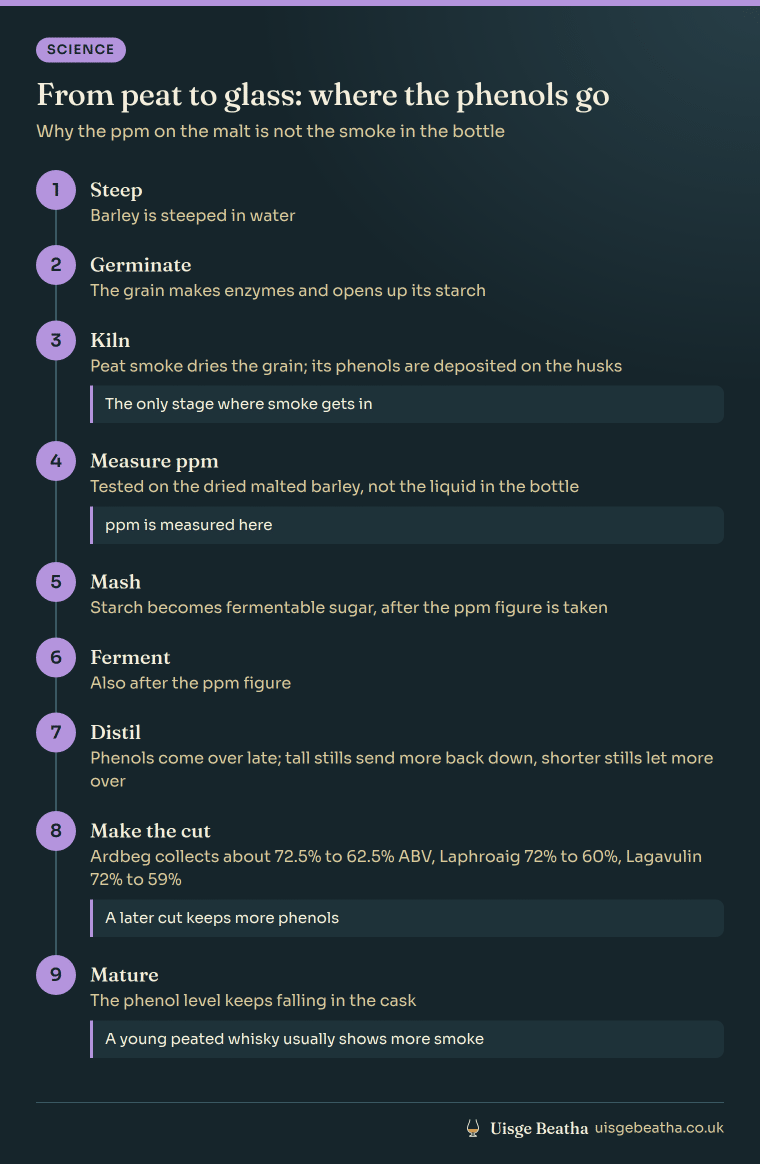
To make single malt whisky, barley is steeped in water and allowed to germinate. Germination makes the enzymes and opens up the starch, which is later converted into fermentable sugars in the mash. To stop germination, maltsters dry the grain in a kiln. If peat is burned under the kiln, its smoke carries phenols, aromatic compounds such as cresols, guaiacols and xylenols, which are deposited on the barley husks.
The whisky is not filtered through peat and peat is not added to the wash. The smoky character comes from the malting stage, and once the grain is kilned and dried, its phenol level is set.
What does PPM actually measure?
PPM stands for phenol parts per million.
The key point that labels rarely spell out: PPM is measured on the dried malted barley, not in the liquid inside the bottle. Bruichladdich says plainly that the figure “refers to the peat level of the barley”, and that its maltster, Bairds, measures it in house and blends peated and unpeated malt to hit the level each distillery orders.
When Ardbeg works to a 50 to 55 ppm specification, or an Octomore release states a figure above 100 ppm, that number records the phenols on the grain before mashing, fermentation, distillation and years of oak maturation.
Two numbers for the same malt are not always comparable either. Phenols can be measured by a colorimetric method or by high-performance liquid chromatography (HPLC), and Scotchwhisky.com reported, when Octomore 08.3 was announced, that HPLC gives higher readings. A ppm figure is most useful when the label or producer says what was measured and how.
Why barley PPM doesn’t equal smoke in the glass
If two distilleries bought identical malt kilned to 50 ppm, their whiskies could still taste very different. Bruichladdich says ppm levels fall through distillation and maturation, and three stages decide how far:
- Phenols come late in the run: phenols are large molecules with high boiling points, so they come across towards the end of the spirit run, as Whiskipedia explains. How many are kept depends on where the distiller makes the cut.
- Still shape and reflux: taller stills and upward-sloping lyne arms send more heavy vapour back down to be redistilled (reflux), while shorter stills let more of it over. Ardbeg fits purifiers to its spirit stills, which return heavy vapour to the still.
- The spirit cut: the later the cut from spirit to feints, the more late-running phenols go into the spirit. Published cut points on Islay differ: Ardbeg collects from about 72.5% down to 62.5% ABV, Laphroaig from 72% to 60%, and Lagavulin from 72% to 59%, according to the distillery records in the Whiskipedia knowledge graph.
Then comes the cask. As peated spirit matures, its phenol level keeps falling, so a young peated whisky usually shows more smoke than a much older one from the same distillery.
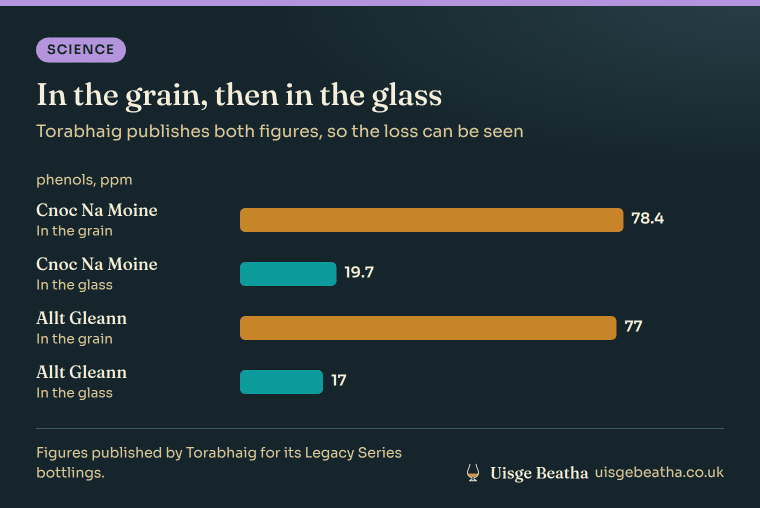
Few producers publish what is left in the bottle. Torabhaig on Skye does, for two of its Legacy Series releases: on its own product pages, Cnoc Na Mòine has 78.4 ppm in the grain and 19.7 ppm in the glass, and Allt Gleann 77 ppm and 17 ppm. About three quarters of the measured phenols never reach the bottle.
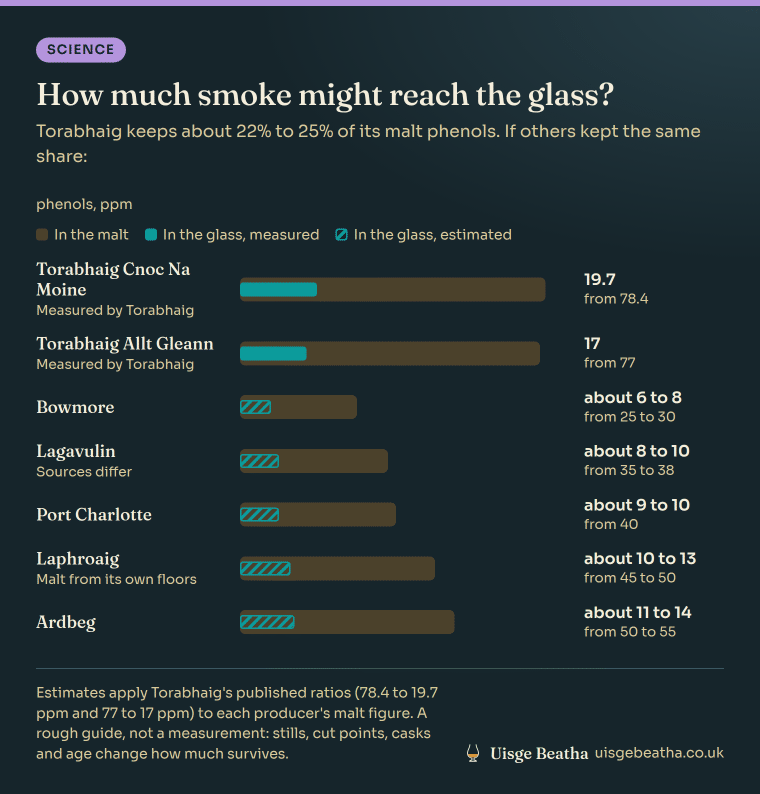
If other distilleries kept the same share as Torabhaig, a 50 ppm malt would give a whisky of roughly 11 to 13 ppm. Treat that as a rough guide, not a measurement: stills, cut points, casks and age all change how much survives, so the real figures could be quite different.
Islay malt specifications: from unpeated to Octomore
Distilleries order malt to their own phenol specification, and some vary it by product. These are the published malt figures, which say nothing certain about how a given bottle tastes:
On smaller screens, scroll sideways to see every column.
| Distillery or brand | Malt specification | Source and notes |
|---|---|---|
| Bunnahabhain | Core range unpeated | Also makes a peated spirit, at 35 to 45 ppm, for about a third of production (distillery records) |
| Bowmore | 25 to 30 ppm | Distillery records; about a quarter of its malt is made on its own floors |
| Lagavulin | Usually given as 35 to 38 ppm | Sources differ: 35, 36 and 38 ppm all appear. The distillery records give 36 ppm, with heavily peated malt (50 to 70 ppm) run for about three weeks a year |
| Port Charlotte (Bruichladdich) | 40 ppm | Bruichladdich |
| Laphroaig | 45 to 50 ppm for its floor-malted share | Distillery records; Laphroaig malts about 20% of its needs on its own floors and buys the rest |
| Ardbeg | 50 to 55 ppm | Distillery records |
| Octomore (Bruichladdich) | 80 to over 300 ppm, by release | Bruichladdich; Octomore 08.3 measured 309.1 ppm |
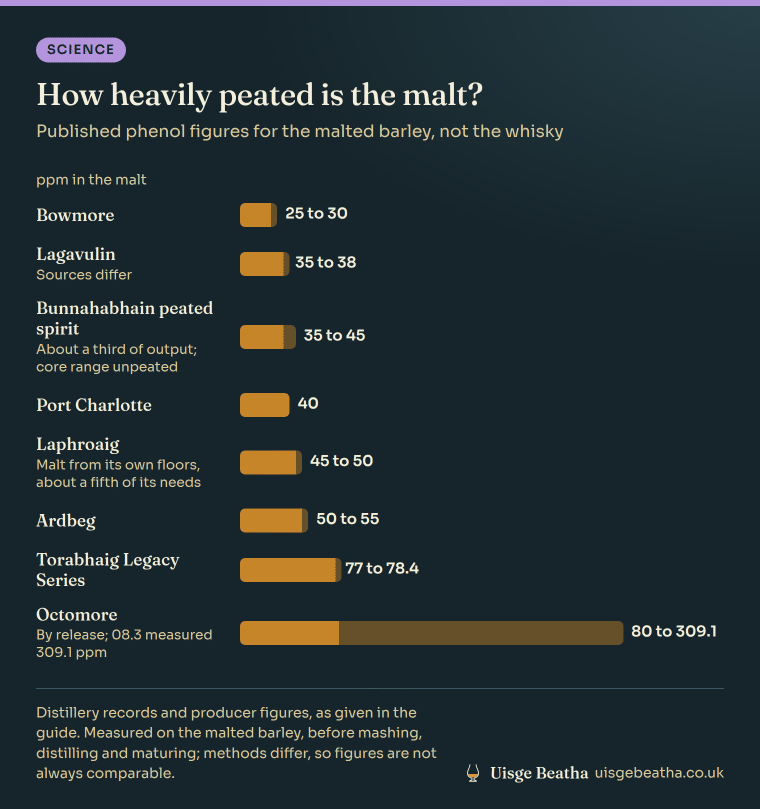
On the search questions: Laphroaig’s floor-malted barley is 45 to 50 ppm, but that is only about a fifth of its malt. Lagavulin’s figure depends on the source, so treat any single number with caution. And the “peatiest” whisky is not settled by ppm: the highest published malt figure is Octomore’s, but how smoky a bottle tastes depends on distillation, cask and age as well.
Peat smoke vs wood smoke
A whisky made from unpeated malt can still be described as smoky or toasty. Charred and toasted casks break down lignin in the wood into flavour compounds, including vanilla, spicy and smoky notes, as Whiskipedia explains. That character comes from the cask, not from peated malt, and a ppm figure does not measure it.
The main compounds behind these notes, and where each comes from:
On smaller screens, scroll sideways to see every column.
| Compound | Main source | Usual aroma description |
|---|---|---|
| Phenol and cresols | Peat smoke | Medicinal, antiseptic, tarry |
| Guaiacol | Peat smoke and charred oak | Wood smoke, smoked bacon, roasted coffee |
| Eugenol | Mostly oak, some in peat smoke | Clove, allspice, warm spice |
| Vanillin | Lignin breakdown in toasted oak | Vanilla, cream |
Guaiacol’s two routes explain why an unpeated whisky from a heavily charred cask can still taste smoky. Whether European oak gives more eugenol than American oak is reported both ways in the sources; the toasting of the cask matters as much as the species.
Peated single malts with published malt figures
Here are five peated single malts from Islay whose producers or distillery records give a malt specification:
Ardbeg 10 Year Old: £40.52 at Master of Malt. From Ardbeg on the south coast of Islay, bottled at 46% ABV, non-chill filtered, and matured in bourbon casks. Ardbeg’s malt specification is 50 to 55 ppm, and its spirit stills have purifiers. Ardbeg describes it as “sea spray, tarry rope, lime”.
Port Charlotte 10 Year Old: £54.95 at Hard To Find Whisky. Heavily peated single malt from Bruichladdich, bottled at 50% ABV. Bruichladdich says the Port Charlotte range is peated to 40 ppm and that this whisky is distilled, matured and bottled on Islay, non-chill filtered and without added colouring.
Lagavulin 16 Year Old: £72.95 at Master of Malt. Bottled at 43% ABV. Lagavulin’s usual malt figure is given as anything from 35 to 38 ppm, depending on the source. Its distillation is often described as among the slowest on Islay.
Caol Ila 12 Year Old: £49.95 at Hard To Find Whisky. Bottled at 43% ABV at Caol Ila, which looks out over the Sound of Islay and is the island’s largest distillery. It is best known for peated whisky, though it also makes unpeated spirit. It has three wash stills with descending lyne arms and three spirit stills with straight lyne arms.
Laphroaig 10 Year Old Sherry Oak Finish: £49.95 at Hard To Find Whisky. Bottled at 48% ABV and finished in Oloroso sherry casks, for 12 to 18 months according to trade reports at its launch. Laphroaig floor-malts about 20% of its barley on site, to 45 to 50 ppm.

Ardbeg 10 Year Old
10 years · 46.0% ABV · 70cl
from £40.52 4 retailers
£45.47 delivered
Save up to £4.48
Compare prices
Port Charlotte 10 Year Old
10 years · 50.0% ABV · 70cl
from £54.95 5 retailers
£59.90 delivered
Save up to £14.05
Compare prices
Lagavulin 16 Year Old
16 years · 43.0% ABV · 70cl
from £72.95 5 retailers
£77.90 delivered
Save up to £21.00
Compare prices
Caol Ila 12 Year Old
12 years · 43.0% ABV · 70cl
from £49.95 2 retailers
£55.90 delivered
Save up to £12.01
Compare prices
Laphroaig 10 Year Old Sherry Oak Finish
10 years · 48.0% ABV · 70cl
from £49.95 4 retailers
£55.90 delivered
Save up to £5.05
Compare pricesHow to approach peated whisky as a beginner
A high ppm figure doesn’t guarantee a smokier bottle, and a modest one doesn’t rule it out. If you are new to peat, start with a whisky made from less heavily peated malt, such as one from Bowmore (25 to 30 ppm), or an older bottling, where maturation has had longer to soften the smoke. Then work up to the figures above 50 ppm. Our peated whisky for beginners guide and the heavily peated list go further, and peat level vs price study looks at whether higher ppm means a higher price.
Sources and review
Questions
What does PPM mean on a whisky bottle?
Which whisky has the highest PPM?
Are all Islay single malts peated?
Does peated whisky lose its smokiness as it ages in the cask?
About the author
