On this page
GuideBeginners
Peated whisky for beginners: a first taste of smoke
A step-by-step route into peated whisky, from unpeated Islay malts to Bowmore, Talisker, Caol Ila and Lagavulin, and what ppm does and doesn't tell you.
Start with a moderately peated malt such as Bowmore 12 Year Old or Talisker 10 Year Old. If you like the smoke, move on to Caol Ila 12 Year Old or Lagavulin 16 Year Old, then to the heavily peated Ardbeg 10 Year Old or Laphroaig Quarter Cask. You can stop at any step; smoke is a matter of taste, not a test.
Where the smoke comes from
Peat smoke enters whisky before distillation. Malted barley is dried in a kiln, and when peat is burned in that kiln, phenols in the smoke stick to the grain. Distillers measure them as phenol parts per million (ppm) in the malt.
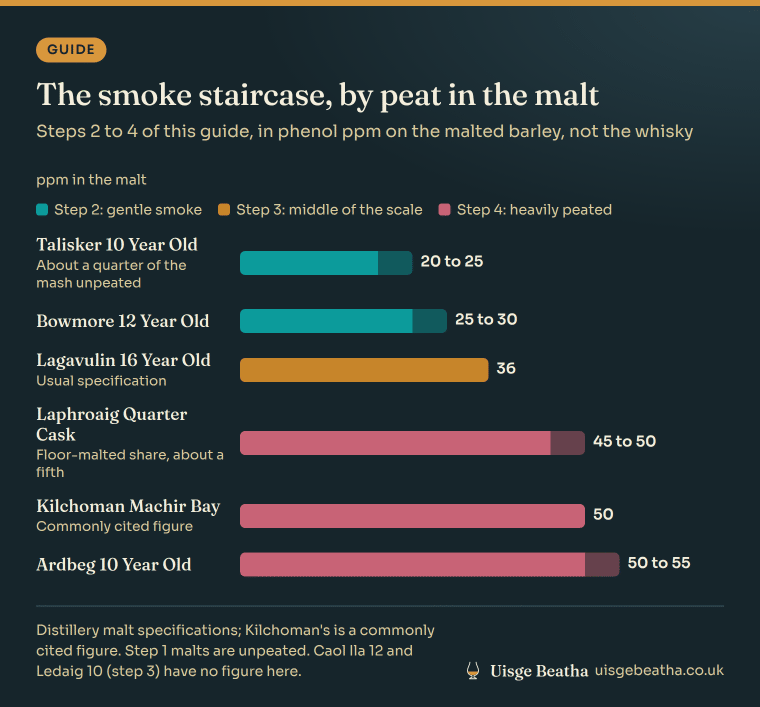
That figure is a rough guide only. Distillation and maturation remove a lot of the phenols, so two whiskies made from malt at the same ppm can taste very different, and an older whisky usually tastes less smoky than a young one from the same malt. Producers rarely print ppm on the label. The figures below are the distilleries’ own malt specifications where they publish one, otherwise commonly cited figures, and none of them is a label fact. Whiskipedia explains the limits of ppm.
Step 1: Islay without the smoke
Not every Islay whisky is peated. These two use unpeated malt, so you can try the island’s style first.
Bunnahabhain 12 Year Old: £41.39 at Master of Malt. A 46.3% ABV unpeated Islay single malt, bottled without chill-filtration.
Bruichladdich The Classic Laddie Scottish Barley: £51.00 at The Whisky Shop. A 50% ABV unpeated Islay single malt with no age statement, made from Scottish barley.

Bunnahabhain 12 Year Old
12 years · 46.3% ABV · 70cl
from £41.39 2 retailers
£46.34 delivered
Save up to £6.56
Compare prices
Bruichladdich The Classic Laddie Scottish Barley
50.0% ABV · 70cl
from £51.00 2 retailers
£55.99 delivered
Compare pricesStep 2: Gentle smoke
Bowmore 12 Year Old: currently unavailable. A 40% ABV Islay single malt. Bowmore specifies its malt at 25 to 30 ppm, and the distillery still malts part of its own barley on traditional floors.
Talisker 10 Year Old: £39.15 at Master of Malt. A 45.8% ABV single malt from the Isle of Skye. Talisker specifies 20 to 25 ppm for its peated malt, which is mixed with about a quarter unpeated malt, and its house style is often described as peppery and coastal. Whiskipedia on Talisker.

Step 3: Middle of the scale
Caol Ila 12 Year Old: £49.95 at Hard To Find Whisky. A 43% ABV Islay single malt from the largest distillery on the island by capacity. Whiskipedia on Caol Ila.
Ledaig 10 Year Old: £39.50 at Master of Malt. A 46.3% ABV peated single malt from the Tobermory distillery on Mull. Ledaig is the name Tobermory uses for its peated spirit.
Lagavulin 16 Year Old: £72.95 at Master of Malt. A 43% ABV Islay single malt whose usual malt specification is about 36 ppm (for a few weeks a year the distillery uses more heavily peated malt). Sixteen years in the cask make it one of the older core peated malts. Whiskipedia on Lagavulin.

Caol Ila 12 Year Old
12 years · 43.0% ABV · 70cl
from £49.95 2 retailers
£55.90 delivered
Save up to £12.01
Compare prices
Ledaig 10 Year Old
10 years · 46.3% ABV · 70cl
from £39.50 4 retailers
£44.45 delivered
Save up to £8.45
Compare prices
Lagavulin 16 Year Old
16 years · 43.0% ABV · 70cl
from £72.95 5 retailers
£77.90 delivered
Save up to £21.00
Compare pricesStep 4: Heavily peated
Ardbeg 10 Year Old: £40.52 at Master of Malt. A 46% ABV Islay single malt, bottled without chill-filtration. Ardbeg specifies its malt at 50 to 55 ppm.
Laphroaig Quarter Cask: £47.00 at The Whisky Shop. A 48% ABV Islay single malt with no age statement, finished in small quarter casks of about 125 litres, which speed up the wood’s effect. Laphroaig specifies 45 to 50 ppm for the malt it floor-malts on site, about a fifth of what it uses. Whiskipedia on Laphroaig.
Kilchoman Machir Bay: £44.25 at Master of Malt. A 46% ABV Islay single malt, mostly from malt commonly cited as peated to about 50 ppm.

Ardbeg 10 Year Old
10 years · 46.0% ABV · 70cl
from £40.52 4 retailers
£45.47 delivered
Save up to £4.48
Compare prices
Laphroaig Quarter Cask
48.0% ABV · 70cl
from £47.00 2 retailers
£51.99 delivered
Compare prices
Kilchoman Machir Bay
46.0% ABV · 70cl
from £44.25 4 retailers
£49.20 delivered
Save up to £9.75
Compare pricesFor a wider view, the chart below plots every in-stock peated bottle with a stated ppm against its UK shelf price. Read more in peat level vs price.
This price comparison is temporarily unavailable while its data is refreshed. Browse current bottle comparisons instead.
Ways to try it
A few drops of water lower the strength and often make the smoke easier to read. A peated highball, one part whisky to three or four parts cold soda, is another gentle start. Peated malts are often paired with smoked fish, strong cheese or dark chocolate, but these are options, not rules. For more picks across every smoke level, see peated whisky.
Sources and review
Where to go next
Questions
What is the least smoky Islay whisky?
Is Lagavulin too smoky for a beginner?
Why can peated whisky taste medicinal?
What is peat?
About the author
