On this page
GuideIf you like X
Best Scotch for bourbon drinkers
A flavour bridge from bourbon to Scotch single malts, comparing virgin oak finishes, first-fill bourbon casks and unpeated malts, with live UK prices.
If you are an American whiskey drinker whose primary reference point is bold, sweet, 100-proof Kentucky straight bourbon, approaching Scotch can feel fraught with peril.
Perhaps someone once handed you a glass of heavily peated Islay malt that tasted like a bonfire on an old tyre yard, and you swore off Scotch forever. Or perhaps you bought a cheap supermarket blend that felt thin, watery, and tasted mostly of damp cardboard and ethanol.
Here is the open secret the Scotch industry rarely puts in bold print on the front label: Scotch and bourbon are practically first cousins.
The Kentucky–Scotland connection
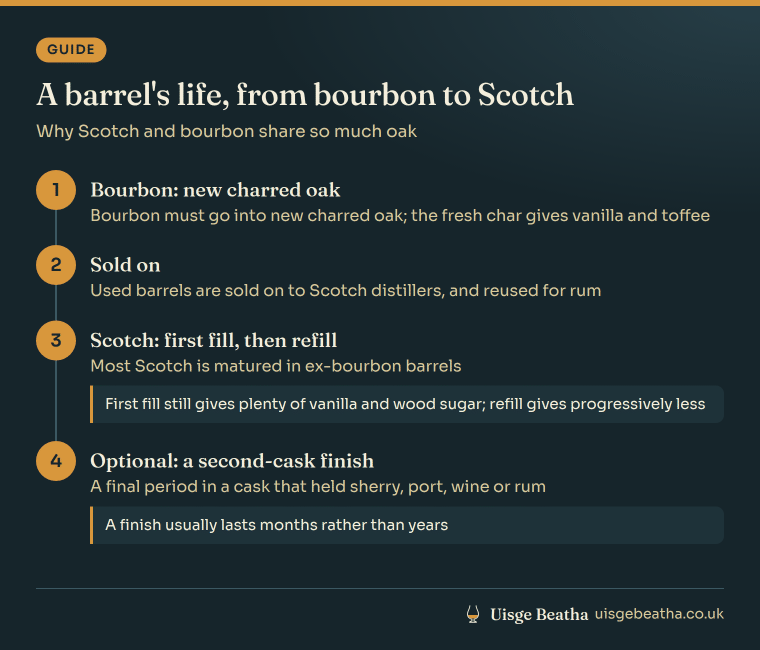
Most single malt Scotch whisky is matured in oak barrels shipped directly from Kentucky. Because American federal law requires bourbon to be matured in new charred oak containers, the used barrels are sold on, and Scottish distilleries buy them up by the hundred-thousand.
The difference is that Scottish warehouses are damp and cold, rarely topping 18°C in summer. That means Scotch matures at a gentle, slow pace over 10 to 18 years, developing delicate floral, orchard fruit, and malty esters from barley, while extracting the residual vanilla and oak lactones left behind by the bourbon.
So a bourbon drinker who dislikes Scotch may simply dislike peat smoke, or light 40% ABV blends. A better starting point is unpeated, wood-forward single malt bottled at a higher strength.
The three best Scotch routes for bourbon fans
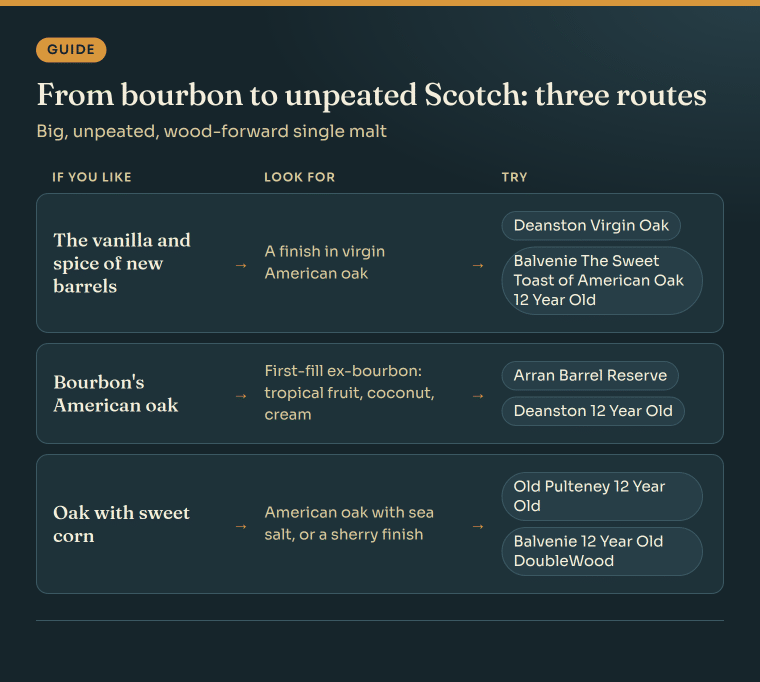
1. The Virgin American Oak Bridge
If your palate craves the aggressive vanilla, toasted oak, and baking spice of brand-new barrels, look for a Scotch finished in virgin (unused) American oak.
- Deanston Virgin Oak: £31.30 at Master of Malt. Highland single malt from Deanston finished in virgin oak casks from Kelvin Cooperage in Louisville, Kentucky. 46.3% ABV.
- Deanston is located in Perthshire, operating in an 18th-century cotton mill on the River Teith. They use unpeated Scottish barley, long fermentations of about 85 hours, and crucially: they never chill-filter and add zero caramel colouring. Bottled at a healthy 46.3% ABV, the virgin American oak finish injects intense candied orange, nutmeg, and vanilla right into Deanston’s signature waxy, honeyed malt.
- Balvenie The Sweet Toast of American Oak 12 Year Old: £49.00 at The Whisky Shop. Speyside single malt from Balvenie finished in deeply toasted virgin Kentucky oak barrels. 43% ABV.
- Balvenie brings virgin American oak casks from Kelvin Cooperage in Kentucky to their on-site cooperage in Dufftown, Scotland, where their coopers give them a prolonged, deep toast rather than an aggressive burn. This caramelises the wood sugars and draws out vanillin.


2. The First-Fill Bourbon Cask Bridge
When Scotch goes into an ex-bourbon barrel that has never held Scotch before (first-fill), the barrel is still loaded with American oak influence: tropical fruit, coconut, and rich cream.
- Arran Barrel Reserve: £35.00 at The Whisky Shop. Island single malt from Arran at Lochranza, matured 100% in first-fill ex-bourbon barrels. 43% ABV.
- Arran’s spirit is clean, orchard-fruit forward, and completely unpeated. By maturing exclusively in first-fill bourbon barrels, the distillery lets the sweet American white oak sing: crisp green apples, lemon zest, and coconut cream.
- Deanston 12 Year Old: £35.95 at Master of Malt. 100% ex-bourbon matured for twelve full years, bottled at 46.3% ABV.
- Unlike its younger Virgin Oak sibling, the 12 Year Old spends its entire life in ex-bourbon casks. Twelve Scottish winters give the malt a waxy, honeycomb mouthfeel that coats the tongue like a high-end small-batch bourbon.


3. The Rich & Salty Maritime Oak
Bourbon often pairs oak with sweet corn. Coastal Highland malts pair that same American oak with a lick of sea salt, balancing the sweetness like salted caramel.
- Old Pulteney 12 Year Old: £29.95 at Hard To Find Whisky. Matured predominantly in air-dried ex-bourbon casks in the far north of Scotland at Wick. 40% ABV.
- Known as ‘The Maritime Malt’. Pulteney’s stills have a unique boil bulb and no swan neck: the lyne arm goes straight into a worm tub condenser. That produces a heavy spirit that matures for twelve years in warehouses beside the sea.
- Balvenie 12 Year Old DoubleWood: £50.28 at Master of Malt. The benchmark Speyside malt: matured in ex-bourbon oak, then finished in Spanish oloroso sherry casks. 40% ABV.
- Created in 1993 by long-serving malt master David Stewart MBE. Twelve years in American oak provides the vanilla backbone; nine months in European oak sherry casks provides dried fruit and gentle cinnamon tannins.


Quick checklist for bourbon drinkers buying Scotch
- Avoid the word “Peated”: Unless you actively want campfire smoke and medicinal iodine, stick to unpeated malts. Look for Speyside, unpeated Highlands, or the Lowlands.
- Look for “Non-Chill-Filtered”: Chill-filtration removes fatty acids and oils so the whisky doesn’t turn cloudy when cold. Un-chillfiltered malts retain the rich, oily texture bourbon drinkers love.
- Check the ABV: Aim for 43% to 46.3% ABV. A 40% bottling can feel light on the palate if you are used to 90 or 100 proof Kentucky whiskeys.
- Embrace water: Don’t be afraid to add three drops of water to open up the malt aromas in your glass.
Sources and review
Questions
Which Scotch tastes most like bourbon?
Why do some Scotches taste smoky while bourbon never does?
What does 'first-fill bourbon cask' mean on a Scotch label?
Why does 40% ABV Scotch feel thinner than bourbon?
About the author
