On this page
Single cask vs single barrel whisky explained
What single cask whisky means, how to read cask numbers and outturns, single cask vs single barrel, and why single cask is not always cask strength.
A single cask bottling holds whisky from one individual cask, rather than a vatting of many. Because every cask matures differently, two single casks from the same distillery and year can differ, and when a cask is bottled, that release is finished. The label tells you which cask it was, who bottled it, the bottle size and the ABV: check those for each release.
Single cask vs single malt: clearing up the confusion
“Single malt” and “single cask” answer different questions. Under the Scotch Whisky Regulations 2009, a single malt Scotch is made at a single distillery from water and malted barley, distilled in pot stills. Most single malts are vatted from many casks to produce a consistent house style: the UK government’s Scotch Whisky technical file explains that every cask is different, so blenders monitor and adjust their recipes from batch to batch.
“Single cask” means everything in the bottle came from one cask. It says nothing about strength: a single cask can be bottled at cask strength or reduced with water, so look for a separate “cask strength” statement. Single cask labels often give the cask number and, for some releases, the distillation and bottling dates, the cask type and the total number of bottles (the outturn). The Single Cask, an independent bottler, puts the cask number in each release name, for example.
Single cask vs single barrel: is there a difference?
Mostly wording. American producers such as Four Roses and Jack Daniel’s use “single barrel” for whiskey drawn from one barrel; Scotch labels more often say “single cask”. Both describe whisky from one container. As with any single cask, barrels from the same distillery can differ, which is why single barrel labels often identify the barrel.
Outturn: how many bottles are in a cask?
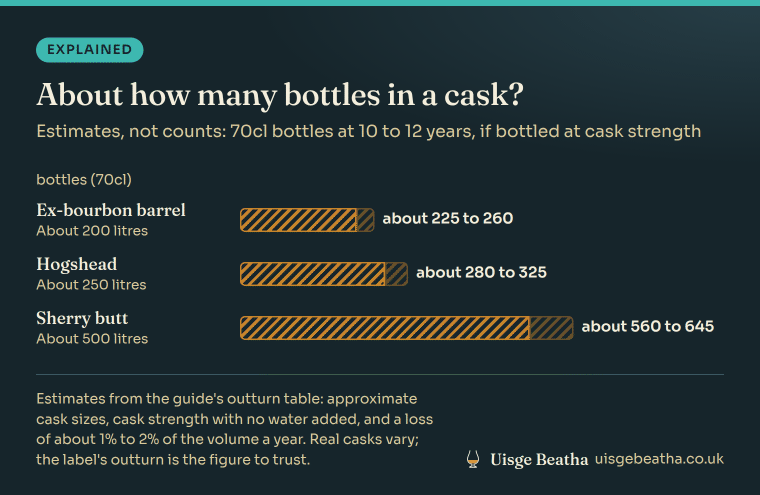
The outturn is the number of bottles a cask produced. It depends on the size of the cask, how much was lost during maturation and whether water was added before bottling. The table below gives rough estimates, using the sizes Whiskipedia gives and assuming a loss of 1% to 2% of the volume a year; the Scotch Whisky technical file puts the average at about 2%.
On smaller screens, scroll sideways to see every column.
| Cask type | Approximate capacity | Estimated yield at 10 to 12 years (70cl, cask strength) |
|---|---|---|
| Ex-bourbon barrel | about 200 litres | 225 to 260 bottles |
| Hogshead | about 250 litres | 280 to 325 bottles |
| Sherry butt | about 500 litres | 560 to 645 bottles |
These are estimates, not a guarantee of any bottle count. Real casks vary in size, aren’t always filled to capacity and lose different amounts depending on the warehouse. At the same rates, a 200-litre barrel left for 30 years would hold roughly 110 to 150 litres, about 155 to 210 bottles at cask strength. The label’s outturn, where given, is the figure to trust.
Single cask and single barrel bottles to compare
These bottles are labelled single cask or single barrel. Each line uses the producer’s or bottler’s own description:
- Four Roses Single Barrel: currently unavailable. Bourbon at 100 proof (50% ABV). Four Roses says it uses its OBSV recipe: the higher-rye Mash Bill B (60% corn, 35% rye, 5% malted barley) with its V yeast strain.
- Jack Daniel’s Single Barrel Select: £43.99 at Master of Malt. Tennessee whiskey at 45% ABV in its UK bottling. Jack Daniel’s says the barrels chosen for Single Barrel Select rest in the upper floors of its warehouses.
- Jack Daniel’s Single Barrel Rye: £48.00 at Master of Malt. Rye whiskey from a single barrel, made from a grain bill of 70% rye, 18% corn and 12% malted barley, at 45% ABV in its UK listing.
- Connoisseurs Choice Glenrothes 2009 16 Year Old, cask 19602410: £139.95 at Hard To Find Whisky. A single cask Speyside single malt from Glenrothes, bottled by Gordon & MacPhail at 55.5% ABV. Retailer listings describe it as a first-fill sherry hogshead distilled in 2009 and bottled in 2025, with an outturn of 302 bottles.

Jack Daniel's Single Barrel Select
45.0% ABV · 70cl
from £43.99 4 retailers
£48.94 delivered
Save up to £3.96
Compare prices
Jack Daniel's Single Barrel Rye
45.0% ABV · 70cl
from £48.00 4 retailers
£52.95 delivered
Save up to £26.00
Compare prices
Connoisseurs Choice Glenrothes 2009 16 Year Old #19602410
16 years · 55.5% ABV · 70cl
from £139.95 3 retailers
£139.95 delivered
Save up to £0.05
Compare pricesA warning on buying whole casks
A single cask bottle is a bottle of whisky. Buying a whole cask is a different matter, and it is often marketed as if it were a financial product. The Scotch Whisky Association’s cask guidance notes there is no official cask price list or public exchange, and the FCA’s scam guidance names whisky among the unregulated products that investment scams often involve, with unexpected approaches, pressure to act quickly and offers that sound too good to be true among its warning signs. A cask also loses volume and strength every year, and bottling it means paying duty and VAT. Our guide to buying a whisky cask sets out the costs, checks and risks in full.
Sources and review
Questions
What is the difference between single malt and single cask?
How many bottles does a single cask of whisky yield?
How big is a whisky cask?
Who bottles single cask whisky?
About the author
