On this page
What is single malt Scotch whisky?
What defines a single malt Scotch whisky, what 'single' really means, why it must use pot stills, and the 5 legal categories of Scotch whisky.
Single malt Scotch whisky is Scotch distilled at a single distillery from only water and malted barley, in one or more batches in pot stills. Like all Scotch, it must be matured in Scotland in oak casks of no more than 700 litres for at least three years (Scotch Whisky Regulations 2009, regulation 3).
If you have ever stood in front of a supermarket spirits shelf feeling bewildered by words like “Single Malt”, “Blended Malt”, “Single Grain”, and “Small Batch”, you are not alone. Only some of those words are defined in law. “Small Batch” is not one of them.
Here is the straightforward, hype-free guide to what single malt Scotch actually is, what that word “single” means, and how single malts differ from the other four types of Scotch whisky.
The legal checklist: what makes a single malt?
In the UK, Scotch is governed by the Scotch Whisky Regulations 2009 (S.I. 2009/2890). Regulation 3(2) defines Single Malt Scotch Whisky as a Scotch whisky distilled in one or more batches at a single distillery, from water and malted barley without any other cereals, in pot stills. Every Scotch whisky must also meet the general rules in regulation 3(1). Taken together:
- One grain: Distilled from water and malted barley only, with no other cereals (no wheat, rye, maize or unmalted barley).
- One distillery: Mashed, fermented and distilled at a single distillery in Scotland.
- One still type: Distilled in batches in pot stills, never in continuous column stills. The regulations do not specify what the stills are made of, although Scotch malt distilleries use copper pot stills in practice, as the UK government’s Scotch Whisky technical file describes.
- Scottish maturation: Matured only in Scotland, only in oak casks of no more than 700 litres, for not less than three years.
- Bottling strength: A minimum of 40% ABV.
Notice what is not on that list: price, packaging or Scottish ownership. It is a production standard.
What does the word “single” actually mean?
The most common misunderstanding is that “single malt” means the whisky came from one single cask, or was made in one single day.
It does not. “Single” refers to the distillery, not the barrel. The regulation itself says a single malt may be distilled “in one or more batches”.
A standard bottle of Glenfiddich 12, Talisker 10 or Laphroaig 10 is vatted together from many casks of the same distillery’s whisky, so that each release keeps a consistent house style. As long as all of it was distilled at that one distillery, it is a single malt. A whisky drawn from one cask is sold as a single cask bottling.
The 5 legal types of Scotch whisky
Regulation 3(2) of the 2009 Regulations sets out five categories of Scotch whisky:
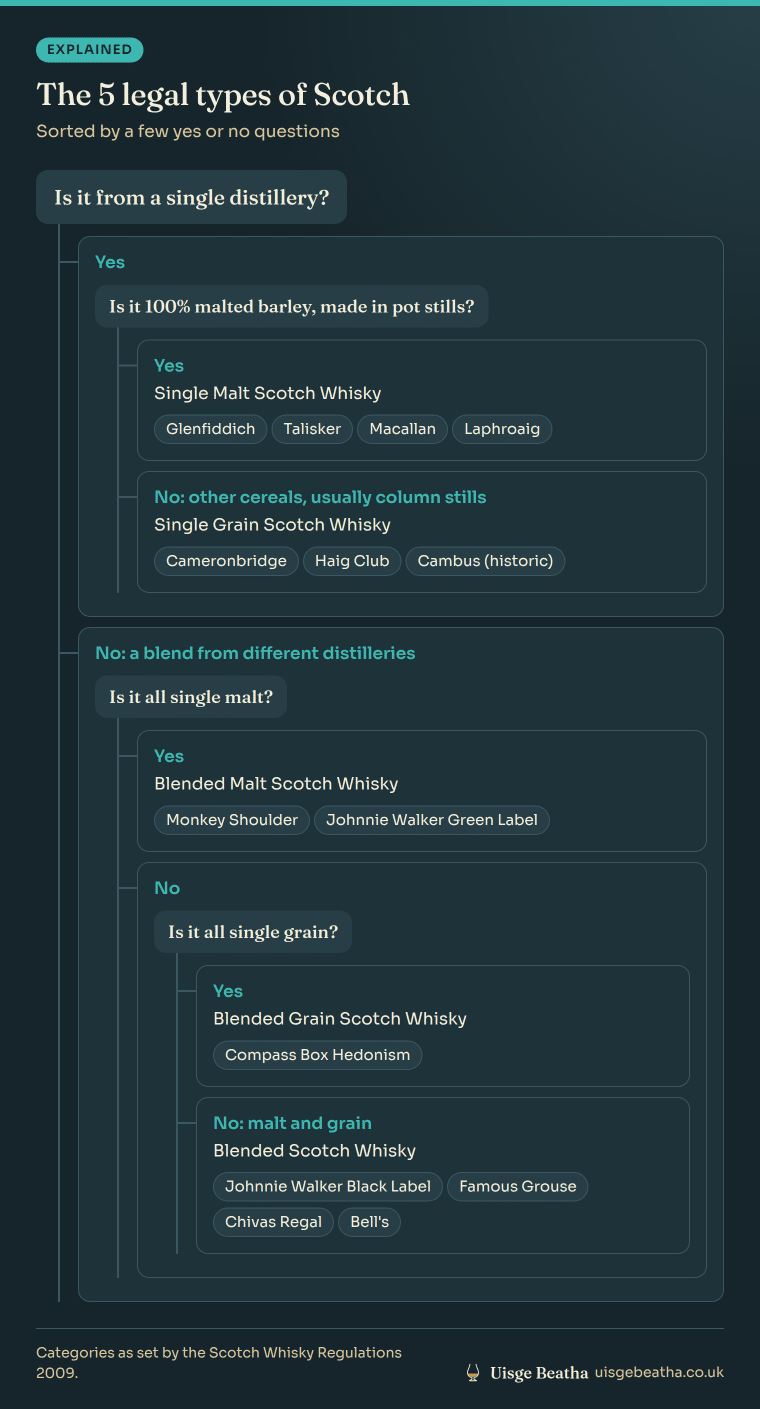
1. Single Malt Scotch Whisky
Malted barley only, pot stills, single distillery. (Examples: Glenfiddich, Talisker, Macallan, Laphroaig).
2. Single Grain Scotch Whisky
Distilled at a single Scottish distillery, but not meeting the single malt or blend definitions. It is usually made from wheat or maize with some malted barley, in continuous column stills, which must distil at less than 94.8% ABV, as the technical file explains. The same file notes that grain whisky can also be made from malted barley alone in a column still. (Examples: Cameronbridge, Haig Club, which is distilled at Cameronbridge, and the closed Cambus distillery).
3. Blended Malt Scotch Whisky
A blend of two or more Single Malt Scotch whiskies distilled at different distilleries. These were formerly called “vatted malt” or “pure malt”; the regulations now ban “pure malt” on Scotch labels (regulation 11). (Examples: Monkey Shoulder, Johnnie Walker Green Label).
4. Blended Grain Scotch Whisky
A blend of two or more Single Grain Scotch whiskies distilled at different distilleries. (Example: Compass Box Hedonism).
5. Blended Scotch Whisky
A blend of one or more Single Malts with one or more Single Grain Scotch whiskies. Blended Scotch is the biggest category: in 2025 bottled blends made up 56.7% of Scotch exports by volume and 59.8% by value, according to the Scotch Whisky Association’s 2025 export figures. Single malt was 29.7% of volume and 34.4% of value. (Examples: Johnnie Walker Black Label, Famous Grouse, Chivas Regal, Bell’s).
Why pot stills matter
Single malt must be made in pot stills, which work differently from column stills. A continuous column still can distil at very high strength, just under the 94.8% ABV legal limit for Scotch, which gives a lighter spirit.
A pot still works in batches. Malt Scotch is usually distilled twice: first in a larger wash still, then in a smaller spirit still (Scotch Whisky technical file). The technical file also says each malt distillery has its own copper stills and that differences in still shape lead to differences in flavour. Copper reacts with sulphur compounds in the vapour, which is one reason it is used. New make from a pot still usually leaves the spirit safe at roughly 68% to 71% ABV, well below column-still strength, so more of the character of the barley and fermentation carries through.
Single malt benchmarks to explore
Here are four Scottish single malts that show the range of the category:
Glenfiddich 12 Year Old: £36.96 at Master of Malt. The flagship single malt of Glenfiddich in Dufftown, Speyside, bottled at 40% ABV. William Grant founded the distillery in 1886 and it first produced spirit on Christmas Day 1887.
Balvenie 12 Year Old DoubleWood: £50.28 at Master of Malt. Speyside single malt from Balvenie, matured in two cask types and finished in sherry casks, bottled at 40% ABV. Balvenie is one of the few Scotch distilleries that malts some of its own barley on site.
Talisker 10 Year Old: £39.15 at Master of Malt. Single malt distilled at Talisker on the Isle of Skye, bottled at 45.8% ABV. Talisker has two wash stills and three spirit stills, all connected to worm tub condensers, and its wash stills have a U-bend in the lyne arm.
Auchentoshan 12 Year Old: £29.95 at Hard To Find Whisky. Lowland single malt bottled at 40% ABV. Auchentoshan is one of only two Scotch distilleries that triple distil all of their spirit (Rosebank is the other), with a narrow spirit cut between about 82.5% and 80% ABV.

Glenfiddich 12 Year Old
12 years · 40.0% ABV · 70cl
from £36.96 4 retailers
£41.91 delivered
Save up to £9.04
Compare prices
Balvenie 12 Year Old DoubleWood
12 years · 40.0% ABV · 70cl
from £50.28 4 retailers
£55.23 delivered
Save up to £3.72
Compare prices
Talisker 10 Year Old
10 years · 45.8% ABV · 70cl
from £39.15 5 retailers
£44.10 delivered
Save up to £12.80
Compare prices
Auchentoshan 12 Year Old
12 years · 40.0% ABV · 70cl
from £29.95 4 retailers
£35.90 delivered
Save up to £4.05
Compare pricesHow to begin exploring single malt
There is no rule that single malt must be drunk neat or at cask strength. Unpeated Speyside and Lowland malts such as Glenfiddich 12 or Auchentoshan 12 are a common starting point, and adding a little water is a matter of taste. Browse every single malt or blended malt to compare current prices.
Sources and review
Questions
What is the difference between single malt and blended Scotch?
Does single malt mean the whisky comes from one cask?
Can single malt whisky be produced outside Scotland?
About the author
