On this page
GuideIf you like X
Best whisky for craft beer lovers
Malt whisky starts as an unhopped beer. Here is how to move from pale ale, stout or smoked beer to a whisky with flavours you already know, at UK prices.
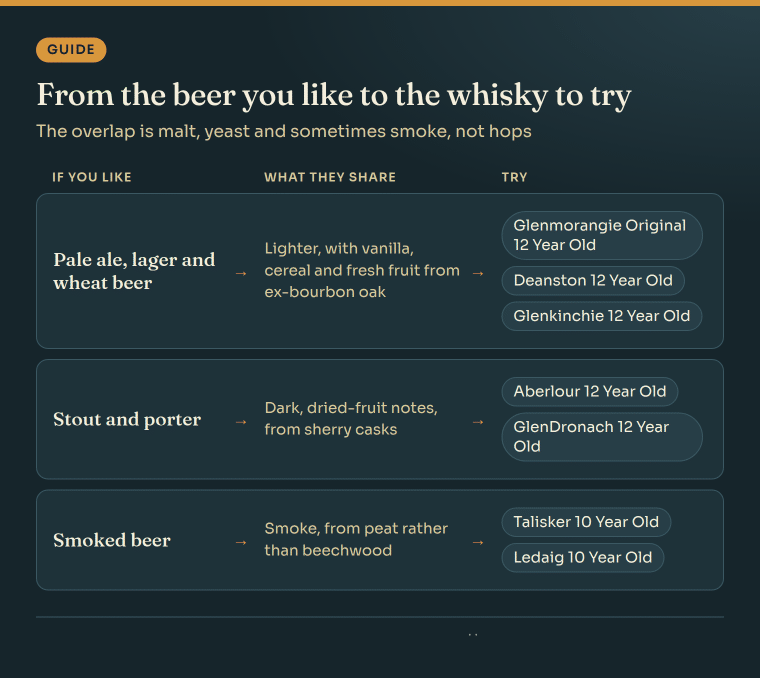
If you drink craft beer, start with the beer style you like best. Pale ale and lager drinkers usually get on with light, bourbon-cask malts such as Glenmorangie Original 12 Year Old. Stout and porter drinkers often prefer sherry-cask malts such as Aberlour 12 Year Old. Fans of smoked beer can go straight to a peated malt such as Talisker 10 Year Old.
How whisky and beer are related
Malt whisky starts the same way as beer. Malted barley is mashed with hot water to release its sugars, giving a sweet liquid called wort. Brewers boil the wort with hops before it is fermented; distillers skip the hops, and yeast ferments the unhopped wort into a “wash” of about 8% ABV, so whisky has no hop bitterness. The wash is then distilled, usually twice in copper pot stills for Scotch malt, and the spirit is matured in oak. Scotch must spend at least three years in the cask, and much of its flavour comes from that wood.
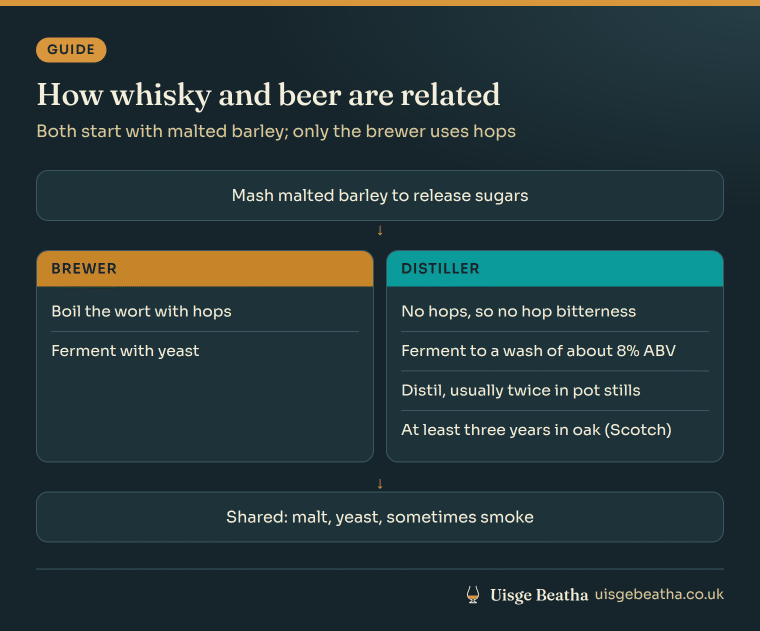
So the overlap is malt, yeast and sometimes smoke, not hops. Whiskipedia on fermentation and double distillation explain the steps in more detail.
For pale ale, lager and wheat beer drinkers
Malts matured mainly in ex-bourbon American oak casks tend to taste lighter, with vanilla, cereal and fresh fruit, which is a short step from a pale beer.
Glenmorangie Original 12 Year Old: £39.00 at The Whisky Shop. A 40% ABV Highland single malt matured in ex-bourbon casks. Glenmorangie’s stills are among the tallest in Scotland, which the distillery says gives a lighter spirit.
Deanston 12 Year Old: £35.95 at Master of Malt. A 46.3% ABV unpeated Highland malt, bottled without chill-filtration, from a distillery built in 1965 inside a former cotton mill on the River Teith. Deanston’s house style is usually described as malty and honeyed.
Glenkinchie 12 Year Old: £47.95 at Hard To Find Whisky. A 43% ABV Lowland single malt from East Lothian, one of the lighter, grassier styles of Scotch.

Glenmorangie Original 12 Year Old
12 years · 40.0% ABV · 70cl
from £39.00 3 retailers
£43.99 delivered
Save up to £0.95
Compare prices
Deanston 12 Year Old
12 years · 46.3% ABV · 70cl
from £35.95 4 retailers
£40.90 delivered
Save up to £9.00
Compare prices
Glenkinchie 12 Year Old
12 years · 43.0% ABV · 70cl
from £47.95 2 retailers
£53.90 delivered
Save up to £2.57
Compare pricesFor stout and porter drinkers
Roast and chocolate in a stout come from dark malts. Whisky gets similar dark, dried-fruit notes from sherry casks instead. Oloroso casks held a dry, nutty sherry; Pedro Ximénez (PX) casks held a very sweet one. Whiskipedia on oloroso casks.
Aberlour 12 Year Old: £45.00 at The Whisky Shop. A 40% ABV Speyside single malt matured in a mix of traditional oak and sherry casks.
GlenDronach 12 Year Old: £49.95 at Hard To Find Whisky. A 43% ABV Highland single malt matured in PX and oloroso sherry casks. GlenDronach was founded in 1826.

Aberlour 12 Year Old
12 years · 40.0% ABV · 70cl
from £45.00 2 retailers
£49.99 delivered
Compare prices
Glendronach 12 Year Old
12 years · 43.0% ABV · 70cl
from £49.95 5 retailers
£55.90 delivered
Save up to £11.05
Compare pricesFor smoked beer drinkers
Peated whisky gets its smoke from peat burned in the kiln that dries the malted barley. It smells earthier and more medicinal than the beechwood smoke of a Bamberg Rauchbier, so start with a moderate one. Whiskipedia on peat.
Talisker 10 Year Old: £39.15 at Master of Malt. A 45.8% ABV single malt from the Isle of Skye, peated by house style rather than by a stated figure on the label. The distillery’s peated malt is commonly cited at 20 to 25 ppm phenols, measured on the malted barley rather than the whisky, and about a quarter of the mash is reportedly unpeated malt.
Ledaig 10 Year Old: £39.50 at Master of Malt. A 46.3% ABV peated single malt from the Tobermory distillery on Mull. Ledaig is the name Tobermory uses for its peated spirit.

Talisker 10 Year Old
10 years · 45.8% ABV · 70cl
from £39.15 5 retailers
£44.10 delivered
Save up to £12.80
Compare prices
Ledaig 10 Year Old
10 years · 46.3% ABV · 70cl
from £39.50 4 retailers
£44.45 delivered
Save up to £8.45
Compare pricesBeer-cask whiskies
Some whiskies are finished in casks that held beer, such as Glenfiddich’s IPA Experiment (2016) or Jameson Caskmates Stout Edition. Since 2019 the Scotch Whisky Technical File has allowed Scotch to mature in ex-beer casks, provided no fruit, flavouring or sweetening was added to the beer after fermentation. These releases come and go, and the finish usually lasts months rather than years, so the base whisky still sets most of the flavour.
Sources and review
Where to go next
Questions
Is whisky made from beer?
What is an IPA-cask whisky?
What whisky suits stout drinkers?
Can beer drinkers enjoy peated whisky?
About the author
