On this page
GuideBeginners
Whisky for people who don't like whisky
Burn, smoke or bitterness: what usually puts people off whisky, and the styles, serves and mixers that change it, with bottles to try at UK prices.
If whisky put you off, work out why first. Most people mean one of three things: alcohol burn, smoke, or a dry, bitter woodiness. Each has a fix. Water or a long drink cuts the burn, unpeated whisky removes the smoke, and a sweeter style such as a wheated bourbon or an Irish blend softens the wood. No whisky stops tasting of whisky, so start with a small measure.
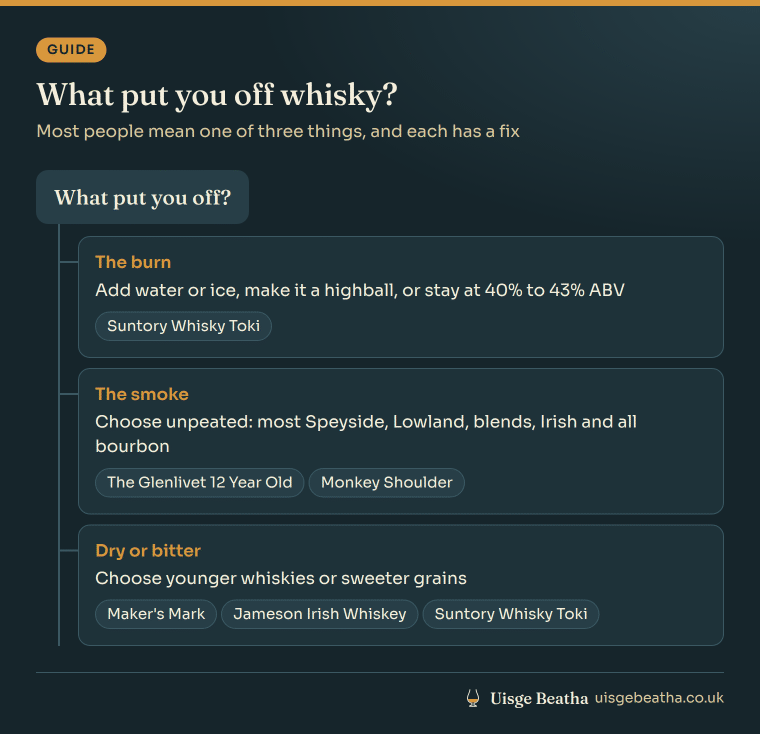
If it was the burn
Alcohol triggers the mouth’s heat receptors, the same ones chilli triggers. Whisky is bottled at 40% ABV or more, roughly three times the strength of wine, so the first sip of a neat whisky can be a shock.
- Add water. A few drops lower the strength and often bring out more aroma. Keep going until the heat stops masking the flavour.
- Add ice. Cold dulls both the burn and the flavour, which can be a fair trade at first.
- Make it long. A highball, one part whisky to three or four parts soda water over ice, brings a 40% ABV whisky down to about 8% to 10% ABV, the strength of a strong beer.
- Stay at 40% to 43% ABV. Avoid cask-strength bottles, which are often 55% to 60%.
Whiskipedia explains how water changes whisky.
If it was the smoke
Smoke comes from peat, burned to dry the malted barley at some distilleries. It is a choice, not a feature of all whisky. Most Speyside and Lowland malts, most blends, almost all Irish whiskey and all bourbon are unpeated. Whiskipedia on peat in whisky explains how it works.
The Glenlivet 12 Year Old (£34.95 at Hard To Find Whisky). Unpeated Speyside single malt at 40% ABV, matured in American and European oak.
Monkey Shoulder (£30.95 at Hard To Find Whisky). A blended malt from William Grant & Sons at 40% ABV, made to be mixed as well as sipped.
If it was dry or bitter
A dry, tannic finish usually comes from the oak. Younger whiskies and whiskies made with sweeter grains show less of it.
Maker’s Mark (£35.00 at The Whisky Shop). Kentucky bourbon at 45% ABV, made with red winter wheat in place of rye. Bourbon must be at least 51% corn and aged in new charred oak, which gives vanilla and caramel.
Jameson Irish Whiskey (£23.40 at Master of Malt). A triple-distilled blend of pot still and grain whiskey from Midleton in County Cork, 40% ABV.
Suntory Whisky Toki (£29.50 at Master of Malt). A light Japanese blend at 43% ABV, which Suntory designed for the highball.

The Glenlivet 12 Year Old
12 years · 40.0% ABV · 70cl
from £34.95 4 retailers
£40.90 delivered
Save up to £6.05
Compare prices
Monkey Shoulder
40.0% ABV · 70cl
from £30.95 4 retailers
£35.90 delivered
Save up to £1.05
Compare prices
Maker's Mark Bourbon
45.0% ABV · 70cl
from £35.00 2 retailers
£39.99 delivered
Compare prices
Jameson Irish Whiskey
40.0% ABV · 70cl
from £23.40 4 retailers
£28.35 delivered
Save up to £4.55
Compare prices
Suntory Whisky Toki
43.0% ABV · 70cl
from £29.50 4 retailers
£34.45 delivered
Save up to £5.50
Compare pricesServes that change the experience
- Highball: whisky and chilled soda water, one to three or four, over ice, with lemon peel. Toki or a light blended Scotch.
- Whisky and ginger: one part whisky to three parts ginger ale, with lime. Jameson or Maker’s Mark.
- Whisky Sour: 50 ml whisky, 25 ml lemon juice and 15 ml to 25 ml sugar syrup, shaken with ice. Bourbon is the usual base.
Start with one small drink rather than a tasting flight, and drink water alongside.
More blends to compare

Slane Irish Whiskey
40.0% ABV · 70cl
from £24.60 5 retailers
£29.10 delivered
Save up to £7.35
Compare prices
Antiquary 15 Year Old Claret Cask Matured
15 years · 40.0% ABV · 70cl
from £36.50 4 retailers
£41.45 delivered
Save up to £13.50
Compare prices
Antiquary 21 Year Old Port Cask Matured
21 years · 40.0% ABV · 70cl
from £88.77 4 retailers
£93.72 delivered
Save up to £19.23
Compare prices
Ardray Blended Scotch Whisky 70cl
48.0% ABV · 70cl
from £57.00 4 retailers
£61.95 delivered
Save up to £2.95
Compare prices
Black Bottle 10 Year Old
10 years · 40.0% ABV · 70cl
from £28.00 4 retailers
£32.95 delivered
Save up to £1.95
Compare prices
Black Bottle Blended Scotch Whisky
40.0% ABV · 70cl
from £21.95 4 retailers
£27.45 delivered
Save up to £14.05
Compare pricesSources and review
Where to go next
Questions
Why does whisky burn?
Does whisky taste better with age?
What is the best whisky mixer?
What whisky should I try if I dislike whisky?
About the author
