On this page
Whisky maturation and age statements explained
What a Scotch age statement legally means, why no age statement is not no age, how oak changes spirit, and why whisky stops ageing in the bottle.
On a bottle of Scotch, the age statement is the age of the youngest whisky in it, not an average. Every whisky in a bottle labelled 12 years old has spent at least 12 years in oak casks in Scotland. A bottle with no age statement has no age on the label, but as Scotch it is still at least three years old.
New-make spirit from a Scottish distillery’s pot stills runs off at roughly 68% to 71% ABV, according to Whiskipedia, and it is colourless. It usually goes into the cask at a lower strength: around 63.5% is common. Years later, that same spirit leaves the warehouse with its colour and much of its flavour taken from the cask.
Distillers often say most of a mature single malt’s flavour comes from the cask; figures of 60% to 80% are commonly quoted, but they are rules of thumb, not measurements. Misconceptions about age statements, bottle ageing and maturation remain widespread, so here is what the rules say and what the wood does.
What does an age statement legally mean?
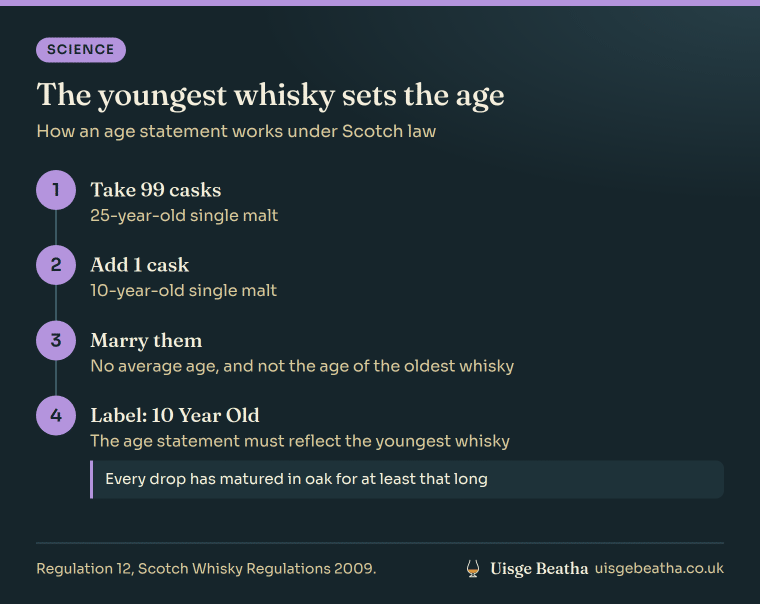
Regulation 12 of the Scotch Whisky Regulations 2009 requires any age on Scotch to be stated in years, and points to the spirit drinks rule that an age may only refer to the youngest alcoholic component. An age statement on a bottle of Scotch is the age of the youngest whisky in it.
If a blender combined ninety-nine casks of 25-year-old single malt with one cask of 10-year-old, the bottle could only be labelled 10 years old. The age can’t be an average, and the UK government’s Scotch Whisky technical file says no reference may be made, on the label or in promotion, to the ages of the older whiskies in the bottle. If a bottle of Scotch carries an age statement, all of the whisky in it has matured for at least that many years.
What does NAS mean?
NAS stands for no age statement. It means the label gives no age, not that the whisky has no age. Every Scotch, with or without an age statement, has been matured for at least three years. A NAS whisky lets a blender use younger casks alongside older ones without labelling the bottle with the youngest age, and Whiskipedia links its spread to the youngest-age rule and to shortages of aged stock.
How do you judge an NAS whisky as a shopper?
Look past the story on the label to the facts that are stated. Check the ABV and whether the label says “non-chill filtered” (the chill filtration guide explains what that claim does and does not mean), and look for a “natural colour” statement, which means no plain caramel (E150a) was added. Then compare the price with the same distillery’s age-stated bottles: if the NAS bottling costs more than the distillery’s 12-year-old, check what it offers in return, such as a particular cask type or a higher strength.
What is whisky called before it is aged?
Freshly distilled spirit is called new make in Scotland (white dog in the United States). Under regulation 3, it can’t be sold as Scotch whisky until it has been matured in oak in Scotland for at least three years.
These are the rules for Scotch. Other countries set their own minimum ages and labelling rules, so don’t assume they apply to whisky made elsewhere.
The three stages of maturation chemistry
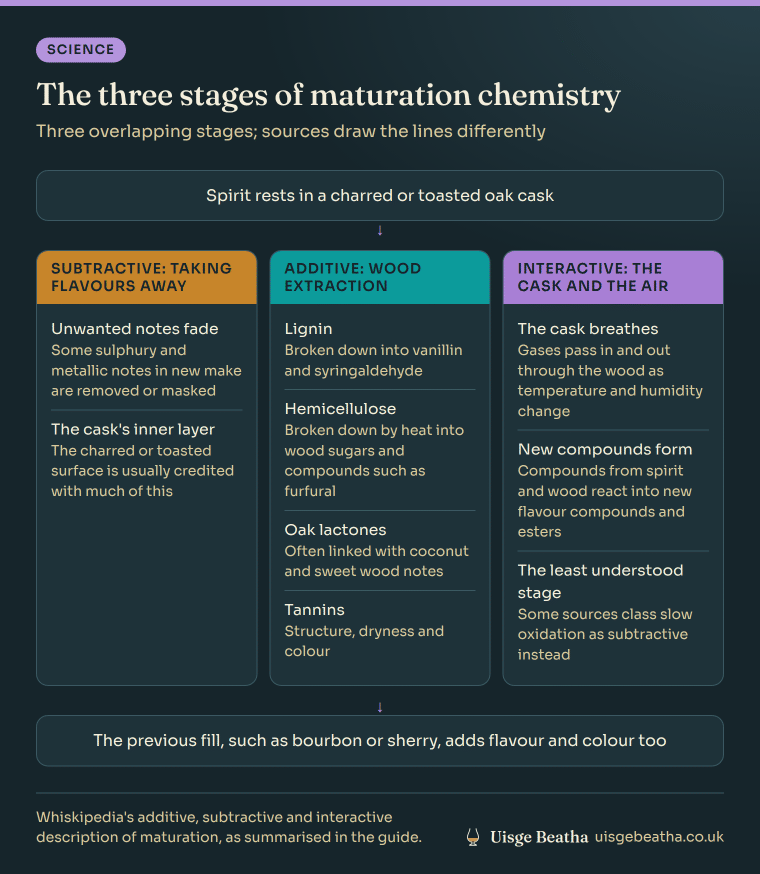
Maturation is not a passive resting period. It is often described in three overlapping stages, though sources draw the lines between them differently:
1. Subtractive maturation (taking flavours away)
Maturation removes or masks some unwanted notes in new make, such as sulphury and metallic ones, as Whiskipedia explains. The charred or toasted layer on the inside of the cask is usually credited with much of this.
2. Additive maturation (wood extraction)
The spirit draws flavour and colour compounds from the wood, especially from its toasted inner surface, and from whatever the cask held before, such as bourbon or sherry. Among them:
- Lignin: broken down into vanillin (vanilla) and syringaldehyde.
- Hemicellulose: broken down by heat into wood sugars and compounds such as furfural.
- Oak lactones: often linked with coconut and sweet wood notes.
- Tannins: structure, dryness and colour.
3. Interactive maturation (the cask and the air)
The least understood stage. The cask is not airtight: gases pass in and out through the wood as temperature and humidity change, and compounds from the spirit and the wood react to form new flavour compounds and esters. Slow oxidation is part of this, though some sources class it as subtractive.
The angel’s share: the cost of evaporation
A cask maturing in Scotland loses roughly 1% to 2% of its contents a year to evaporation, according to Whiskipedia, against as much as 12% in much hotter climates such as India or Australia. This loss is the angel’s share.
In Scotland’s cool, damp warehouses, alcohol usually evaporates a little faster than water, so a cask’s strength slowly falls as well as its volume. In hot, dry warehouses, such as the upper floors of many Kentucky rickhouses, water escapes faster than alcohol, so the strength can climb even as the volume drops. At 1% to 2% a year, compounding, a 250-litre hogshead would hold roughly 150 to 195 litres after 25 years. That lost volume is one reason older whisky costs more; see why old whisky is expensive.
The bottle ageing myth: does whisky age in the glass?
A common belief is that a 12-year-old whisky bought in 1980 and kept in a cupboard is now a 58-year-old whisky. It isn’t: it is still a 12-year-old whisky.
Whisky matures only in contact with the oak cask. Wine can keep changing in a corked bottle, but whisky in a sealed glass bottle has no cask to interact with, so its maturation stops when it is bottled. Once a bottle is opened, the air in it can slowly change the aroma and taste, faster as the bottle empties, which is a change but not ageing.
Is older always better? The over-ageing trap
Older is not automatically better. An 18-year-old isn’t superior to a 12-year-old just because of the number, and age is not a measure of quality.
Casks don’t keep improving a spirit indefinitely. A delicate spirit left too long in a very active cask, such as a first-fill European oak sherry cask, can end up dominated by wood tannin, tasting dry and bitter rather than balanced. How long is right depends on the spirit, the cask and the warehouse.
Single malts at different ages to compare
Here are four single malts with age statements, from 12 to 18 years:
Glenfiddich 12 Year Old: £36.96 at Master of Malt. A Speyside single malt from Glenfiddich, matured in bourbon and sherry casks. 40% ABV.
Balvenie 12 Year Old DoubleWood: £50.28 at Master of Malt. From Balvenie in Speyside, matured first in bourbon casks and then in sherry casks, the two-cask method developed by its former malt master David Stewart. 40% ABV.
Lagavulin 16 Year Old: £72.95 at Master of Malt. A peated single malt from Lagavulin on the south coast of Islay, bottled at 43% ABV. Its malt specification is usually given as 35 to 38 ppm, depending on the source, and its new make is filled almost entirely into ex-bourbon hogsheads, according to the distillery records in the Whiskipedia knowledge graph.
Highland Park 18 Year Old: currently unavailable. A single malt from Highland Park in Orkney, which uses peat cut from Hobbister Hill, said to be rich in heather. 43% ABV.

Glenfiddich 12 Year Old
12 years · 40.0% ABV · 70cl
from £36.96 4 retailers
£41.91 delivered
Save up to £9.04
Compare prices
Balvenie 12 Year Old DoubleWood
12 years · 40.0% ABV · 70cl
from £50.28 4 retailers
£55.23 delivered
Save up to £3.72
Compare prices
Lagavulin 16 Year Old
16 years · 43.0% ABV · 70cl
from £72.95 5 retailers
£77.90 delivered
Save up to £21.00
Compare pricesSummary: how to read an age statement
Treat an age statement as a fact about the youngest whisky in the bottle, not as a quality score. On Scotch it guarantees a minimum number of years in oak casks in Scotland; it tells you nothing for certain about how the whisky tastes or whether it is worth more. A bottle with no age statement is still at least three years old. Browse 12-year-old whisky or no age statement whisky to compare bottles.
Sources and review
Questions
What is the legal minimum age for Scotch whisky?
Does an age statement give the average age of the whisky?
Does an unopened bottle of whisky get better with age?
What is the difference between dunnage and racked warehouses?
About the author
