
Glendronach 12 Year Old
12 years · 43.0% ABV · 70cl
from £49.95 5 retailers
£55.90 delivered
Save up to £11.05
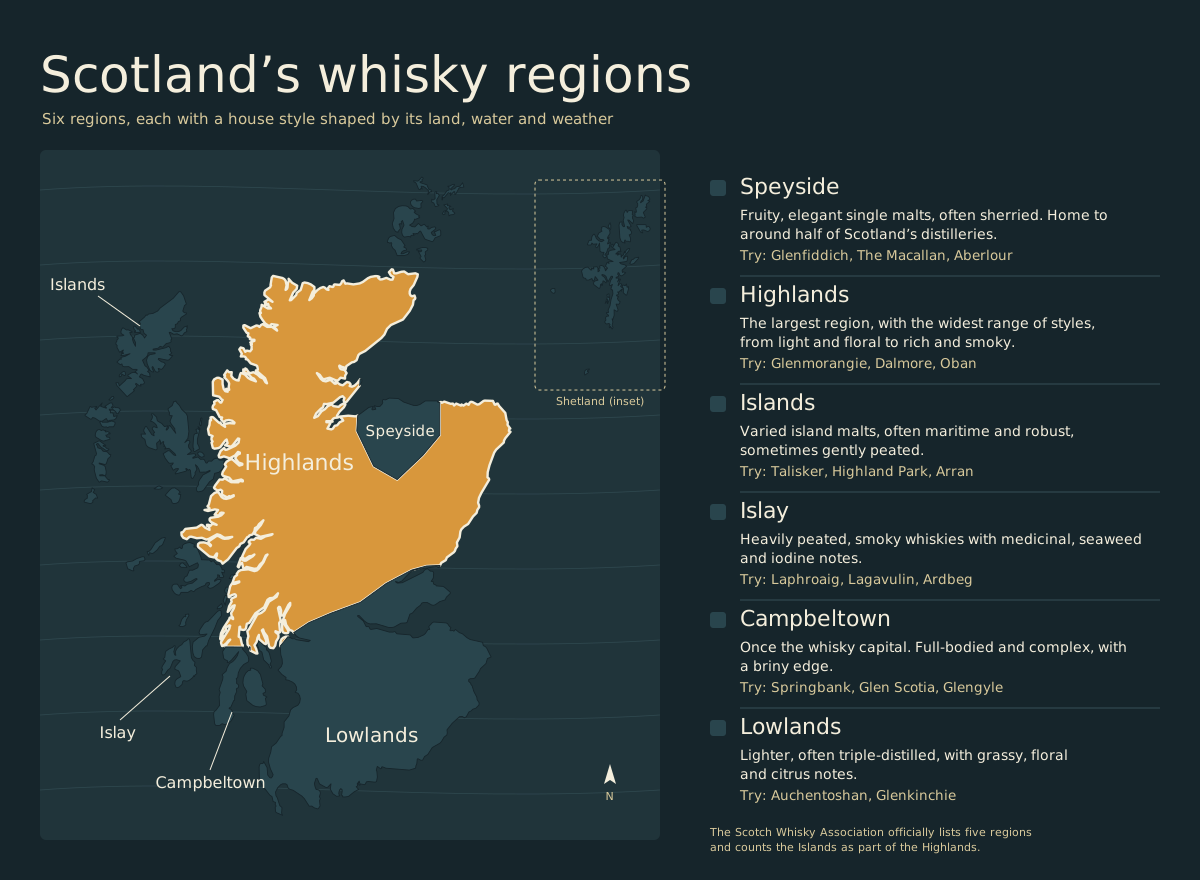
Compare pricesThe Highland region covers most of mainland Scotland north of the Highland line, from Glengoyne above Glasgow to Old Pulteney in Wick. With that much ground there is no single Highland style: Glenmorangie tends to be light and fruity, Dalmore and GlenDronach lean on sherry casks, and the coastal northern malts carry a salty edge.
Speyside sits within the Highlands geographically but is a protected region in its own right, so it has its own page. The islands count as Highland in law, but we list them separately under Islands, which is also where you will find Highland Park, on Orkney.
12 years · 43.0% ABV · 70cl
from £49.95 5 retailers
£55.90 delivered
Save up to £11.05
Compare prices
12 years · 43.0% ABV · 70cl
from £55.95 5 retailers
£60.90 delivered
Save up to £12.01
Compare prices
43.0% ABV · 70cl
from £66.95 5 retailers
£71.90 delivered
Save up to £13.05
Compare prices
10 years · 57.5% ABV · 70cl
from £94.96 5 retailers
£99.91 delivered
Save up to £82.04
Compare prices
18 years · 46.0% ABV · 70cl
from £95.00 5 retailers
£99.95 delivered
Save up to £24.95
Compare prices
18 years · 46.0% ABV · 70cl
from £123.50 5 retailers
£123.50 delivered
Save up to £8.50
Compare prices
46.0% ABV · 70cl
from £188.95 5 retailers
£188.95 delivered
Save up to £19.05
Compare prices
21 years · 46.0% ABV · 70cl
from £274.95 5 retailers
£274.95 delivered
Save up to £24.05
Compare prices
12 years · 40.0% ABV · 70cl
from £29.95 4 retailers
£35.90 delivered
Save up to £18.05
Compare prices
40.0% ABV · 70cl
from £31.95 4 retailers
£37.44 delivered
Save up to £5.05
Compare prices
46.0% ABV · 70cl
from £33.00 4 retailers
£37.95 delivered
Save up to £1.95
Compare prices
48.0% ABV · 70cl
from £34.71 4 retailers
£39.66 delivered
Save up to £23.29
Compare prices
12 years · 43.0% ABV · 70cl
from £35.00 4 retailers
£39.95 delivered
Save up to £24.00
Compare prices
12 years · 46.3% ABV · 70cl
from £35.95 4 retailers
£40.90 delivered
Save up to £9.00
Compare prices
12 years · 46.0% ABV · 70cl
from £38.50 4 retailers
£43.45 delivered
Save up to £17.50
Compare prices
12 years · 46.0% ABV · 70cl
from £40.00 4 retailers
£44.95 delivered
Save up to £4.95
Compare prices
12 years · 46.0% ABV · 70cl
from £42.00 4 retailers
£46.95 delivered
Save up to £2.95
Compare prices
50.0% ABV · 70cl
from £43.00 4 retailers
£47.95 delivered
Save up to £2.75
Compare prices
10 years · 40.0% ABV · 70cl
from £44.00 4 retailers
£48.95 delivered
Save up to £9.95
Compare prices
48.0% ABV · 70cl
from £45.75 4 retailers
£50.70 delivered
Save up to £4.20
Compare prices
12 years · 40.0% ABV · 70cl
from £47.95 4 retailers
£52.90 delivered
Save up to £5.05
Compare prices
12 years · 40.0% ABV · 70cl
from £48.25 4 retailers
£53.20 delivered
Save up to £14.75
Compare prices
43.0% ABV · 70cl
from £48.50 4 retailers
£53.45 delivered
Save up to £6.45
Compare prices
46.0% ABV · 70cl
from £48.95 4 retailers
£53.99 delivered
Save up to £3.00
Compare prices
15 years · 43.0% ABV · 70cl
from £52.95 4 retailers
£57.90 delivered
Save up to £7.00
Compare prices
50.5% ABV · 70cl
from £55.25 4 retailers
£60.20 delivered
Save up to £13.75
Compare prices
14 years · 46.0% ABV · 70cl
from £55.90 4 retailers
£60.85 delivered
Save up to £13.60
Compare prices
10 years · 46.0% ABV · 70cl
from £56.50 4 retailers
£61.45 delivered
Save up to £8.45
Compare prices
49.1% ABV · 70cl
from £56.95 4 retailers
£62.90 delivered
Save up to £18.05
Compare prices
12 years · 40.0% ABV · 70cl
from £59.00 4 retailers
£64.99 delivered
Save up to £13.00
Compare prices
15 years · 46.0% ABV · 70cl
from £59.00 4 retailers
£63.95 delivered
Save up to £15.95
Compare prices
46.0% ABV · 70cl
from £63.25 4 retailers
£68.20 delivered
Save up to £13.47
Compare prices
15 years · 43.0% ABV · 70cl
from £66.01 4 retailers
£70.96 delivered
Save up to £12.99
Compare prices
16 years · 46.0% ABV · 70cl
from £68.69 4 retailers
£73.64 delivered
Save up to £11.26
Compare prices
46.5% ABV · 70cl
from £69.95 4 retailers
£75.90 delivered
Save up to £7.05
Compare prices
12 years · 46.0% ABV · 70cl
from £70.50 4 retailers
£75.45 delivered
Save up to £4.50
Compare prices
8 years · 60.3% ABV · 70cl
from £70.95 4 retailers
£75.90 delivered
Save up to £9.05
Compare prices
46.0% ABV · 70cl
from £72.00 4 retailers
£76.99 delivered
Save up to £2.95
Compare prices
15 years · 46.0% ABV · 70cl
from £73.50 4 retailers
£78.45 delivered
Save up to £7.50
Compare prices
15 years · 46.0% ABV · 70cl
from £79.25 4 retailers
£84.20 delivered
Save up to £8.75
Compare prices
18 years · 46.3% ABV · 70cl
from £79.95 4 retailers
£84.90 delivered
Save up to £9.05
Compare prices
46.2% ABV · 70cl
from £93.95 4 retailers
£98.90 delivered
Save up to £1.05
Compare prices
46.3% ABV · 70cl
from £95.50 4 retailers
£100.00 delivered
Save up to £4.50
Compare prices
18 years · 46.0% ABV · 70cl
from £98.95 4 retailers
£103.90 delivered
Save up to £6.00
Compare prices
15 years · 40.0% ABV · 70cl
from £99.95 4 retailers
£105.90 delivered
Save up to £12.05
Compare prices
44.0% ABV · 70cl
from £99.95 4 retailers
£104.00 delivered
Save up to £6.20
Compare prices
17 years · 42.0% ABV · 70cl
from £156.44 4 retailers
£156.44 delivered
Save up to £13.56
Compare prices
18 years · 46.0% ABV · 70cl
from £179.95 4 retailers
£179.95 delivered
Save up to £17.05
Compare pricesLearn more about Highland on Whiskipedia